 VIPSolutions
Give step-by-step solution with explanation and final answer:[cai nk ii: 58 ZT : CE oe i sis i: i 35: i i 1! isi 5835 B23 jié i aed iat = i i: E52 Bes 11 i g28 iis i igs HH if HEH ie i er i i ss 23 i i} is iii f i HH Fe i Ht 1 [iH] HS i EE) i —
Question:
Give step-by-step solution with explanation and final answer: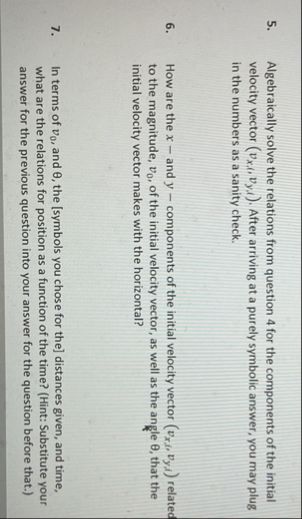 [cai
nk
ii: 58 ZT :
CE oe i
sis i: i
35: i i
1! isi 5835
B23 jié i
aed iat =
i i: E52
Bes 11 i
g28 iis i
igs HH if
HEH ie i
er i
i ss 23
i i} is
iii f i
HH Fe i
Ht 1
[iH] HS i
EE) i
—
This is AI generated Response.
Asked by: Om
Created at: 2026-02-02 05:19:39
Asked by: Om
Created at: 2026-02-02 05:19:39
Final Answer:
Rendered
Raw Text
Did you like this answer?
Let's answer **questions 5, 6, and 7** step by step:
---
## 5. Algebraically solve the relations for the components of the initial velocity vector (**v₀ₓ**, **v₀ᵧ**).
**Given:**
From standard projectile motion, the position as a function of time is:
- \( x(t) = v_{x} t \)
- \( y(t) = v_{y} t - \frac{1}{2} g t^2 \)
Suppose you are given the horizontal distance \( d \) and vertical distance \( h \) that the projectile travels in time \( t \).
### **Step 1: Express \( v_{x} \) and \( v_{y} \) in terms of \( d, h, t, g \):**
\[
x(t) = v_{x} t \implies v_{x} = \frac{d}{t}
\]
\[
y(t) = v_{y} t - \frac{1}{2} g t^2 \implies v_{y} = \frac{h + \frac{1}{2} g t^2}{t}
\]
---
## 6. x- and y-components of the initial velocity in terms of magnitude and angle
Let the initial velocity magnitude be \( v_ \) and the angle with the horizontal be \( \theta \):
\[
v_{x} = v_ \cos\theta
\]
\[
v_{y} = v_ \sin\theta
\]
---
## 7. Position as a function of time
Substitute the expressions from above into the position equations:
\[
x(t) = v_{x} t = \left(\frac{d}{t}\right)t = d
\]
\[
y(t) = v_{y} t - \frac{1}{2} g t^2 = \left(\frac{h + \frac{1}{2} g t^2}{t}\right)t - \frac{1}{2} g t^2 = h + \frac{1}{2} g t^2 - \frac{1}{2} g t^2 = h
\]
This confirms the initial values at \( t \).
If you want the general expressions for any time \( t \), use:
\[
x(t) = v_{x} t = \frac{d}{t_f} t
\]
\[
y(t) = v_{y} t - \frac{1}{2} g t^2 = \frac{h + \frac{1}{2} g t_f^2}{t_f} t - \frac{1}{2} g t^2
\]
Where \( t_f \) is the total flight time.
---
### **Summary Table**
| Step | Expression |
|------|------------|
| 5 | \( v_{x} = \frac{d}{t} \), \( v_{y} = \frac{h + \frac{1}{2} g t^2}{t} \) |
| 6 | \( v_{x} = v_ \cos\theta \), \( v_{y} = v_ \sin\theta \) |
| 7 | \( x(t) = \frac{d}{t_f} t \), \( y(t) = \frac{h + \frac{1}{2} g t_f^2}{t_f} t - \frac{1}{2} g t^2 \) |
---
Let me know if you need numbers plugged in or further explanation!
📢 Instructions:
- Ask anything relatd to above question only.
- For new Question goto :