 VIPSolutions
Give step-by-step solution with explanation and final answer:Consider two points A and B separated by a distance of 0.15 m in an electric field with a magnitude 0£72,000% , as illustrated in the diagram. Note which point is “downstream” and which is “upstream”. J E=72000 & — PET J (a) Whatis the electric potential (voltage) difference from A to B, AVyg = Vg — Va? (b) Whatis the change in electric potential energy if a charge of +5.0 uC is moved from A to B? (c) Whatis the change in electric potential energy if a charge of 5.0 uC is moved from A to B?
Question:
Give step-by-step solution with explanation and final answer: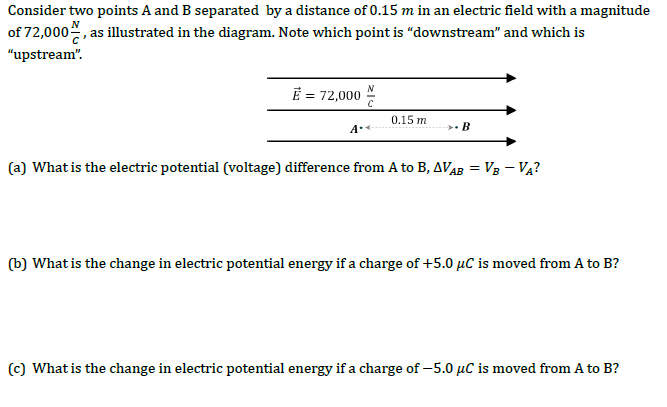 Consider two points A and B separated by a distance of 0.15 m in an electric field with a magnitude
0£72,000% , as illustrated in the diagram. Note which point is “downstream” and which is
“upstream”.
J
E=72000 &
—
PET
J
(a) Whatis the electric potential (voltage) difference from A to B, AVyg = Vg — Va?
(b) Whatis the change in electric potential energy if a charge of +5.0 uC is moved from A to B?
(c) Whatis the change in electric potential energy if a charge of 5.0 uC is moved from A to B?
This is AI generated Response.
Asked by: Om
Created at: 2026-02-02 04:52:39
Asked by: Om
Created at: 2026-02-02 04:52:39
Final Answer:
Rendered
Raw Text
Did you like this answer?
Let's solve each part step by step:
---
## (a) Electric Potential Difference (\(\Delta V_{AB}\))
**Formula:**
The electric potential difference between two points in a uniform electric field \(\vec{E}\) separated by a distance \(d\) is:
\[
\Delta V = V_B - V_A = -E \cdot d
\]
where \(d\) is the distance from A to B, and the negative sign indicates that potential decreases in the direction of the electric field.
**Given:**
- \(E = 72,000 \ \text{N/C}\)
- \(d = .15 \ \text{m}\)
- The field points from A to B (A is "upstream," B is "downstream").
**Calculation:**
\[
\Delta V_{AB} = V_B - V_A = -E \cdot d
\]
\[
\Delta V_{AB} = - (72,000 \ \text{N/C}) \times (.15 \ \text{m})
\]
\[
\Delta V_{AB} = - 10,800 \ \text{V}
\]
**Final Answer (a):**
\[
\boxed{\Delta V_{AB} = V_B - V_A = -10,800 \ \text{V}}
\]
---
## (b) Change in Electric Potential Energy for \(+5.\,\mu\text{C}\) Charge
**Formula:**
\[
\Delta U = q \Delta V
\]
**Given:**
- \(q = +5.\,\mu\text{C} = 5. \times 10^{-6}\,\text{C}\)
- \(\Delta V_{AB} = -10,800\,\text{V}\)
**Calculation:**
\[
\Delta U = (5. \times 10^{-6}\,\text{C}) \times (-10,800\,\text{V})
\]
\[
\Delta U = -.054\,\text{J}
\]
**Final Answer (b):**
\[
\boxed{\Delta U = -.054\,\text{J}}
\]
---
## (c) Change in Electric Potential Energy for \(-5.\,\mu\text{C}\) Charge
**Given:**
- \(q = -5.\,\mu\text{C} = -5. \times 10^{-6}\,\text{C}\)
- \(\Delta V_{AB} = -10,800\,\text{V}\)
**Calculation:**
\[
\Delta U = (-5. \times 10^{-6}\,\text{C}) \times (-10,800\,\text{V})
\]
\[
\Delta U = +.054\,\text{J}
\]
**Final Answer (c):**
\[
\boxed{\Delta U = +.054\,\text{J}}
\]
---
### **Summary Table**
| Subpart | Calculation | Final Answer |
|---------|-------------|--------------|
| (a) | \(\Delta V_{AB} = -E \cdot d\) | \(\boxed{-10,800 \ \text{V}}\) |
| (b) | \(\Delta U = q \Delta V\) | \(\boxed{-.054 \ \text{J}}\) |
| (c) | \(\Delta U = q \Delta V\) | \(\boxed{+.054 \ \text{J}}\) |
---
**Note:**
- "Upstream" is point A (higher potential), "downstream" is point B (lower potential) because electric potential decreases in the direction of the electric field.
📢 Instructions:
- Ask anything relatd to above question only.
- For new Question goto :