 VIPSolutions
Give step-by-step solution with explanation and final answer: {give me the answer without using bullet-points}Reaction: A— B (first order) Rate law: —rp = k;Ca, k=0.8 min! Fresh feed: e Caro = 4 kmol/m® e Flow rate Fr= 0.5 m*/min Recycle ratio: R= Fr -15 Fr Reactor volume: V =1.5 m*® Assume. steady state and perfect mixing. Tasks: 4. Determine reactor inlet concentration 2. Write CSTR design equation 3. Find exit concentration Cp 4. Overall conversion 5. Effect if recycle ratio doubles
Question:
Give step-by-step solution with explanation and final answer:
{give me the answer without using bullet-points}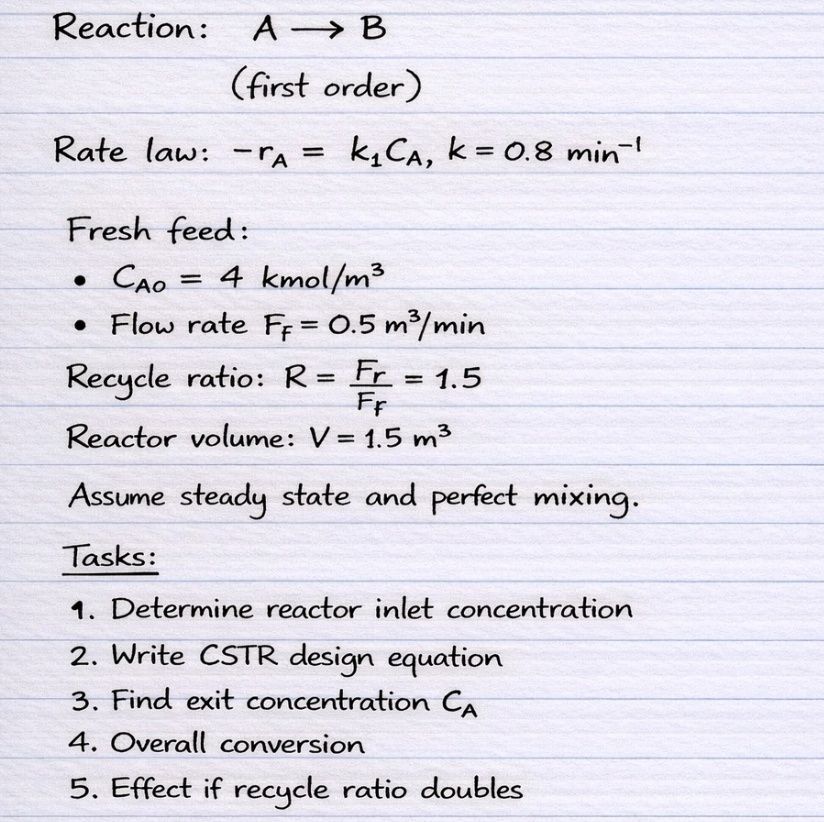 Reaction: A— B
(first order)
Rate law: —rp = k;Ca, k=0.8 min!
Fresh feed:
e Caro = 4 kmol/m®
e Flow rate Fr= 0.5 m*/min
Recycle ratio: R= Fr -15
Fr
Reactor volume: V =1.5 m*®
Assume. steady state and perfect mixing.
Tasks:
4. Determine reactor inlet concentration
2. Write CSTR design equation
3. Find exit concentration Cp
4. Overall conversion
5. Effect if recycle ratio doubles
This is AI generated Response.
Asked by: Francis
Created at: 2026-01-31 08:43:25
Asked by: Francis
Created at: 2026-01-31 08:43:25
Final Answer:
Rendered
Raw Text
Did you like this answer?
Let's work through the problem step by step:
### 1. Determine Reactor Inlet Concentration
Let \( C_{A} \) be the concentration in the fresh feed, \( C_{AR} \) be the concentration at the reactor inlet, and \( C_A \) be the reactor exit concentration.
Recycle ratio \( R = \frac{F_R}{F_F} = 1.5 \).
Total flow to reactor: \( F = F_F + F_R = F_F(1 + R) = .5 \times (1 + 1.5) = 1.25 \) m³/min.
The inlet concentration to the reactor is:
\[
C_{AR} = \frac{F_F C_{A} + F_R C_A}{F}
\]
\[
C_{AR} = \frac{.5 \times 4 + (.5 \times 1.5) \times C_A}{1.25}
\]
\[
C_{AR} = \frac{2 + .75 C_A}{1.25}
\]
### 2. Write CSTR Design Equation
At steady state for a first-order reaction:
\[
V = \frac{F(C_{AR} - C_A)}{k C_A}
\]
Given \( k = .8 \) min\(^{-1} \), \( V = 1.5 \) m³, and \( F = 1.25 \) m³/min.
So,
\[
1.5 = \frac{1.25 (C_{AR} - C_A)}{.8 C_A}
\]
\[
1.5 \times .8 C_A = 1.25 C_{AR} - 1.25 C_A
\]
\[
1.2 C_A + 1.25 C_A = 1.25 C_{AR}
\]
\[
2.45 C_A = 1.25 C_{AR}
\]
\[
C_A = \frac{1.25}{2.45} C_{AR}
\]
\[
C_A = .5102 C_{AR}
\]
### 3. Find Exit Concentration \( C_A \)
Recall from earlier: \( C_{AR} = \frac{2 + .75 C_A}{1.25} \).
Now substitute the expression for \( C_A \) in terms of \( C_{AR} \):
Let \( C_A = .5102 C_{AR} \):
\[
C_{AR} = \frac{2 + .75 \times .5102 C_{AR}}{1.25}
\]
\[
C_{AR} = \frac{2 + .38265 C_{AR}}{1.25}
\]
\[
1.25 C_{AR} = 2 + .38265 C_{AR}
\]
\[
1.25 C_{AR} - .38265 C_{AR} = 2
\]
\[
.86735 C_{AR} = 2
\]
\[
C_{AR} = \frac{2}{.86735} = 2.305 \text{ kmol/m}^3
\]
Now, \( C_A = .5102 \times 2.305 = 1.177 \text{ kmol/m}^3 \)
### 4. Overall Conversion
Overall conversion:
\[
X = \frac{C_{A} - C_A}{C_{A}}
\]
\[
X = \frac{4 - 1.177}{4} = \frac{2.823}{4} = .7058
\]
So, overall conversion is **70.6%**.
### 5. Effect if Recycle Ratio Doubles
If \( R \) doubles, \( R = 3. \):
New total flow: \( F = .5 \times (1 + 3) = 2. \) m³/min.
New expressions:
\[
C_{AR} = \frac{.5 \times 4 + .5 \times 3 \times C_A}{2.} = \frac{2 + 1.5 C_A}{2.}
\]
CSTR design equation:
\[
1.5 = \frac{2. (C_{AR} - C_A)}{.8 C_A}
\]
\[
1.5 \times .8 C_A = 2. C_{AR} - 2. C_A
\]
\[
1.2 C_A + 2. C_A = 2. C_{AR}
\]
\[
3.2 C_A = 2. C_{AR}
\]
\[
C_A = \frac{2.}{3.2} C_{AR} = .625 C_{AR}
\]
Now substitute:
\[
C_{AR} = \frac{2 + 1.5 \times .625 C_{AR}}{2.}
\]
\[
C_{AR} = \frac{2 + .9375 C_{AR}}{2.}
\]
\[
2 C_{AR} = 2 + .9375 C_{AR}
\]
\[
2 C_{AR} - .9375 C_{AR} = 2
\]
\[
1.0625 C_{AR} = 2
\]
\[
C_{AR} = \frac{2}{1.0625} = 1.882 \text{ kmol/m}^3
\]
\[
C_A = .625 \times 1.882 = 1.176 \text{ kmol/m}^3
\]
Overall conversion:
\[
X = \frac{4 - 1.176}{4} = .706
\]
Thus, doubling the recycle ratio barely changes the exit concentration or conversion (from about 70.6% to 70.6%), indicating diminishing returns for increasing recycle at these conditions.
---
**Summary of answers:**
1. Reactor inlet concentration \( C_{AR} = 2.305 \) kmol/m³.
2. CSTR design equation: \( V = \frac{F(C_{AR} - C_A)}{k C_A} \).
3. Exit concentration \( C_A = 1.177 \) kmol/m³.
4. Overall conversion \( X = 70.6\% \).
5. If recycle ratio doubles: \( C_A = 1.176 \) kmol/m³, \( X = 70.6\% \) (almost unchanged).
📢 Instructions:
- Ask anything relatd to above question only.
- For new Question goto :