 VIPSolutions
Give step-by-step solution with explanation and final answer:Q2 Find v(t) for t >On the following circuit a0 sa Veutd + Veh § WER oc) Jo
Question:
Give step-by-step solution with explanation and final answer: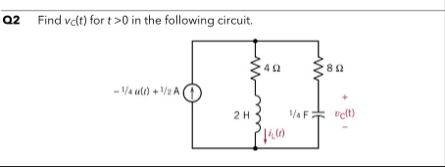 Q2 Find v(t) for t >On the following circuit
a0 sa
Veutd + Veh §
WER oc)
Jo
This is AI generated Response.
Asked by: Alok Kumar
Created at: 2026-01-31 03:43:10
Asked by: Alok Kumar
Created at: 2026-01-31 03:43:10
Final Answer:
Rendered
Raw Text
Did you like this answer?
Let's solve for \( v_C(t) \) for \( t > \) **step by step**:
---
## **Step 1: Write the given circuit details**
- **Current source:** \( i_s(t) = -\frac{1}{4}u(t) + \frac{1}{2} \) A
- **Inductor:** \( L = 2 \) H
- **Capacitor:** \( C = \frac{1}{4} \) F
- **Resistors:** \( R_1 = 4\,\Omega \), \( R_2 = 8\,\Omega \)
- **Unknown:** \( v_C(t) \) across the capacitor
---
## **Step 2: Write the node equation at the top node**
Let \( v_C(t) \) be the voltage across the capacitor.
### **Current through each element:**
- **Inductor:** \( i_L = \frac{1}{L} \int (v_C(t) - ) dt \)
- **4Ω resistor:** \( i_{R_1} = \frac{v_C(t)}{4} \)
- **8Ω resistor:** \( i_{R_2} = \frac{v_C(t)}{8} \)
- **Capacitor:** \( i_C = C \frac{dv_C}{dt} \)
But, since the inductor and the two resistors are in parallel with the capacitor, we need a systematic equation.
---
## **Step 3: Laplace Transform the circuit**
Let \( V_C(s) \) be the Laplace transform of \( v_C(t) \).
- **Inductor impedance:** \( 2s \)
- **Capacitor impedance:** \( \frac{1}{sC} = \frac{1}{s \cdot \frac{1}{4}} = \frac{4}{s} \)
- **Resistors:** \( 4\,\Omega,\,8\,\Omega \)
- **Current source:** \( I_s(s) = \mathcal{L}\left\{-\frac{1}{4}u(t) + \frac{1}{2}\right\} = -\frac{1}{4}\cdot \frac{1}{s} + \frac{1}{2}\cdot \frac{1}{s} = \frac{1}{4s} \)
All four elements are in parallel, so the total **admittance** is:
\[
Y_{total}(s) = \frac{1}{4} + \frac{1}{8} + \frac{1}{2s} + \frac{s}{4}
\]
---
## **Step 4: Write KCL in Laplace domain**
Sum of currents leaving the top node = current source:
\[
\frac{V_C(s)}{4} + \frac{V_C(s)}{8} + \frac{V_C(s)}{2s} + s \cdot \frac{V_C(s)}{4} = I_s(s)
\]
\[
V_C(s) \left[ \frac{1}{4} + \frac{1}{8} + \frac{1}{2s} + \frac{s}{4} \right] = \frac{1}{4s}
\]
\[
V_C(s) \left( \frac{1}{4} + \frac{1}{8} + \frac{1}{2s} + \frac{s}{4} \right) = \frac{1}{4s}
\]
Combine terms:
\[
\frac{1}{4} + \frac{1}{8} = \frac{3}{8}
\]
So:
\[
V_C(s) \left( \frac{3}{8} + \frac{1}{2s} + \frac{s}{4} \right) = \frac{1}{4s}
\]
Multiply both sides by 8 to clear denominators:
\[
V_C(s) \left( 3 + \frac{4}{s} + 2s \right) = \frac{2}{s}
\]
\[
V_C(s) (2s + 3 + \frac{4}{s}) = \frac{2}{s}
\]
\[
V_C(s) \left( \frac{2s^2 + 3s + 4}{s} \right) = \frac{2}{s}
\]
\[
V_C(s) (2s^2 + 3s + 4) = 2
\]
\[
V_C(s) = \frac{2}{2s^2 + 3s + 4}
\]
---
## **Step 5: Inverse Laplace Transform**
Let’s write the denominator in standard quadratic form to find the time-domain solution.
\[
2s^2 + 3s + 4
\]
Complete the square:
\[
2(s^2 + \frac{3}{2}s + 2)
\]
\[
= 2\left[ (s + \frac{3}{4})^2 + 2 - (\frac{9}{16}) \right]
\]
\[
= 2\left[ (s + \frac{3}{4})^2 + \frac{23}{16} \right]
\]
So,
\[
V_C(s) = \frac{2}{2 \left( (s + \frac{3}{4})^2 + \frac{23}{16} \right) }
= \frac{1}{ (s + \frac{3}{4})^2 + \frac{23}{16} }
\]
Let \( \alpha = \frac{3}{4} \), \( \omega^2 = \frac{23}{16} \), \( \omega = \sqrt{\frac{23}{16}} \).
The Laplace pair is:
\[
\mathcal{L}^{-1}\left\{ \frac{1}{(s + a)^2 + b^2} \right\} = \frac{1}{b} e^{-a t} \sin(bt)
\]
Therefore:
\[
v_C(t) = \frac{1}{\sqrt{23/16}} e^{-3t/4} \sin \left( \sqrt{\frac{23}{16}} t \right) \cdot u(t)
\]
\[
\sqrt{\frac{23}{16}} = \frac{\sqrt{23}}{4}
\]
So,
\[
v_C(t) = \frac{4}{\sqrt{23}} e^{-3t/4} \sin \left( \frac{\sqrt{23}}{4} t \right) u(t)
\]
---
## **Final Answer**
\[
\boxed{
v_C(t) = \frac{4}{\sqrt{23}}\, e^{-3t/4}\, \sin\left( \frac{\sqrt{23}}{4}\, t \right)\, u(t)
}
\]
- Where \( u(t) \) is the unit step function.
- This is the voltage across the capacitor for \( t > \).
📢 Instructions:
- Ask anything relatd to above question only.
- For new Question goto :