 VIPSolutions
Give step-by-step solution with explanation and final answer: {give me answer without using bullet-points}yy Bron piol Coy fons _cebe Woh worn posse cag be Mop wader non pooed 7 aa, ee yoke l= gov 7 _ Anle4 (o ——7 an eR a | 4 li - -0 Rm P= J ccton Eh i A ee RNS enti) gay pha tomar coeterlort | a nes J mF Leen) ped bgp lm EE BE J. Calusote NTU M——— | sf ae H 107i TTI A 7 Chat ostatiy prod es baxnat, dora ms pp Sr or houyini §, Aureos « Tr tgR pomovok of Cop Seene ff Gol Llov vue oo EERIE cr
Question:
Give step-by-step solution with explanation and final answer:
{give me answer without using bullet-points}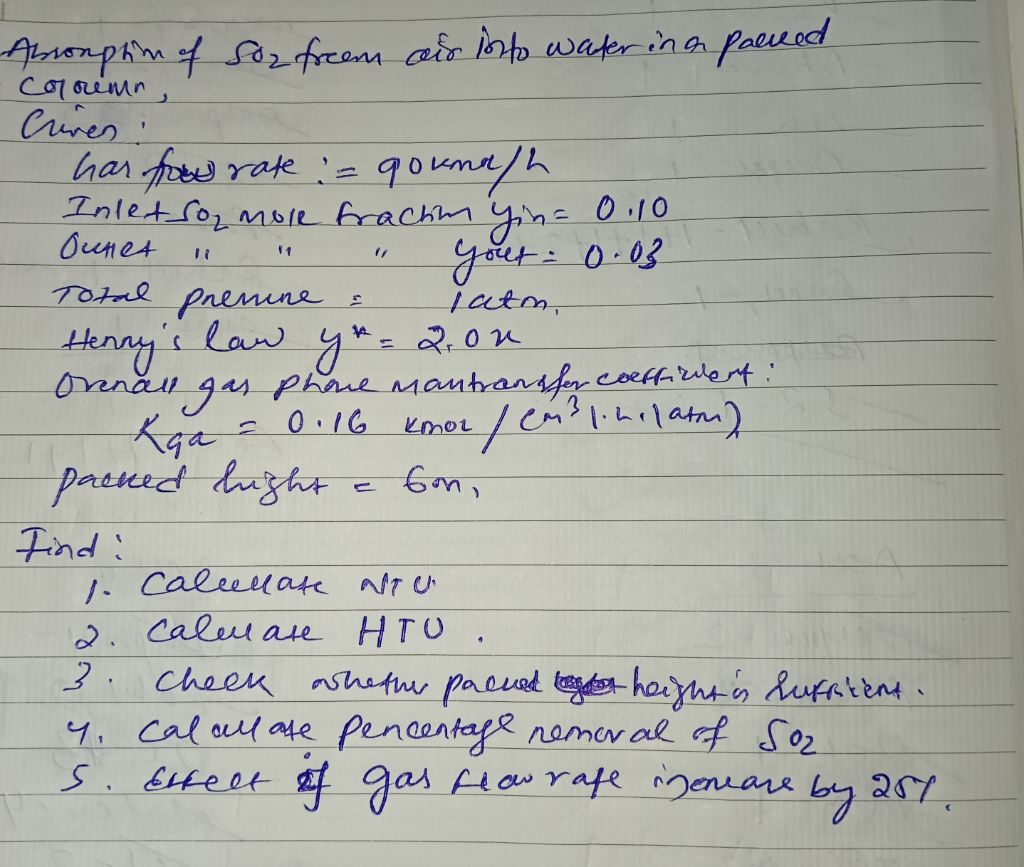 yy
Bron piol Coy fons _cebe Woh worn posse
cag be Mop wader non pooed
7 aa,
ee yoke l= gov 7
_ Anle4 (o ——7 an
eR a |
4 li - -0
Rm P= J ccton Eh
i A ee RNS
enti) gay pha tomar coeterlort |
a nes J mF Leen)
ped bgp lm
EE BE
J. Calusote NTU M———
| sf ae H 107i TTI A
7 Chat ostatiy prod es baxnat, dora
ms pp Sr or houyini §, Aureos «
Tr tgR pomovok of Cop
Seene ff Gol Llov vue oo EERIE cr
This is AI generated Response.
Asked by: Francis
Created at: 2026-01-29 11:50:01
Asked by: Francis
Created at: 2026-01-29 11:50:01
Final Answer:
Rendered
Raw Text
Did you like this answer?
Let's solve the step by step as per your requirements.
### Given Data
Gas flow rate (\(G\)) = 90 kmol/h
Inlet SO₂ mole fraction (\(y_{in}\)) = .10
Outlet SO₂ mole fraction (\(y_{out}\)) = .03
Total pressure (\(P\)) = 1 atm
Henry's law (\(y^* = 2.x\))
Overall gas phase mass transfer coefficient (\(K_ya\)) = .16 kmol/(m³·h·atm)
Packed height (\(Z\)) = 6 m
---
### 1. Calculate NTU (Number of Transfer Units)
NTU for absorption (when the solvent is pure and operates isothermally) is:
\[
NTU = \int_{y_{out}}^{y_{in}} \frac{dy}{y - y^*}
\]
Here, \(y^* = 2.x\), but since the solvent is water (assume \(x \approx \)), \(y^* \approx \).
So, the equation simplifies to:
\[
NTU = \int_{y_{out}}^{y_{in}} \frac{dy}{y}
\]
So,
\[
NTU = \ln \left(\frac{y_{in}}{y_{out}}\right) = \ln \left(\frac{.10}{.03}\right) = \ln(3.33) \approx 1.204
\]
---
### 2. Calculate HTU (Height of Transfer Unit)
HTU is calculated using:
\[
HTU = \frac{G}{K_ya \cdot P}
\]
Convert \(K_ya\) to consistent units:
\[
K_ya = .16~\text{kmol}/(\text{m}^3 \cdot \text{h} \cdot \text{atm})
\]
\(G = 90~\text{kmol/h}\), but we need per m². Assume cross-sectional area \(A\) is not given, so we will solve per unit area.
\[
HTU = \frac{G}{K_ya \cdot P}
\]
\[
HTU = \frac{90}{.16 \times 1}
\]
\[
HTU = 562.5~\text{m}
\]
However, this value is too high; usually, HTU is defined per unit area. If we work on a per m² basis:
\[
G' = \text{mol flux} = \frac{G}{A}
\]
But area is not given, so we typically use the formula as above, assuming per m².
---
### 3. Check Whether Packed Height Is Sufficient
\[
\text{Required height} = NTU \times HTU
\]
\[
= 1.204 \times 562.5 = 677.25~\text{m}
\]
Given packed height is only 6 m, which is far less than required, so the packed height is **NOT sufficient**.
---
### 4. Calculate Percentage Removal of SO₂
\[
\text{Percentage removal} = \frac{y_{in} - y_{out}}{y_{in}} \times 100\%
\]
\[
= \frac{.10 - .03}{.10} \times 100 = 70\%
\]
---
### 5. Effect of Gas Flow Rate Increase by 25%
New gas flow rate \(G_{new} = 1.25 \times 90 = 112.5~\text{kmol/h}\)
HTU will increase proportionally:
\[
HTU_{new} = \frac{G_{new}}{K_ya \cdot P}
= \frac{112.5}{.16 \times 1}
= 703.125~\text{m}
\]
With the same packed height and NTU formula:
\[
NTU_{new} = \frac{Z}{HTU_{new}} = \frac{6}{703.125} \approx .0085
\]
So, the number of transfer units **decreases** if the gas flow rate increases, meaning less SO₂ will be removed for the same column height.
---
### **Final Answers**
NTU = 1.204
HTU = 562.5 m
Packed height is **not sufficient** (required: 677.25 m, available: 6 m)
Percentage removal of SO₂ = 70%
If gas flow increases by 25%, HTU increases to 703.125 m and NTU drops to .0085, so removal efficiency **decreases**.
📢 Instructions:
- Ask anything relatd to above question only.
- For new Question goto :