Give step-by-step solution with explanation and final answer:
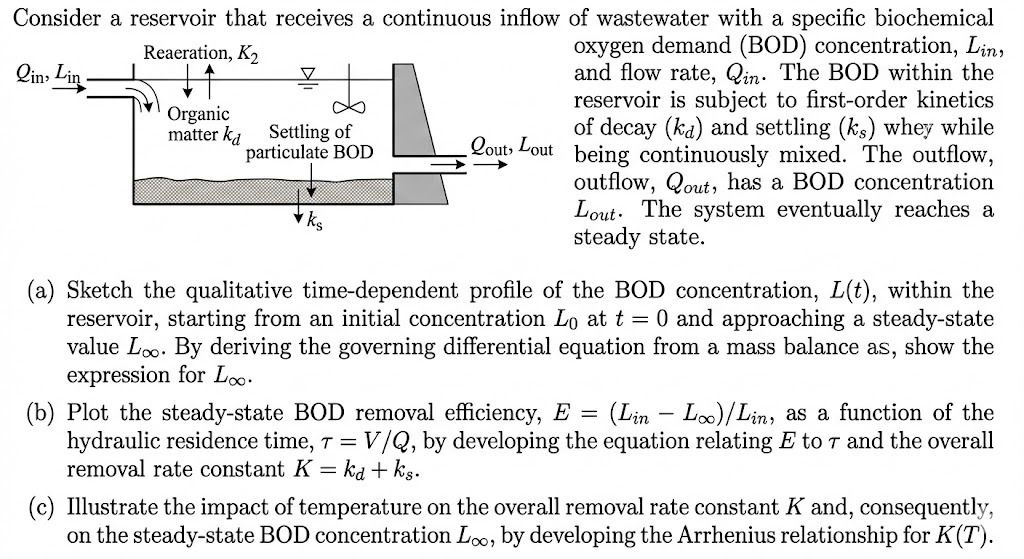
{give me the answer without using bulling-points}Consider a reservoir that receives a continuous inflow of wastewater with a specific biochemical
Reacration, K, oxygen demand (BOD) concentration, Li,
Ons Lig vl and flow rate, Q;,. The BOD within the
TR o B reservoir is subject to first-order kinetics
rganic 8 g
matter k; Settling of of decay (kg) and settling (ks) whey while
particulate BOD Lows Lout being continuously mixed. The outflow,
Ga I) outflow, Qout, has a BOD concentration
E— - 7 Loy. The system eventually reaches a
steady state.
(a) Sketch the qualitative time-dependent profile of the BOD concentration, L(t), within the
reservoir, starting from an initial concentration Ly at t = 0 and approaching a steady-state
value Ly. By deriving the governing differential equation from a mass balance as, show the
expression for Lo.
(b) Plot the steady-state BOD removal efficiency, £ = (Lin — Loo)/Lin, as a function of the
hydraulic residence time, 7 = V/Q, by developing the equation relating E to 7 and the overall
removal rate constant K = kq + ks.
(c) Illustrate the impact of temperature on the overall removal rate constant K and, consequently,
on the steady-state BOD concentration Loo, by developing the Arrhenius relationship for K(T').
Question:
Give step-by-step solution with explanation and final answer:
{give me the answer without using bulling-points}Consider a reservoir that receives a continuous inflow of wastewater with a specific biochemical
Reacration, K, oxygen demand (BOD) concentration, Li,
Ons Lig vl and flow rate, Q;,. The BOD within the
TR o B reservoir is subject to first-order kinetics
rganic 8 g
matter k; Settling of of decay (kg) and settling (ks) whey while
particulate BOD Lows Lout being continuously mixed. The outflow,
Ga I) outflow, Qout, has a BOD concentration
E— - 7 Loy. The system eventually reaches a
steady state.
(a) Sketch the qualitative time-dependent profile of the BOD concentration, L(t), within the
reservoir, starting from an initial concentration Ly at t = 0 and approaching a steady-state
value Ly. By deriving the governing differential equation from a mass balance as, show the
expression for Lo.
(b) Plot the steady-state BOD removal efficiency, £ = (Lin — Loo)/Lin, as a function of the
hydraulic residence time, 7 = V/Q, by developing the equation relating E to 7 and the overall
removal rate constant K = kq + ks.
(c) Illustrate the impact of temperature on the overall removal rate constant K and, consequently,
on the steady-state BOD concentration Loo, by developing the Arrhenius relationship for K(T').
This is AI generated Response.
Asked by: Francis
Created at: 2026-01-29 10:09:58
Final Answer:
RenderedRaw Text
Did you like this answer?
### (a) Time-dependent BOD Profile and Steady-State Expression
Let \( L(t) \) be the BOD concentration in the reservoir at time \( t \).
Initial concentration: \( L() = L_ \).
At steady state (as \( t \to \infty \)): \( L(t) \to L_\infty \).
**Mass balance on the reservoir:**
\[
\text{Accumulation} = \text{In} - \text{Out} - \text{Decay} - \text{Settling}
\]
\[
V \frac{dL}{dt} = Q_{in}L_{in} - Q_{out}L - V k_d L - V k_s L
\]
Assume \( Q_{in} = Q_{out} = Q \):
\[
V \frac{dL}{dt} = Q L_{in} - Q L - V (k_d + k_s)L
\]
\[
\frac{dL}{dt} = \frac{Q}{V}(L_{in} - L) - (k_d + k_s)L
\]
\[
\frac{dL}{dt} = \frac{Q}{V}L_{in} - \left(\frac{Q}{V} + k_d + k_s\right)L
\]
Define the hydraulic residence time \( \tau = \frac{V}{Q} \), and \( K = k_d + k_s \):
\[
\frac{dL}{dt} = \frac{1}{\tau}L_{in} - \left(\frac{1}{\tau} + K\right)L
\]
At steady state (\( \frac{dL}{dt} = \)):
\[
= \frac{1}{\tau}L_{in} - \left(\frac{1}{\tau} + K\right)L_\infty
\]
\[
\left(\frac{1}{\tau} + K\right)L_\infty = \frac{1}{\tau}L_{in}
\]
\[
L_\infty = \frac{L_{in}}{1 + K\tau}
\]
So, the BOD concentration \( L(t) \) will exponentially decay from \( L_ \) to \( L_\infty \).
---
### (b) Steady-State BOD Removal Efficiency
Removal efficiency is:
\[
E = \frac{L_{in} - L_\infty}{L_{in}}
\]
Substitute \( L_\infty \):
\[
E = 1 - \frac{L_\infty}{L_{in}} = 1 - \frac{1}{1 + K\tau}
\]
\[
E = \frac{K\tau}{1 + K\tau}
\]
This shows that removal efficiency increases with higher \( K \) (removal rate) and higher \( \tau \) (residence time).
---
### (c) Impact of Temperature on \( K \) and \( L_\infty \)
The removal rate constant \( K \) is temperature dependent. The Arrhenius equation for \( K \) is:
\[
K(T) = K_{20} \theta^{(T-20)}
\]
where \( K_{20} \) is the rate constant at \( 20^\circ\text{C} \), \( \theta \) is typically 1.03–1.07, and \( T \) is temperature in °C.
As \( T \) increases, \( K(T) \) increases, which leads to a lower steady-state BOD \( L_\infty \):
\[
L_\infty = \frac{L_{in}}{1 + K(T)\tau}
\]
Higher temperature → higher \( K \) → lower \( L_\infty \), meaning better BOD removal at higher temperatures.
---
**Summary of Answers:**
(a) The BOD concentration \( L(t) \) decays exponentially from \( L_ \) to \( L_\infty = \frac{L_{in}}{1 + K\tau} \).
(b) The steady-state BOD removal efficiency is \( E = \frac{K\tau}{1 + K\tau} \).
(c) As temperature increases, the removal rate constant \( K \) increases according to \( K(T) = K_{20}\theta^{(T-20)} \), thereby decreasing \( L_\infty \) and improving removal efficiency.
VIPSolutions focuses on clear, step‑by‑step explanations so you can learn quickly. Whether you need an AI‑generated walkthrough or a short hint to get unstuck, each solution is organized for fast reading and easy review later.
Search similar questions, compare approaches, and bookmark the best answers for revision. Our goal is simple: quick, reliable study help that feels natural—not noisy.
 VIPSolutions
 Consider a reservoir that receives a continuous inflow of wastewater with a specific biochemical
Reacration, K, oxygen demand (BOD) concentration, Li,
Ons Lig vl and flow rate, Q;,. The BOD within the
TR o B reservoir is subject to first-order kinetics
rganic 8 g
matter k; Settling of of decay (kg) and settling (ks) whey while
particulate BOD Lows Lout being continuously mixed. The outflow,
Ga I) outflow, Qout, has a BOD concentration
E— - 7 Loy. The system eventually reaches a
steady state.
(a) Sketch the qualitative time-dependent profile of the BOD concentration, L(t), within the
reservoir, starting from an initial concentration Ly at t = 0 and approaching a steady-state
value Ly. By deriving the governing differential equation from a mass balance as, show the
expression for Lo.
(b) Plot the steady-state BOD removal efficiency, £ = (Lin — Loo)/Lin, as a function of the
hydraulic residence time, 7 = V/Q, by developing the equation relating E to 7 and the overall
removal rate constant K = kq + ks.
(c) Illustrate the impact of temperature on the overall removal rate constant K and, consequently,
on the steady-state BOD concentration Loo, by developing the Arrhenius relationship for K(T').