Give step-by-step solution with explanation and final answer:F; en
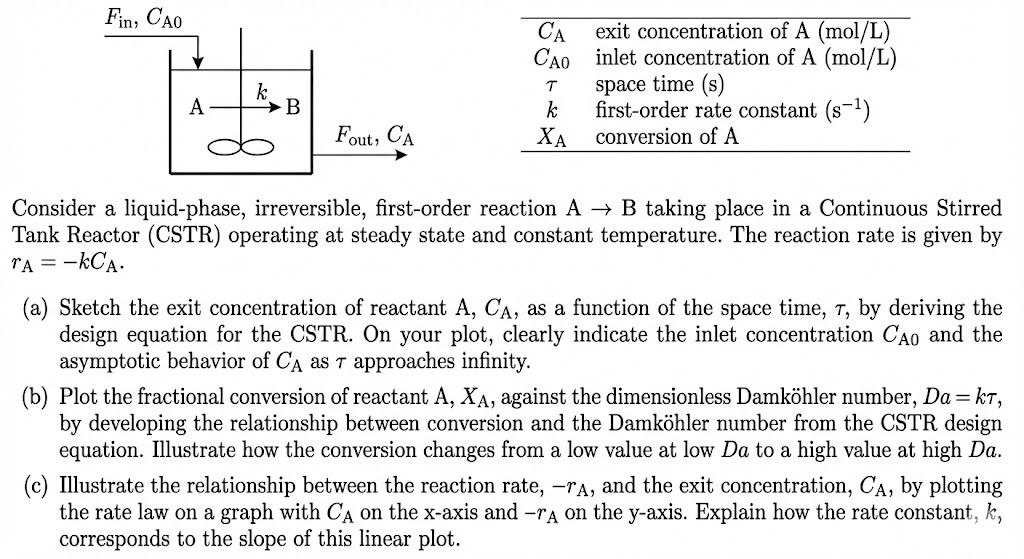
in, Cao Ca exit concentration of A (mol/L)
Chao inlet concentration of A (mol/L)
k 7 space time (s)
A B k first-order rate constant (s7*)
i Fout, Ca Xa conversion of A
Consider a liquid-phase, irreversible, first-order reaction A — B taking place in a Continuous Stirred
Tank Reactor (CSTR) operating at steady state and constant temperature. The reaction rate is given by
7A = —kCa.
(a) Sketch the exit concentration of reactant A, Cy, as a function of the space time, 7, by deriving the
design equation for the CSTR. On your plot, clearly indicate the inlet concentration Cao and the
asymptotic behavior of Cy as 7 approaches infinity.
(b) Plot the fractional conversion of reactant A, X, against the dimensionless Damkghler number, Da = kr,
by developing the relationship between conversion and the Damkéhler number from the CSTR design
equation. Illustrate how the conversion changes from a low value at low Da to a high value at high Da.
(c) Mlustrate the relationship between the reaction rate, —r4, and the exit concentration, Ca, by plotting
the rate law on a graph with Cy on the x-axis and —r4 on the y-axis. Explain how the rate constant, k,
corresponds to the slope of this linear plot.
Question:
Give step-by-step solution with explanation and final answer:F; en
in, Cao Ca exit concentration of A (mol/L)
Chao inlet concentration of A (mol/L)
k 7 space time (s)
A B k first-order rate constant (s7*)
i Fout, Ca Xa conversion of A
Consider a liquid-phase, irreversible, first-order reaction A — B taking place in a Continuous Stirred
Tank Reactor (CSTR) operating at steady state and constant temperature. The reaction rate is given by
7A = —kCa.
(a) Sketch the exit concentration of reactant A, Cy, as a function of the space time, 7, by deriving the
design equation for the CSTR. On your plot, clearly indicate the inlet concentration Cao and the
asymptotic behavior of Cy as 7 approaches infinity.
(b) Plot the fractional conversion of reactant A, X, against the dimensionless Damkghler number, Da = kr,
by developing the relationship between conversion and the Damkéhler number from the CSTR design
equation. Illustrate how the conversion changes from a low value at low Da to a high value at high Da.
(c) Mlustrate the relationship between the reaction rate, —r4, and the exit concentration, Ca, by plotting
the rate law on a graph with Cy on the x-axis and —r4 on the y-axis. Explain how the rate constant, k,
corresponds to the slope of this linear plot.
This is AI generated Response.
Asked by: Francis
Created at: 2026-01-29 08:38:26
Final Answer:
RenderedRaw Text
Did you like this answer?
Let's solve each part step-by-step.
---
# (a) **CSTR Design Equation and \( C_A \) vs. \( \tau \)**
### **Step 1: Write the CSTR Mole Balance**
At steady state:
\[
\text{In} - \text{Out} + \text{Generation} =
\]
For component \( A \):
\[
F_{in} C_{A} - F_{out} C_A + V(-kC_A) =
\]
With \( F_{in} = F_{out} = F \) and \( \tau = \frac{V}{F} \):
\[
F(C_{A} - C_A) - kVC_A =
\]
\[
C_{A} - C_A = k\tau C_A
\]
### **Step 2: Rearrange for \( C_A \) as a Function of \( \tau \)**
\[
C_{A} = C_A (1 + k\tau)
\]
\[
C_A = \frac{C_{A}}{1 + k\tau}
\]
### **Step 3: Sketch and Behavior**
- At \( \tau = \): \( C_A = C_{A} \)
- As \( \tau \to \infty \): \( C_A \to \) (asymptotic approach)
**Plot**: \( y \)-axis is \( C_A \), \( x \)-axis is \( \tau \). The curve starts at \( C_{A} \) and decreases asymptotically toward .
---
# (b) **Fractional Conversion \( X_A \) vs. Damköhler Number \( Da \)**
### **Step 1: Define Fractional Conversion**
\[
X_A = \frac{C_{A} - C_A}{C_{A}}
\]
### **Step 2: Substitute \( C_A \) from Part (a)**
\[
X_A = 1 - \frac{C_A}{C_{A}} = 1 - \frac{1}{1 + k\tau}
\]
### **Step 3: Define Damköhler Number**
\[
Da = k\tau
\]
So,
\[
X_A = 1 - \frac{1}{1 + Da}
\]
\[
X_A = \frac{Da}{1 + Da}
\]
### **Step 4: Plot Behavior**
- At \( Da \to \), \( X_A \to \)
- At \( Da \to \infty \), \( X_A \to 1 \)
**Plot**: \( y \)-axis is \( X_A \), \( x \)-axis is \( Da \). The curve starts at , approaches 1 asymptotically.
---
# (c) **Reaction Rate \( -r_A \) vs. Exit Concentration \( C_A \)**
### **Step 1: Write the Rate Law**
\[
-r_A = k C_A
\]
### **Step 2: Plot**
Plot \( -r_A \) (y-axis) vs. \( C_A \) (x-axis).
- This is a straight line through the origin with slope \( k \).
### **Step 3: Explanation**
- The slope of the line is the first-order rate constant \( k \).
- The larger \( k \), the steeper the line.
---
## **Summary of Answers**
### **(a)**
\[
\boxed{C_A = \frac{C_{A}}{1 + k\tau}}
\]
- Starts at \( C_{A} \), decreases to as \( \tau \to \infty \).
### **(b)**
\[
\boxed{X_A = \frac{Da}{1 + Da} = \frac{k\tau}{1 + k\tau}}
\]
- Starts at , increases to 1 as \( Da \to \infty \).
### **(c)**
- Plot \( -r_A \) vs. \( C_A \): straight line through origin, slope \( k \).
- The rate constant \( k \) is the slope of this line.
---
## **Sketches (Description)**
1. **\( C_A \) vs. \( \tau \):**
- Hyperbolic decay from \( C_{A} \) to .
2. **\( X_A \) vs. \( Da \):**
- Rises from to 1, approaching 1 asymptotically.
3. **\( -r_A \) vs. \( C_A \):**
- Straight line through origin, slope = \( k \).
If you need actual graphs or a more detailed algebraic derivation, let me know!
VIPSolutions focuses on clear, step‑by‑step explanations so you can learn quickly. Whether you need an AI‑generated walkthrough or a short hint to get unstuck, each solution is organized for fast reading and easy review later.
Search similar questions, compare approaches, and bookmark the best answers for revision. Our goal is simple: quick, reliable study help that feels natural—not noisy.
 VIPSolutions
 F; en
in, Cao Ca exit concentration of A (mol/L)
Chao inlet concentration of A (mol/L)
k 7 space time (s)
A B k first-order rate constant (s7*)
i Fout, Ca Xa conversion of A
Consider a liquid-phase, irreversible, first-order reaction A — B taking place in a Continuous Stirred
Tank Reactor (CSTR) operating at steady state and constant temperature. The reaction rate is given by
7A = —kCa.
(a) Sketch the exit concentration of reactant A, Cy, as a function of the space time, 7, by deriving the
design equation for the CSTR. On your plot, clearly indicate the inlet concentration Cao and the
asymptotic behavior of Cy as 7 approaches infinity.
(b) Plot the fractional conversion of reactant A, X, against the dimensionless Damkghler number, Da = kr,
by developing the relationship between conversion and the Damkéhler number from the CSTR design
equation. Illustrate how the conversion changes from a low value at low Da to a high value at high Da.
(c) Mlustrate the relationship between the reaction rate, —r4, and the exit concentration, Ca, by plotting
the rate law on a graph with Cy on the x-axis and —r4 on the y-axis. Explain how the rate constant, k,
corresponds to the slope of this linear plot.