 VIPSolutions
Give step-by-step solution with explanation and final answer:Calculate the total work, in kJ, for process 1-3 shown in the figure when the system consists of 4.000 kg of nitrogen. sw © 400 + ® § a [| 1° 0s 1 mike The total work for process 1-3is[ kJ.
Question:
Give step-by-step solution with explanation and final answer: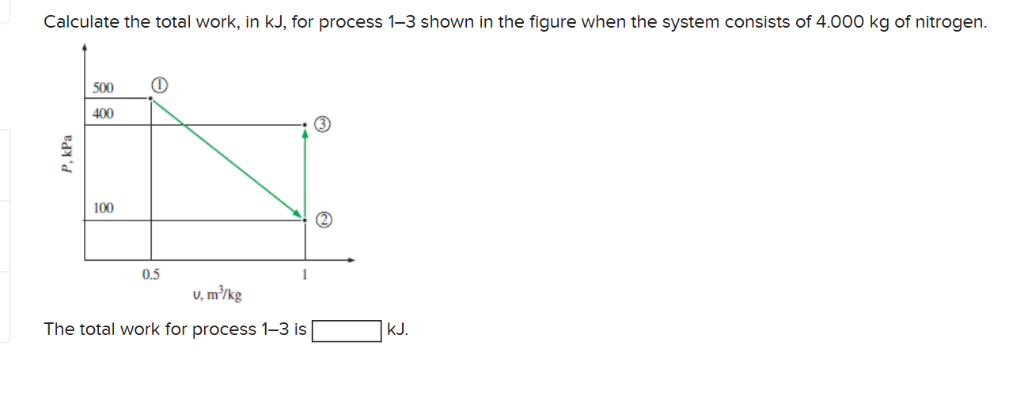 Calculate the total work, in kJ, for process 1-3 shown in the figure when the system consists of 4.000 kg of nitrogen.
sw ©
400
+ ®
§
a
[| 1°
0s 1
mike
The total work for process 1-3is[ kJ.
This is AI generated Response.
Asked by: Om
Created at: 2026-01-29 08:25:33
Asked by: Om
Created at: 2026-01-29 08:25:33
Final Answer:
Rendered
Raw Text
Did you like this answer?
Let's solve the problem step by step.
## **Step 1: Understand the process on the PV diagram**
- **Process 1–2:** From (P1, v1) = (500 kPa, .5 m³/kg) to (P2, v2) = (100 kPa, 1 m³/kg) — a straight line (linear process on PV diagram).
- **Process 2–3:** From (P2, v2) = (100 kPa, 1 m³/kg) to (P3, v3) = (400 kPa, 1 m³/kg) — vertical line (isochoric process, volume is constant).
Given:
- Mass, \( m = 4.000 \) kg
---
## **Step 2: Work done in each process**
### **Process 1–2 (Linear on PV diagram):**
The work done (\( W_{12} \)) is the area under the line between 1 and 2:
\[
W_{12} = m \times \text{Area under 1-2 line}
\]
For a straight line:
\[
\text{Area} = \text{Area}_{\text{rectangle}} + \text{Area}_{\text{triangle}}
\]
Where:
- Rectangle: Height = lower pressure (100 kPa), Base = (1 - .5) m³/kg = .5 m³/kg
- Triangle: Height = (500 - 100) kPa = 400 kPa, Base = .5 m³/kg
So,
\[
\text{Area}_{\text{rect}} = 100 \times .5 = 50 \ \text{kPa·m}^3/\text{kg}
\]
\[
\text{Area}_{\text{tri}} = \frac{1}{2} \times .5 \times (500 - 100) = .25 \times 400 = 100 \ \text{kPa·m}^3/\text{kg}
\]
\[
\text{Total area} = 50 + 100 = 150 \ \text{kPa·m}^3/\text{kg}
\]
\[
W_{12} = m \times \text{Total area}
\]
\[
W_{12} = 4.000 \times 150 = 600 \ \text{kPa·m}^3
\]
Since 1 kPa·m³ = 1 kJ,
\[
W_{12} = 600 \ \text{kJ}
\]
---
### **Process 2–3 (Isochoric, constant volume):**
No work is done during a constant volume process:
\[
W_{23} =
\]
---
### **Step 3: Total Work**
\[
W_{1-3} = W_{12} + W_{23} = 600 + = 600 \ \text{kJ}
\]
---
## **Final Answer**
\[
\boxed{600 \ \text{kJ}}
\]
---
### **Summary Table**
| Process | Work (kJ) |
|-----------|-----------|
| 1 → 2 | 600 |
| 2 → 3 | |
| **Total** | **600** |
**The total work for process 1–3 is \(\boxed{600}\) kJ.**
📢 Instructions:
- Ask anything relatd to above question only.
- For new Question goto :