VIPSolutions logo ✨ VIPSolutions

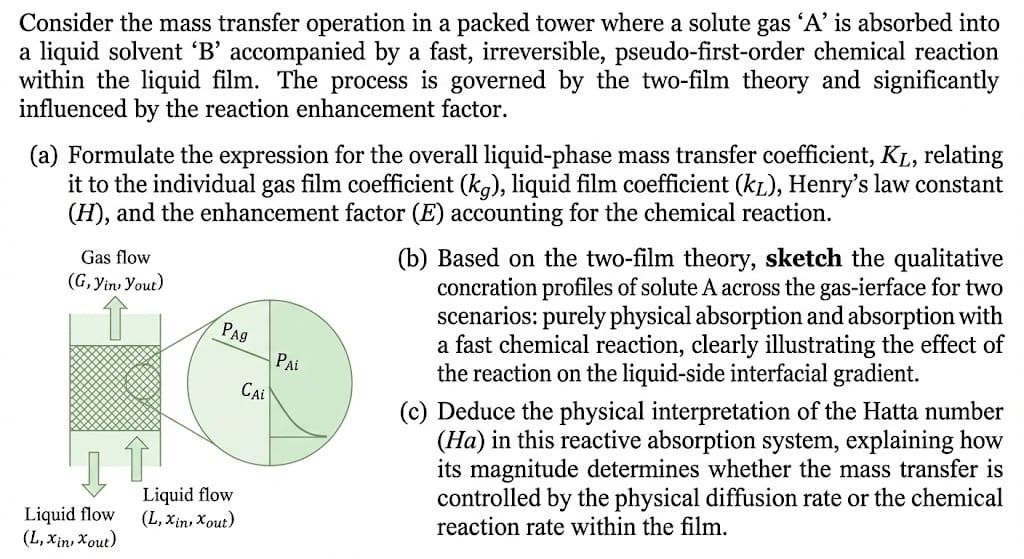
Give step-by-step solution with explanation and final answer: {give me the answer without using bullet-points}Consider the mass transfer operation in a packed tower where a solute gas ‘A’ is absorbed into a liquid solvent ‘B’ accompanied by a fast, irreversible, pseudo-first-order chemical reaction within the liquid film. The process is governed by the two-film theory and significantly influenced by the reaction enhancement factor. (a) Formulate the expression for the overall liquid-phase mass transfer coefficient, Kr, relating it to the individual gas film coefficient (ky), liquid film coefficient (kz), Henry's law constant (H), and the enhancement factor (E) accounting for the chemical reaction. Gas flow (b) Based on the two-film theory, sketch the qualitative (Yin You) concration profiles of solute A across the gas-ierface for two f py 1 scenarios: purely physical absorption and absorption with nm al J \ a fast chemical reaction, clearly illustrating the effect of ea ( o & the reaction on the liquid-side interfacial gradient. a A ) (c) Deduce the physical interpretation of the Hatta number CA \ 4 (Ha) in this reactive absorption system, explaining how 1 T T—— its magnitude determines whether the mass transfer is Na: Liquid flow controlled by the physical diffusion rate or the chemical Lquid flow (1, x1, x10) reaction rate within the film. (Ly Xin) Xour)
Question:

Give step-by-step solution with explanation and final answer: {give me the answer without using bullet-points}Uploaded ImageConsider the mass transfer operation in a packed tower where a solute gas ‘A’ is absorbed into a liquid solvent ‘B’ accompanied by a fast, irreversible, pseudo-first-order chemical reaction within the liquid film. The process is governed by the two-film theory and significantly influenced by the reaction enhancement factor. (a) Formulate the expression for the overall liquid-phase mass transfer coefficient, Kr, relating it to the individual gas film coefficient (ky), liquid film coefficient (kz), Henry's law constant (H), and the enhancement factor (E) accounting for the chemical reaction. Gas flow (b) Based on the two-film theory, sketch the qualitative (Yin You) concration profiles of solute A across the gas-ierface for two f py 1 scenarios: purely physical absorption and absorption with nm al J \ a fast chemical reaction, clearly illustrating the effect of ea ( o & the reaction on the liquid-side interfacial gradient. a A ) (c) Deduce the physical interpretation of the Hatta number CA \ 4 (Ha) in this reactive absorption system, explaining how 1 T T—— its magnitude determines whether the mass transfer is Na: Liquid flow controlled by the physical diffusion rate or the chemical Lquid flow (1, x1, x10) reaction rate within the film. (Ly Xin) Xour)

This is AI generated Response.
Asked by: singaluri krishna kumari
Created at: 2026-01-29 06:30:32

Final Answer:

Rendered Raw Text
Did you like this answer?
Let's solve each part step by step, with explanations and final answers: --- ### (a) **Expression for Overall Liquid-Phase Mass Transfer Coefficient (\(K_L\))** According to the two-film theory, the resistance to mass transfer is shared between the gas and liquid phases. The overall liquid-phase mass transfer coefficient, \(K_L\), is related to the individual film coefficients, Henry's law constant (\(H\)), and the enhancement factor (\(E\)), as follows: The total resistance to transfer is the sum of the resistances in the gas and liquid films: \[ \frac{1}{K_L} = \frac{1}{k_L E} + \frac{H}{k_g} \] Here: - \(k_L\) = liquid film mass transfer coefficient - \(E\) = enhancement factor due to reaction in the liquid film - \(H\) = Henry's law constant (molality/partial pressure units) - \(k_g\) = gas film mass transfer coefficient This equation accounts for the effect of a fast pseudo-first-order reaction, which enhances the liquid film mass transfer coefficient by \(E\). --- ### (b) **Concentration Profiles Across Gas-Liquid Interface** For qualitative sketches (as a description): - **Purely Physical Absorption:** The concentration of A in the gas phase decreases linearly through the gas film up to the interface, then decreases linearly through the liquid film to the bulk liquid. The gradient across the liquid film is moderate, showing only physical mass transfer. - **Absorption with Fast Chemical Reaction:** The concentration gradient in the gas film is similar, but within the liquid film, the concentration of A drops steeply near the interface due to rapid consumption by reaction. The gradient is much steeper in the liquid film, showing that the reaction enhances the mass transfer rate by lowering the interfacial concentration of A. **Effect:** The main effect of a fast chemical reaction is to greatly increase the driving force in the liquid film, resulting in a steeper concentration gradient and thus a higher flux of A into the liquid. --- ### (c) **Physical Interpretation of the Hatta Number (\(Ha\))** The Hatta number is defined for a pseudo-first-order reaction as: \[ Ha = \frac{\text{rate of reaction}}{\text{rate of diffusion}} = \frac{k_1 C_{B} \delta_L^2}{D_A} \] or, more commonly, \[ Ha = \frac{\sqrt{k_1 D_A} \, C_{B} \, \delta_L}{D_A} \] **Interpretation:** - If \(Ha \ll 1\): The reaction is slow compared to diffusion, so the overall rate is controlled by the reaction rate. - If \(Ha \gg 1\): The reaction is very fast; as soon as A diffuses into the liquid, it reacts almost instantly. The rate is now controlled by the diffusion of A through the liquid film. - If \(Ha \sim 1\): Both diffusion and reaction contribute significantly to the overall rate. **Conclusion:** The magnitude of the Hatta number determines whether the mass transfer in the system is limited by diffusion (high \(Ha\)) or by chemical reaction (low \(Ha\)) within the liquid film. --- **Final Answers:** (a) \[ \frac{1}{K_L} = \frac{1}{k_L E} + \frac{H}{k_g} \] (b) For purely physical absorption, the concentration profile of solute A is a smooth gradient in both phases. For absorption with a fast reaction, the liquid-side gradient is much steeper, showing a rapid drop near the interface due to enhanced mass transfer by the reaction. (c) The Hatta number quantifies the relative rates of reaction and diffusion. If \(Ha \ll 1\), the process is reaction-controlled; if \(Ha \gg 1\), it is diffusion-controlled; if \(Ha \approx 1\), both processes are significant.

📢 Instructions:

  • Ask anything relatd to above question only.
  • For new Question goto :

Study Help, Fast Answers

VIPSolutions focuses on clear, step‑by‑step explanations so you can learn quickly. Whether you need an AI‑generated walkthrough or a short hint to get unstuck, each solution is organized for fast reading and easy review later.

Search similar questions, compare approaches, and bookmark the best answers for revision. Our goal is simple: quick, reliable study help that feels natural—not noisy.