 VIPSolutions
Give step-by-step solution with explanation and final answer:250 1b 2501t | 150 Ib/ft TERT EN = = B antes aft 61t —
Question:
Give step-by-step solution with explanation and final answer: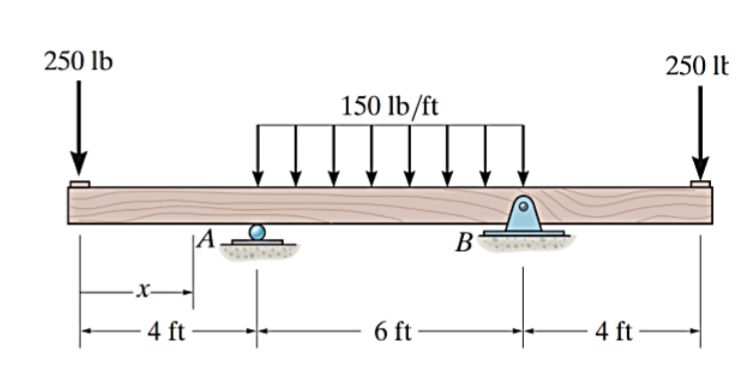 250 1b 2501t
| 150 Ib/ft
TERT EN
= = B antes
aft 61t —
This is AI generated Response.
Asked by: Rahul
Created at: 2026-01-29 04:06:31
Asked by: Rahul
Created at: 2026-01-29 04:06:31
Final Answer:
Rendered
Raw Text
Did you like this answer?
Let's solve the **step-by-step** problem for the beam shown in the image.
---
## **Step 1: Understanding the Problem**
- A simply supported beam rests on supports at \( A \) and \( B \).
- There are two point loads of \( 250\, \text{lb} \) each, at both ends.
- There is a **uniformly distributed load (UDL)** of \( 150\, \text{lb/ft} \) over the central \( 6\, \text{ft} \) of the beam.
- The distances are marked as \( 4\, \text{ft} \) from each end to the start of the UDL, and \( 6\, \text{ft} \) is the length of the UDL.
- The positions of supports \( A \) and \( B \) are to be determined (denoted by \( x \)), assuming they are under the beam between the loads.
---
## **Step 2: Drawing the Free-Body Diagram**
- Let's denote the **reactions at A and B** as \( R_A \) and \( R_B \), respectively.
- The total length of the beam: \( 4 + 6 + 4 = 14\, \text{ft} \).
---
## **Step 3: Calculating the Total Loads**
- **Point loads**: \( 250\, \text{lb} \) each at both ends.
- **UDL total load**: \( 150\, \text{lb/ft} \times 6\, \text{ft} = 900\, \text{lb} \).
- UDL acts at the center of the 6 ft section, i.e., at \( 4 + 3 = 7\, \text{ft} \) from the left end.
---
## **Step 4: Applying Equilibrium Equations**
### **Sum of Vertical Forces = **
\[
R_A + R_B = 250 + 900 + 250 = 140\, \text{lb}
\]
---
### **Sum of Moments About A = **
Let's take moments about \( A \):
- **Moment arm for left 250 lb**: \( x \) (but it acts before A, so negative direction?)
- **Moment arm for UDL**: The UDL (900 lb) acts at the centroid of the distributed load, which is \( 4 + 3 = 7\, \text{ft} \) from the left end, so distance from A is \( 7 - x \).
- **Moment arm for right 250 lb**: It acts at \( 14\, \text{ft} \) from the left, so distance from A is \( 14 - x \).
- **Reaction at B**: Distance from A to B is \( 6\, \text{ft} \).
\[
\begin{align*}
\sum M_A = : & \\
-250 \cdot x & \quad \text{(counterclockwise)} \\
+ 900 \cdot (7-x) & \quad \text{(clockwise)} \\
+ 250 \cdot (14-x) & \quad \text{(clockwise)} \\
- R_B \cdot 6 & \quad \text{(counterclockwise)} \\
=
\end{align*}
\]
But \( x \) is not given in the original image as a variable; the supports are at 4 ft from the left end (A) and 10 ft from the left end (B). Let's clarify:
- \( A \) is at 4 ft from the left end.
- \( B \) is at \( 4 + 6 = 10 \) ft from the left end.
So, use these values:
- Distance from A to left end = 4 ft.
- Distance from B to left end = 10 ft.
---
### **Rewriting the Moment Equation About A**
Take moments about \( A \) (which is 4 ft from the left end):
- Left end 250 lb: 4 ft to the left of A (acts at -4 ft from A, but moment is clockwise).
- UDL: 3 ft from A (since UDL centroid is at 7 ft from the left end, A is at 4 ft, so 7 - 4 = 3 ft from A).
- Right end 250 lb: 14 - 4 = 10 ft from A.
- B: 10 - 4 = 6 ft from A.
Now, sum moments about A (counterclockwise positive):
\[
\begin{align*}
\sum M_A = : \\
+250 \cdot (-4) \\
+ 900 \cdot 3 \\
+ 250 \cdot 10 \\
- R_B \cdot 6 \\
=
\end{align*}
\]
\[
-100 + 270 + 250 - 6R_B =
\]
\[
(-100 + 270 + 250) - 6R_B =
\]
\[
420 - 6R_B =
\]
\[
6R_B = 420
\]
\[
R_B = \frac{420}{6} = 700\, \text{lb}
\]
---
### **Sum of Vertical Forces**
\[
R_A + R_B = 140
\]
\[
R_A + 700 = 140
\]
\[
R_A = 700\, \text{lb}
\]
---
## **Step 5: Final Answer**
### **Reactions at Supports**
\[
\boxed{
R_A = 700\, \text{lb} \quad \text{(upward)}
}
\]
\[
\boxed{
R_B = 700\, \text{lb} \quad \text{(upward)}
}
\]
---
## **Summary Table**
| Support | Reaction (lb) |
|---------|--------------|
| A | 700 |
| B | 700 |
---
### **Explanation**
- The reactions at both supports are equal because the loading is symmetric about the center of the beam.
- All loads and distances were summed and moments about support A were used to solve for the unknown reactions.
---
**Let me know if you need shear/moment diagrams or further details!**
📢 Instructions:
- Ask anything relatd to above question only.
- For new Question goto :