 VIPSolutions
Give step-by-step solution with explanation and final answer:Problem 3 [10marks, 5 each] a) Derive an expression for the (horizontal) divergence D of the geostrophic wind and give a physical interpretation of the results. By definition, du dv D= wt a a) Calculate the divergence of the geostrophic wind at 45°N at a point where 1, = 10m/s.
Question:
Give step-by-step solution with explanation and final answer: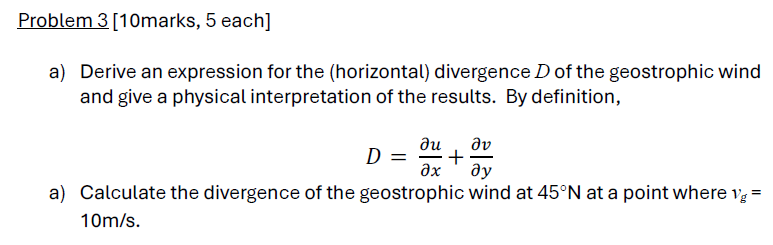 Problem 3 [10marks, 5 each]
a) Derive an expression for the (horizontal) divergence D of the geostrophic wind
and give a physical interpretation of the results. By definition,
du dv
D= wt a
a) Calculate the divergence of the geostrophic wind at 45°N at a point where 1, =
10m/s.
This is AI generated Response.
Asked by: Rahul
Created at: 2026-01-29 03:23:35
Asked by: Rahul
Created at: 2026-01-29 03:23:35
Final Answer:
Rendered
Raw Text
Did you like this answer?
# Problem 3 Solution
Let's solve each part step by step.
---
## **a) Expression for Horizontal Divergence of Geostrophic Wind**
### **Step 1: Definition of Geostrophic Wind**
The geostrophic wind components are:
\[
u_g = -\frac{1}{f} \frac{\partial \Phi}{\partial y}
\]
\[
v_g = \frac{1}{f} \frac{\partial \Phi}{\partial x}
\]
where:
- \( u_g \), \( v_g \): Zonal and meridional geostrophic wind components
- \( f \): Coriolis parameter (\( f = 2\Omega \sin\phi \))
- \( \Phi \): Geopotential
### **Step 2: Expression for Horizontal Divergence**
By definition,
\[
D = \frac{\partial u}{\partial x} + \frac{\partial v}{\partial y}
\]
For geostrophic wind,
\[
D_g = \frac{\partial u_g}{\partial x} + \frac{\partial v_g}{\partial y}
\]
Substitute the expressions for \( u_g \) and \( v_g \):
\[
D_g = \frac{\partial}{\partial x} \left(-\frac{1}{f} \frac{\partial \Phi}{\partial y}\right) + \frac{\partial}{\partial y} \left( \frac{1}{f} \frac{\partial \Phi}{\partial x} \right)
\]
Assuming \( f \) is constant (valid for small regions):
\[
D_g = -\frac{1}{f} \frac{\partial^2 \Phi}{\partial x \partial y} + \frac{1}{f} \frac{\partial^2 \Phi}{\partial y \partial x}
\]
Since mixed partial derivatives are equal (if \( \Phi \) is smooth):
\[
D_g = -\frac{1}{f} \frac{\partial^2 \Phi}{\partial x \partial y} + \frac{1}{f} \frac{\partial^2 \Phi}{\partial x \partial y} =
\]
### **Physical Interpretation**
**The horizontal divergence of the geostrophic wind is zero** (for constant \( f \)):
- This means the geostrophic wind is non-divergent; it neither converges nor diverges horizontally.
- Physically, this is because the geostrophic wind flows parallel to isobars (contours of constant pressure) and does not "pile up" or "spread out" air horizontally.
---
## **b) Calculate the Divergence at \( 45^\circ N \) for \( v_g = 10 \) m/s**
From part (a), we derived that:
\[
D_g =
\]
So, **the divergence is zero** at any latitude (as long as \( f \) is constant and the wind is geostrophic), including at \( 45^\circ N \).
---
## **Final Answers**
### **a)**
**Expression:**
\[
D_g = \frac{\partial u_g}{\partial x} + \frac{\partial v_g}{\partial y} =
\]
**Physical Interpretation:**
The geostrophic wind is non-divergent; its flow does not cause horizontal convergence or divergence.
---
### **b)**
**The divergence of the geostrophic wind at \( 45^\circ N \) is:**
\[
\boxed{}
\]
📢 Instructions:
- Ask anything relatd to above question only.
- For new Question goto :