 VIPSolutions
Give step-by-step solution with explanation and final answer:1 Pris the products fo the recon eo. md provide resonable ep by ip mechan Ee el ee or pt 5 0 cuncin — fr) © o wre res, Se = KS Fr ——— ee a ie ht ror Tame dt i cai io hie Sg Wy of ia = o 3.0 Th rf Gc coma og. oie py ep io "5 ceria KY (1th fd rcs gion cid cm i do etm cil’ eit
Question:
Give step-by-step solution with explanation and final answer: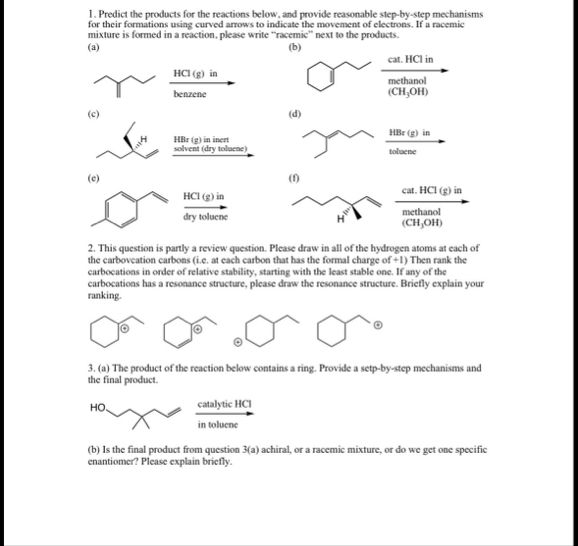 1 Pris the products fo the recon eo. md provide resonable ep by ip mechan
Ee el
ee or pt
5 0
cuncin
— fr)
© o
wre res, Se
= KS
Fr ———
ee a ie ht ror Tame
dt i cai io hie Sg Wy of
ia
=
o
3.0 Th rf Gc coma og. oie py ep io
"5 ceria
KY
(1th fd rcs gion cid cm i do etm cil’
eit
This is AI generated Response.
Asked by: Rahul
Created at: 2026-01-29 03:15:30
Asked by: Rahul
Created at: 2026-01-29 03:15:30
Final Answer:
Rendered
Raw Text
Did you like this answer?
Let's break down and solve the problems step by step:
---
## 1. Predict the products and mechanisms
### (a) Benzene + HCl(g)
**Reaction:**
Benzene does not react with HCl(g) under these conditions because benzene is not reactive towards simple acids without a strong electrophile or catalyst (like AlCl₃ in Friedel-Crafts reactions).
**Product:**
No reaction.
---
### (b) 2-methylbut-2-ene + cat. HCl in methanol
**Mechanism:**
1. Protonation of alkene forms a carbocation (markovnikov, more stable).
2. Carbocation intermediate.
3. Methanol attacks the carbocation (nucleophile).
4. Deprotonation gives the ether.
**Product:**
- The major product is **2-methoxy-2-methylbutane**.
**Racemic?**
- No chiral center is formed; product is **achiral**.
---
### (c) Cyclohexene + HBr(g) (inert solvent)
**Mechanism:**
1. Protonation of alkene to carbocation (at more substituted carbon).
2. Bromide ion attacks the carbocation.
**Product:**
- **Bromocyclohexane**
**Racemic?**
- No chiral center is generated; product is **achiral**.
---
### (d) 2-methylbut-2-ene + HBr(g) in toluene
**Mechanism:**
1. Protonation forms the most stable carbocation.
2. Br⁻ attacks carbocation.
**Product:**
- **2-Bromo-2-methylbutane**
**Racemic?**
- No chiral center; **achiral**.
---
### (e) Toluene + HCl(g) in dry toluene
**Reaction:**
No reaction under these conditions (toluene is not reactive with HCl without a strong electrophile/catalyst).
**Product:**
No reaction.
---
### (f) 3-pentene + cat. HCl(g) in methanol
**Mechanism:**
1. Protonation of alkene at C-2 or C-3 gives the more stable secondary carbocation at C-3.
2. Methanol attacks carbocation, then deprotonation.
**Product:**
- **3-methoxypentane**
**Racemic?**
- If a stereocenter is formed, a racemic mixture forms. Here, the product is **achiral** (no stereocenter at C-3).
---
## 2. Carbocation Stability
Draw hydrogens and rank stability:
- (i) Cyclopropylmethyl carbocation (resonance stabilized)
- (ii) Cyclohexyl carbocation (secondary)
- (iii) Cycloheptyl carbocation (secondary)
- (iv) Cyclopentyl carbocation (secondary)
**Ranking:**
**Cyclopropylmethyl > cycloheptyl ≈ cyclohexyl ≈ cyclopentyl**
- Cyclopropylmethyl is more stable due to resonance (allylic stabilization).
- The rest are secondary carbocations with little difference in stability.
---
## 3. (a) Cyclization with HO(CH₂)₄CH₃ + catalytic HCl in toluene
### Mechanism:
1. Protonation of the alcohol to form good leaving group (water).
2. Intramolecular attack by the terminal carbon (Friedel-Crafts-type cyclization).
3. Deprotonation to form cyclopentane ring.
### Product:
- **Cyclopentylmethanol** (five-membered ring with methanol group attached).
### (b) Is the product chiral, racemic, or achiral?
- The product is **achiral** as no chiral center is formed.
---
## **Summary Table**
| Part | Product | Racemic/Achiral/Chiral |
|------|---------|------------------------|
| (a) | No reaction | - |
| (b) | 2-methoxy-2-methylbutane | Achiral |
| (c) | Bromocyclohexane | Achiral |
| (d) | 2-bromo-2-methylbutane | Achiral |
| (e) | No reaction | - |
| (f) | 3-methoxypentane | Achiral |
| 2 | Stability: cyclopropylmethyl > others | |
| 3 | Cyclopentylmethanol | Achiral |
---
### Let me know if you want detailed curved-arrow mechanisms for any of these!
📢 Instructions:
- Ask anything relatd to above question only.
- For new Question goto :