This is AI generated Response.
Asked by: Rahul
Created at: 2026-01-29 03:08:44
Final Answer:
RenderedRaw Text
Did you like this answer?
Let's break down the mechanism for the inhibition of β-lactamase by **clavulanic acid** step by step, adding the missing arrows and explaining each transformation in an aqueous environment.
---
# Step-by-Step Solution
### **Step 1: Nucleophilic Attack by Serine (Ser-OH)**
- The serine residue in the active site of β-lactamase acts as a nucleophile.
- The lone pair on the oxygen of Ser-OH attacks the carbonyl carbon of the β-lactam ring in clavulanic acid.
- This opens the β-lactam ring, forming a **covalent acyl-enzyme intermediate**.
**Add missing arrow:**
- From the serine oxygen to the carbonyl carbon of the β-lactam.
- From the C=O bond to the oxygen (making it O^- temporarily).
- From the N—C bond (β-lactam ring) to the nitrogen.
---
### **Step 2: Formation of Acyl-Enzyme Intermediate**
- The result is a tetrahedral intermediate that collapses to form the acyl-enzyme.
- The nitrogen of the former β-lactam picks up a proton from water or from the enzyme.
**Add missing arrow:**
- From the lone pair on the nitrogen to a nearby proton (H from enzyme or water).
---
### **Step 3: Rearrangement and Hydrolysis**
- Water (in the aqueous environment) acts as a nucleophile.
- Water attacks the carbonyl carbon of the acyl-enzyme.
- This leads to another tetrahedral intermediate, which collapses, releasing the enzyme and forming a hydrolyzed product.
**Add missing arrows:**
- From the oxygen of water to the carbonyl carbon.
- From the C=O double bond to the oxygen (making it O^- temporarily).
- From the enzyme O—C bond to the enzyme oxygen (regenerating Ser-OH).
---
### **Step 4: Irreversible Inhibition**
- The rearranged product is a hydrolyzed, inactive form.
- Clavulanic acid is now "stuck" as a covalent adduct, irreversibly inhibiting the enzyme.
---
## **Arrows and Mechanism Fixes**
Here’s a summary of the **arrows that should be added** to the mechanism:
1. **Step 1:**
- Ser-OH oxygen attacks β-lactam carbonyl carbon.
- β-lactam C=O double bond shifts to O (making it O^- temporarily).
- N—C bond of β-lactam breaks, N picks up a proton.
2. **Step 2:**
- Collapse of tetrahedral intermediate, reformation of C=O, N leaves, forms acyl-enzyme.
3. **Step 3:**
- Water attacks acyl-enzyme carbonyl carbon.
- C=O double bond shifts to O (making it O^- temporarily).
- Collapse of tetrahedral intermediate, enzyme is released.
4. **Step 4:**
- Rearrangement to final, inactive product.
---
## **Final Answer**
### **Corrected Mechanism Steps:**
1. **Nucleophilic attack by Ser-OH** on the β-lactam ring (add curved arrow from Ser-OH to C=O, and from C=O to O, and from N—C to N).
2. **Ring opening and acyl-enzyme formation** (add arrow from N to pick up a proton).
3. **Nucleophilic attack by water** on the acyl-enzyme (add arrows as above).
4. **Product formation and irreversible inhibition** (add proton transfers and collapse arrows).
---
### **Explanatory Diagram (Summary):**
(You would add the following arrows to the existing image)
- **Step 1:**
- Arrow from Ser-OH to β-lactam C=O
- Arrow from C=O to O
- Arrow from N—C bond to N
- **Step 2:**
- Arrow from N to pick up H⁺ (from enzyme or water)
- **Step 3:**
- Arrow from water O to acyl-enzyme C=O
- Arrow from C=O to O
- Arrow from enzyme O—C to enzyme O
- **Step 4:**
- Arrow for proton transfer and collapse
---
## **Key Points**
- **Clavulanic acid** is a suicide inhibitor for β-lactamase.
- The mechanism involves **covalent acyl-enzyme formation** and **irreversible inhibition**.
- **Add all missing curved arrows for nucleophilic attacks, bond breakage, and proton transfers**.
If you need a hand-drawn, arrow-filled mechanism, let me know!
VIPSolutions focuses on clear, step‑by‑step explanations so you can learn quickly. Whether you need an AI‑generated walkthrough or a short hint to get unstuck, each solution is organized for fast reading and easy review later.
Search similar questions, compare approaches, and bookmark the best answers for revision. Our goal is simple: quick, reliable study help that feels natural—not noisy.
 VIPSolutions
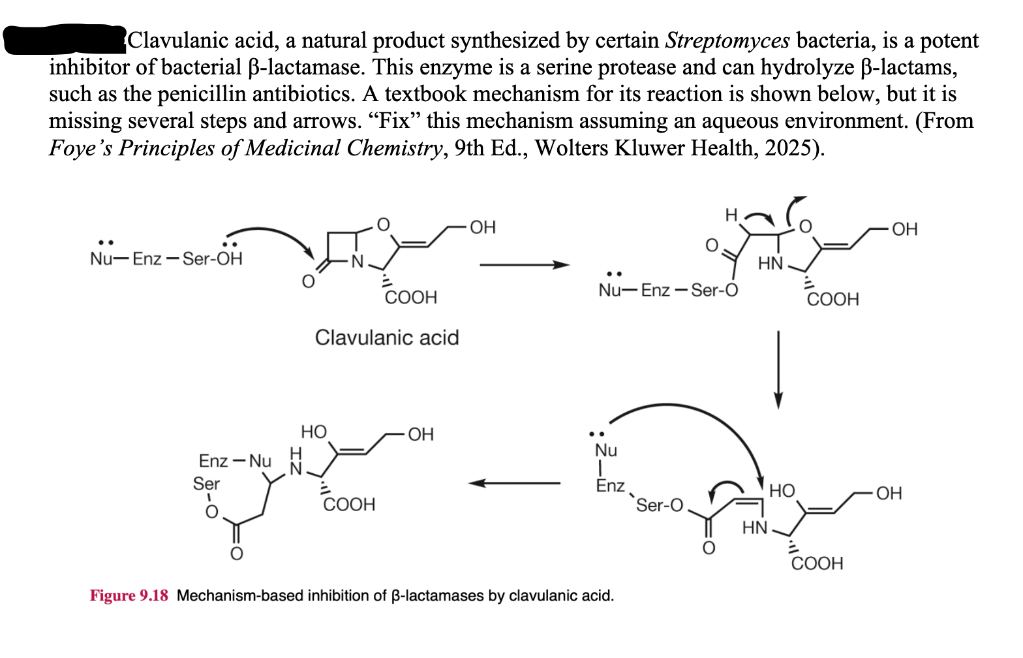 GEER Canc acid, a natural product synthesized by certain Streptomyces bacteria, is a potent
inhibitor of bacterial B-lactamase. This enzyme is a serine protease and can hydrolyze B-lactams,
such as the penicillin antibiotics. A textbook mechanism for its reaction is shown below, but it is
missing several steps and arrows. “Fix” this mechanism assuming an aqueous environment. (From
Foye’s Principles of Medicinal Chemistry, 9th Ed., Wolters Kluwer Health, 2025).
TN 0, OH a 0 OH
Nu— Enz —Ser-OH Ji _ road
o z I z
COOH Nu—Enz —Ser-O = 00H
Clavulanic acid |
HO OH .
Enz—Nu H = he
Ser Z ~~ Enz HO
5 COOH sor-0 A= ad oH
HN
[e] z
© CooH
Figure 9.18 Mechanism-based inhibition of B-lactamases by clavulanic acid.