 VIPSolutions
Give step-by-step solution with explanation and final answer:1 Pris the products fo the recon eo. md provide resonable ep by ip mechan Ee el ee or pt 5 0 cuncin — fr) © o wre res, Se = KS Fr ——— ee a ie ht ror Tame dt i cai io hie Sg Wy of ia = o 3.0 Th rf Gc coma og. oie py ep io "5 ceria KY (1th fd rcs gion cid cm i do etm cil’ eit
Question:
Give step-by-step solution with explanation and final answer: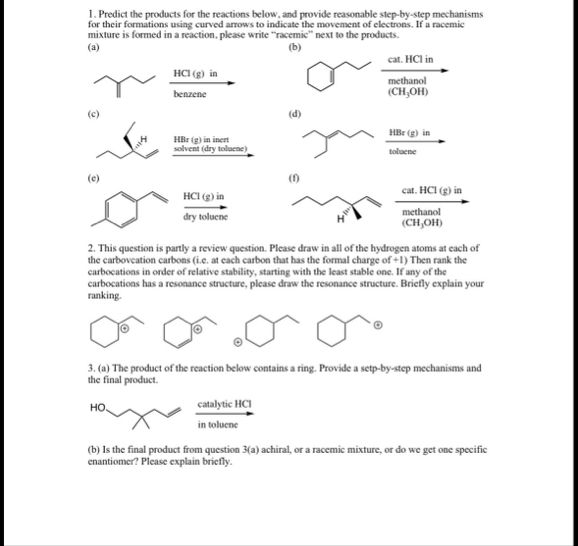 1 Pris the products fo the recon eo. md provide resonable ep by ip mechan
Ee el
ee or pt
5 0
cuncin
— fr)
© o
wre res, Se
= KS
Fr ———
ee a ie ht ror Tame
dt i cai io hie Sg Wy of
ia
=
o
3.0 Th rf Gc coma og. oie py ep io
"5 ceria
KY
(1th fd rcs gion cid cm i do etm cil’
eit
This is AI generated Response.
Asked by: Rahul
Created at: 2026-01-29 03:05:09
Asked by: Rahul
Created at: 2026-01-29 03:05:09
Final Answer:
Rendered
Raw Text
Did you like this answer?
Let's tackle each problem step by step, providing explanations and final answers.
---
# 1. Predict the products and provide step-by-step mechanisms
## (a)
**Reaction:**
Benzene + HCl (gas) in benzene
**Explanation:**
Benzene does **not** react with HCl under these conditions because HCl is not a strong enough electrophile to react with aromatic rings. No Friedel-Crafts catalyst (like AlCl₃) is present.
**Product:**
No reaction.
---
## (b)
**Reaction:**
2-methylbut-2-ene + cat. HCl in methanol (CH₃OH)
**Mechanism:**
1. **Protonation of Alkene**: The double bond attacks H⁺, forming a carbocation at the more substituted carbon (Markovnikov addition).
2. **Nucleophilic Attack**: Methanol attacks the carbocation.
3. **Deprotonation**: Methanol loses a proton to form the ether.
**Product:**
2-chloro-2-methylbutane
- If a new stereocenter is formed, a racemic mixture results.
---
## (c)
**Reaction:**
Cyclohexene + HBr (gas) in inert solvent (dry toluene)
**Mechanism:**
1. **Protonation of double bond** to form the most stable carbocation (Markovnikov).
2. **Br⁻ attacks carbocation.**
**Product:**
Bromocyclohexane
---
## (d)
**Reaction:**
1-butene + HBr (gas) in toluene
**Mechanism:**
1. **Protonation** of the double bond (Markovnikov).
2. **Br⁻ attacks the carbocation.**
**Product:**
2-bromobutane (racemic mixture, since a new chiral center is formed at C2).
---
## (e)
**Reaction:**
Benzene + HCl (gas) in dry toluene
**Explanation:**
Just like part (a), benzene does **not** react with HCl without a Lewis acid catalyst.
**Product:**
No reaction.
---
## (f)
**Reaction:**
1-pentene + cat. HCl (g) in methanol (CH₃OH)
**Mechanism:**
1. **Protonation** of the double bond (Markovnikov).
2. **Methanol attacks the carbocation.**
3. **Deprotonation** leads to the ether.
**Product:**
2-methoxypentane (racemic mixture if a new chiral center is formed).
---
# 2. Carbocation Stability
Draw hydrogens and rank from least to most stable.
- **A:** Cyclopropyl carbocation (least stable, high ring strain, poor overlap)
- **B:** Cyclopentyl carbocation
- **C:** Cyclohexyl carbocation
- **D:** Cycloheptyl carbocation
- **E:** Benzyl carbocation (most stable, resonance stabilization)
**Ranking (least to most stable):**
A < B < C < D < E
- **Resonance structure for E:** Positive charge delocalized on the aromatic ring.
---
# 3. Ring Formation Mechanism
**(a) Mechanism:**
1. **Protonation** of the alcohol by HCl makes a good leaving group (water).
2. **Intramolecular nucleophilic attack**: The terminal carbon attacks the carbocation, forming a ring.
3. **Deprotonation** to form the final product.
**Product:**
Tetrahydrofuran (THF) ring structure.
---
**(b) Is the final product achiral, racemic, or one enantiomer?**
- The product is **achiral** because tetrahydrofuran is a symmetric ring with no chiral centers formed during the reaction.
---
# **Summary Table**
| Part | Product | Racemic? | Comments |
|------|---------|----------|----------|
| 1a | No rxn | - | Benzene inert to HCl without catalyst |
| 1b | 2-chloro-2-methylbutane | Possibly racemic | If chiral center forms |
| 1c | Bromocyclohexane | No | |
| 1d | 2-bromobutane | Racemic | New chiral center |
| 1e | No rxn | - | |
| 1f | 2-methoxypentane | Racemic | New chiral center |
| 2 | E > D > C > B > A | - | Carbocation stability |
| 3a | Tetrahydrofuran | Achiral | |
| 3b | Achiral | - | |
---
If you need step-by-step arrow-pushing mechanisms for any part or resonance structures, let me know!
📢 Instructions:
- Ask anything relatd to above question only.
- For new Question goto :