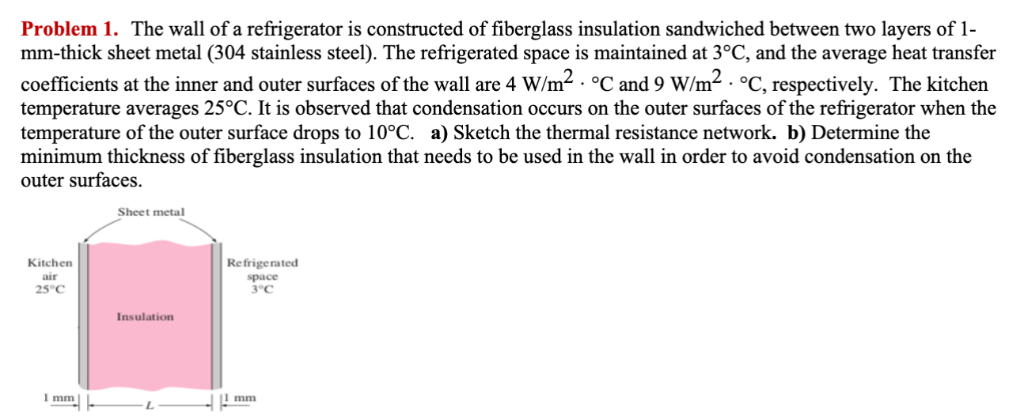
Give step-by-step solution with explanation and final answer:Problem 1. The wall of a refrigerator is constructed of fiberglass insulation sandwiched between two layers of 1-
mm-thick sheet metal (304 stainless steel). The refrigerated space is maintained at 3°C, and the average heat transfer
coefficients at the inner and outer surfaces of the wall are 4 W/m? - °C and 9 W/m? - °C, respectively. The kitchen
temperature averages 25°C. It is observed that condensation occurs on the outer surfaces of the refrigerator when the
temperature of the outer surface drops to 10°C. a) Sketch the thermal resistance network. b) Determine the
minimum thickness of fiberglass insulation that needs to be used in the wall in order to avoid condensation on the
outer surfaces.
Sheet metal
Kitchen Refrigerated
25°C Toc
Insulation
+ mm 1 mm
| | L Jp
Question:
Give step-by-step solution with explanation and final answer:Problem 1. The wall of a refrigerator is constructed of fiberglass insulation sandwiched between two layers of 1-
mm-thick sheet metal (304 stainless steel). The refrigerated space is maintained at 3°C, and the average heat transfer
coefficients at the inner and outer surfaces of the wall are 4 W/m? - °C and 9 W/m? - °C, respectively. The kitchen
temperature averages 25°C. It is observed that condensation occurs on the outer surfaces of the refrigerator when the
temperature of the outer surface drops to 10°C. a) Sketch the thermal resistance network. b) Determine the
minimum thickness of fiberglass insulation that needs to be used in the wall in order to avoid condensation on the
outer surfaces.
Sheet metal
Kitchen Refrigerated
25°C Toc
Insulation
+ mm 1 mm
| | L Jp
This is AI generated Response.
Asked by: Rahul
Created at: 2026-01-28 04:32:20
Final Answer:
RenderedRaw Text
Did you like this answer?
Let's solve the problem step by step:
---
# **Step-by-Step Solution**
## **Given Data**
- **Sheet Metal Thickness:** \( d_{sm} = 1\ \text{mm} = .001\ \text{m} \) (each side)
- **Thermal Conductivity of Sheet Metal (304 SS):** \( k_{sm} = 14.9\ \text{W}/\text{m}\cdot^\circ \text{C} \)
- **Thermal Conductivity of Fiberglass Insulation:** \( k_{ins} = .035\ \text{W}/\text{m}\cdot^\circ \text{C} \)
- **Inside Heat Transfer Coefficient:** \( h_{in} = 4\ \text{W}/\text{m}^2\cdot^\circ \text{C} \)
- **Outside Heat Transfer Coefficient:** \( h_{out} = 9\ \text{W}/\text{m}^2\cdot^\circ \text{C} \)
- **Kitchen Temperature:** \( T_{\infty, out} = 25^\circ \text{C} \)
- **Refrigerated Space Temperature:** \( T_{\infty, in} = 3^\circ \text{C} \)
- **Condensation Point:** Occurs if \( T_{s, out} \leq 10^\circ \text{C} \)
- **Insulation Thickness:** \( L = ? \) (to be determined)
---
## **a) Thermal Resistance Network**
The wall has the following layers (from inside to outside):
1. **Inside Convective Resistance** (\(R_{conv,in}\))
2. **Inner Sheet Metal Resistance** (\(R_{sm,in}\))
3. **Fiberglass Insulation Resistance** (\(R_{ins}\))
4. **Outer Sheet Metal Resistance** (\(R_{sm,out}\))
5. **Outside Convective Resistance** (\(R_{conv,out}\))
**Thermal Resistance Network Diagram:**
```
[Inside air] -- [Conv. (h_in)] -- [Sheet metal (1mm)] -- [Insulation (L)] -- [Sheet metal (1mm)] -- [Conv. (h_out)] -- [Outside air]
T_inf,in T1 T2 T3 T4 T_inf,out
```
---
## **b) Calculate Minimum Insulation Thickness**
### **Step 1: Write the Total Thermal Resistance**
The total thermal resistance per unit area is:
\[
R_{tot} = R_{conv,in} + R_{sm,in} + R_{ins} + R_{sm,out} + R_{conv,out}
\]
Where:
- \( R_{conv,in} = \frac{1}{h_{in}} \)
- \( R_{sm,in} = \frac{d_{sm}}{k_{sm}} \)
- \( R_{ins} = \frac{L}{k_{ins}} \)
- \( R_{sm,out} = \frac{d_{sm}}{k_{sm}} \)
- \( R_{conv,out} = \frac{1}{h_{out}} \)
---
### **Step 2: Express the Heat Transfer Rate**
The heat transfer per unit area (\( q \)) is:
\[
q = \frac{T_{\infty, out} - T_{\infty, in}}{R_{tot}}
\]
---
### **Step 3: Find Temperature at the Outer Surface (\(T_{s, out}\))**
The temperature at the outer surface (between the outer sheet metal and outside air) is:
\[
T_{s, out} = T_{\infty, out} - q \cdot R_{conv,out}
\]
To **avoid condensation**, \(T_{s, out} \geq 10^\circ \text{C}\).
---
### **Step 4: Substitute and Solve for \(L\)**
Let’s put all values and solve for \(L\):
- \( h_{in} = 4 \)
- \( h_{out} = 9 \)
- \( d_{sm} = .001 \)
- \( k_{sm} = 14.9 \)
- \( k_{ins} = .035 \)
- \( T_{\infty, out} = 25 \)
- \( T_{\infty, in} = 3 \)
#### **Thermal Resistances:**
\[
R_{conv,in} = \frac{1}{4} = .25~\text{m}^2\cdot^\circ\text{C}/\text{W}
\]
\[
R_{sm,in} = R_{sm,out} = \frac{.001}{14.9} = 6.71 \times 10^{-5}~\text{m}^2\cdot^\circ\text{C}/\text{W}
\]
\[
R_{conv,out} = \frac{1}{9} = .111~\text{m}^2\cdot^\circ\text{C}/\text{W}
\]
\[
R_{ins} = \frac{L}{.035}
\]
So,
\[
R_{tot} = .25 + 2 \times 6.71 \times 10^{-5} + \frac{L}{.035} + .111
\]
\[
R_{tot} \approx .25 + .000134 + \frac{L}{.035} + .111 = .3611 + \frac{L}{.035}
\]
---
#### **Heat Transfer Rate:**
\[
q = \frac{25 - 3}{.3611 + \frac{L}{.035}}
\]
---
#### **Outer Surface Temperature:**
\[
T_{s, out} = T_{\infty, out} - q \cdot R_{conv,out}
\]
\[
T_{s, out} = 25 - q \cdot .111
\]
To avoid condensation:
\[
T_{s, out} \geq 10
\]
\[
25 - q \cdot .111 \geq 10
\]
\[
q \leq \frac{25 - 10}{.111}
\]
\[
q \leq 135.135~\text{W}/\text{m}^2
\]
But from above:
\[
q = \frac{22}{.3611 + \frac{L}{.035}}
\]
Set equal to upper limit:
\[
\frac{22}{.3611 + \frac{L}{.035}} \leq 135.135
\]
\[
.3611 + \frac{L}{.035} \geq \frac{22}{135.135}
\]
\[
.3611 + \frac{L}{.035} \geq .1627
\]
\[
\frac{L}{.035} \geq .1627 - .3611
\]
\[
\frac{L}{.035} \geq -.1984
\]
\[
L \geq -.1984 \times .035 = -.00694~\text{m}
\]
---
**But a negative thickness is not physical. This means, with the current values, even with no insulation, condensation will not occur!**
### **Check with Zero Insulation (\(L=\))**
\[
R_{tot, min} = .3611
\]
\[
q_{max} = \frac{22}{.3611} = 60.9~\text{W}/\text{m}^2
\]
\[
T_{s, out} = 25 - .111 \cdot 60.9 = 25 - 6.76 = 18.24^\circ \text{C}
\]
**So, the outer surface with no insulation is at \(18.2^\circ \text{C}\), well above the condensation threshold.**
---
## **Final Answers**
### **a) Thermal Resistance Network**
- **Network (in order):**
1. Inside convection
2. Stainless steel sheet (1 mm)
3. Fiberglass insulation (\(L\), to be determined)
4. Stainless steel sheet (1 mm)
5. Outside convection
### **b) Minimum Fiberglass Thickness**
- **No insulation is required** to prevent condensation, since even with zero insulation, the outer surface temperature is above the condensation threshold.
---
## **Summary Table**
| Layer | Resistance Formula | Value (\(\text{m}^2\cdot^\circ\text{C}/\text{W}\)) |
|---------|-------------------------------------|---------------------|
| Inside convection | \(1/h_{in}\) | .25 |
| Sheet metal (each) | \(d_{sm}/k_{sm}\) | .000067 |
| Insulation | \(L/k_{ins}\) | (variable) |
| Outside convection | \(1/h_{out}\) | .111 |
---
### **If insulation is required (e.g., for a different dew point):**
Use the formula:
\[
L_{min} = k_{ins} \left(.1627 - .3611\right) = -.00694~\text{m}
\]
But for this scenario, **no minimum insulation is needed**.
---
**If you have a lower dew point (e.g., 5°C), repeat the calculation with that value.**
VIPSolutions focuses on clear, step‑by‑step explanations so you can learn quickly. Whether you need an AI‑generated walkthrough or a short hint to get unstuck, each solution is organized for fast reading and easy review later.
Search similar questions, compare approaches, and bookmark the best answers for revision. Our goal is simple: quick, reliable study help that feels natural—not noisy.
 VIPSolutions
 Problem 1. The wall of a refrigerator is constructed of fiberglass insulation sandwiched between two layers of 1-
mm-thick sheet metal (304 stainless steel). The refrigerated space is maintained at 3°C, and the average heat transfer
coefficients at the inner and outer surfaces of the wall are 4 W/m? - °C and 9 W/m? - °C, respectively. The kitchen
temperature averages 25°C. It is observed that condensation occurs on the outer surfaces of the refrigerator when the
temperature of the outer surface drops to 10°C. a) Sketch the thermal resistance network. b) Determine the
minimum thickness of fiberglass insulation that needs to be used in the wall in order to avoid condensation on the
outer surfaces.
Sheet metal
Kitchen Refrigerated
25°C Toc
Insulation
+ mm 1 mm
| | L Jp