 VIPSolutions
Give step-by-step solution with explanation and final answer:i x i : i E | f
Question:
Give step-by-step solution with explanation and final answer: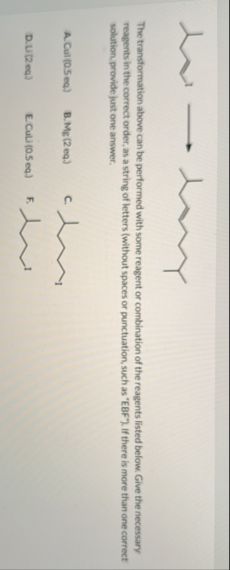 i
x i :
i
E |
f
This is AI generated Response.
Asked by: Rahul
Created at: 2026-01-28 04:01:27
Asked by: Rahul
Created at: 2026-01-28 04:01:27
Final Answer:
Rendered
Raw Text
Did you like this answer?
Let's analyze the transformation step-by-step:
## Step 1: **Identify the Transformation**
**Starting Material:**
A six-carbon chain with a terminal alkyne (triple bond at the end).
**Product:**
A six-carbon chain with a terminal alkene (double bond at the end).
This transformation is **reduction of an alkyne to an alkene**, specifically a **cis-alkene** (Z-alkene), as shown by the product structure.
---
## Step 2: **Recognize the Reagent for Cis-Alkene Formation**
To convert an alkyne to a **cis-alkene**, the classic reagent is **Lindlar's catalyst**, which is a **partially deactivated palladium catalyst** (Pd/CaCO₃, Pb(OAc)₂, and quinoline). This selectively reduces alkynes to cis-alkenes.
**In the choices:**
- **A. (Lindlar's catalyst)**: "G, Lindlar (.5 eq)"
- **B. "Na/NH₃"**: This is a dissolving metal reduction for *trans-alkene* (not the desired product).
- **Others**: Not relevant for selective alkyne reduction to cis-alkene.
---
## Step 3: **Final Answer**
The necessary reagent for this transformation is **G** (Lindlar's catalyst).
### **Answer:**
```
G
```
---
## **Summary Table**
| Step | Reagent Used | Product Type Produced |
|-------------|-----------------------------|-----------------------|
| Alkyne to alkene (cis) | Lindlar's catalyst (G) | Cis-alkene |
| Alkyne to alkene (trans) | Na/NH₃ (B) | Trans-alkene |
**So, the correct answer is:**
**G**
📢 Instructions:
- Ask anything relatd to above question only.
- For new Question goto :