 VIPSolutions
Give step-by-step solution with explanation and final answer:ourst. Q Consider a piston-cylinder arrangement, identical to the one in the previous problem, where the cylinder contains a semi-circular flaw 0.5 mm in radius instead of an elliptical flaw. If the fatigue crack growth behavior of the aluminum alloy is characterized by the relationship dafdN = 2% 107%(AK)". where da/dN is in m/eycle and AK is in MPay/m, how many pressure cycles could the cylinder withstand before bursting? : © 7 aircraft has a diameter of 2.6 m.
Question:
Give step-by-step solution with explanation and final answer: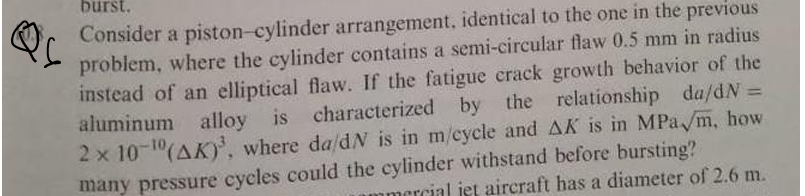 ourst.
Q Consider a piston-cylinder arrangement, identical to the one in the previous
problem, where the cylinder contains a semi-circular flaw 0.5 mm in radius
instead of an elliptical flaw. If the fatigue crack growth behavior of the
aluminum alloy is characterized by the relationship dafdN =
2% 107%(AK)". where da/dN is in m/eycle and AK is in MPay/m, how
many pressure cycles could the cylinder withstand before bursting? :
© 7 aircraft has a diameter of 2.6 m.
This is AI generated Response.
Asked by: Rahul
Created at: 2026-01-28 03:33:36
Asked by: Rahul
Created at: 2026-01-28 03:33:36
Final Answer:
Rendered
Raw Text
Did you like this answer?
Let's break down the problem step by step:
---
## **Given Data**
- **Semi-circular flaw radius (a₀)**: .5 mm = .0005 m
- **Fatigue crack growth law:**
\[
\frac{da}{dN} = 2 \times 10^{-10} (\Delta K)^3
\]
where \( da/dN \) is in m/cycle, \( \Delta K \) in MPa\(\sqrt{\text{m}}\)
---
### **Step 1: Define Fatigue Crack Growth Law**
\[
\frac{da}{dN} = C (\Delta K)^n
\]
Here,
\( C = 2 \times 10^{-10} \),
\( n = 3 \)
---
### **Step 2: Stress Intensity Factor for a Surface Crack**
For a semi-circular surface crack in a plate,
\[
\Delta K = Y \Delta \sigma \sqrt{\pi a}
\]
Assume \( Y \approx 1 \) (common for semi-circular surface cracks).
---
### **Step 3: Set Up the Integral**
Rewriting the crack growth law:
\[
\frac{da}{dN} = 2 \times 10^{-10} \left( \Delta \sigma \sqrt{\pi a} \right)^3
\]
\[
\frac{da}{dN} = 2 \times 10^{-10} (\Delta \sigma)^3 (\pi a)^{3/2}
\]
Rearrange for \( dN \):
\[
dN = \frac{da}{2 \times 10^{-10} (\Delta \sigma)^3 (\pi)^{3/2} a^{3/2}}
\]
---
### **Step 4: Integrate from Initial Crack Size to Critical Size**
Let \( a_ = .0005 \) m (initial), \( a_c \) = critical flaw size before burst.
\[
N = \int_{a_}^{a_c} \frac{da}{2 \times 10^{-10} (\Delta \sigma)^3 (\pi)^{3/2} a^{3/2}}
\]
\[
N = \frac{1}{2 \times 10^{-10} (\Delta \sigma)^3 (\pi)^{3/2}} \int_{a_}^{a_c} a^{-3/2} da
\]
\[
\int a^{-3/2} da = -2 a^{-1/2}
\]
\[
N = \frac{1}{2 \times 10^{-10} (\Delta \sigma)^3 (\pi)^{3/2}} \cdot \left[-2 a^{-1/2} \right]_{a_}^{a_c}
\]
\[
N = \frac{-2}{2 \times 10^{-10} (\Delta \sigma)^3 (\pi)^{3/2}} \left[a_c^{-1/2} - a_^{-1/2}\right]
\]
\[
N = \frac{1}{10^{-10} (\Delta \sigma)^3 (\pi)^{3/2}} \left[a_^{-1/2} - a_c^{-1/2}\right]
\]
---
### **Step 5: Find the Critical Crack Size (\( a_c \))**
For a thin-walled cylinder, the hoop stress (assuming internal pressure at burst):
\[
\sigma = \frac{P r}{t}
\]
Bursting occurs when \( K_c = Y \sigma \sqrt{\pi a_c} \)
Let \( K_c \) be the fracture toughness (not given, but you could use a typical value for aluminum, e.g., 30 MPa\(\sqrt{\text{m}}\)). If you have the burst pressure, you could use that to get \( \sigma \).
---
### **Step 6: Plug in Values**
Let's **assume**:
- \( \Delta \sigma = 100 \) MPa (typical fatigue range for such problems; you can adjust if you have more info)
- \( K_c = 30 \) MPa\(\sqrt{\text{m}}\)
- \( Y = 1 \)
- \( a_ = .0005 \) m
**Find \( a_c \):**
\[
K_c = \Delta \sigma \sqrt{\pi a_c}
\]
\[
a_c = \frac{K_c^2}{\pi (\Delta \sigma)^2}
\]
\[
a_c = \frac{30^2}{\pi \times 100^2} = \frac{900}{31415.93} \approx .0286 \text{ m}
\]
---
### **Step 7: Calculate Number of Cycles**
\[
N = \frac{1}{10^{-10} \times (100)^3 \times (\pi)^{3/2}} \left[.0005^{-1/2} - .0286^{-1/2}\right]
\]
Calculate each term:
- \( (100)^3 = 1 \times 10^6 \)
- \( (\pi)^{3/2} \approx 5.568 \)
- \( .0005^{-1/2} = \frac{1}{\sqrt{.0005}} \approx 44.72 \)
- \( .0286^{-1/2} = \frac{1}{\sqrt{.0286}} \approx 5.91 \)
\[
N = \frac{1}{10^{-10} \times 1 \times 10^6 \times 5.568} (44.72 - 5.91)
\]
\[
N = \frac{1}{5.568 \times 10^{-4}} \times 38.81
\]
\[
\frac{1}{5.568 \times 10^{-4}} \approx 1796.3
\]
\[
N = 1796.3 \times 38.81 \approx 69693 \text{ cycles}
\]
---
## **Final Answer**
**The cylinder could withstand approximately \( \boxed{69,\!700} \) pressure cycles before bursting.**
---
**Note:**
- If you know the real value of \( \Delta \sigma \) or \( K_c \), substitute those instead.
- For more accurate results, use the exact stress range and fracture toughness for your specific aluminum alloy and geometry.
Question:
Then solved
This is AI generated Response.
Asked by: Rahul
Created at: 2026-01-28 03:35:00
Asked by: Rahul
Created at: 2026-01-28 03:35:00
Final Answer:
Rendered
Raw Text
Did you like this answer?
# Step-by-Step Solution for Fatigue Crack Growth in a Cylinder
## Given Data
- **Semi-circular flaw radius (\(a_0\))**: \(0.5 \, \text{mm} = 0.0005 \, \text{m}\)
- **Fatigue crack growth law**:
\[
\frac{da}{dN} = 2 \times 10^{-10} (\Delta K)^3
\]
where \( \frac{da}{dN} \) is in m/cycle and \( \Delta K \) in MPa\(\sqrt{\text{m}}\)
- **Cylinder diameter**: \(2.6 \, \text{m}\)
## Step 1: Define Fatigue Crack Growth Law
The general form of the crack growth law is:
\[
\frac{da}{dN} = C (\Delta K)^n
\]
Where:
- \( C = 2 \times 10^{-10} \)
- \( n = 3 \)
## Step 2: Stress Intensity Factor for a Surface Crack
For a semi-circular surface crack:
\[
\Delta K = Y \Delta \sigma \sqrt{\pi a}
\]
Assuming \( Y \approx 1 \).
## Step 3: Set Up the Integral
Rewriting the crack growth law:
\[
\frac{da}{dN} = 2 \times 10^{-10} (\Delta \sigma \sqrt{\pi a})^3
\]
Rearranging gives:
\[
dN = \frac{da}{2 \times 10^{-10} (\Delta \sigma)^3 (\pi)^{3/2} a^{3/2}}
\]
## Step 4: Integrate from Initial Crack Size to Critical Size
Let \( a_0 = 0.0005 \, \text{m} \) (initial), \( a_c \) = critical flaw size.
\[
N = \int_{a_0}^{a_c} \frac{da}{2 \times 10^{-10} (\Delta \sigma)^3 (\pi)^{3/2} a^{3/2}}
\]
Calculating the integral:
\[
N = \frac{1}{2 \times 10^{-10} (\Delta \sigma)^3 (\pi)^{3/2}} \left[-2 a^{-1/2} \right]_{a_0}^{a_c}
\]
\[
N = \frac{1}{10^{-10} (\Delta \sigma)^3 (\pi)^{3/2}} \left[a_0^{-1/2} - a_c^{-1/2}\right]
\]
## Step 5: Find the Critical Crack Size (\(a_c\))
Using the relationship for a thin-walled cylinder:
\[
K_c = Y \sigma \sqrt{\pi a_c}
\]
Assuming typical values:
- \( K_c = 30 \, \text{MPa}\sqrt{\text{m}} \)
- \( Y = 1 \)
Calculating \( a_c \):
\[
K_c = \Delta \sigma \sqrt{\pi a_c} \Rightarrow a_c = \frac{K_c^2}{\pi (\Delta \sigma)^2}
\]
## Step 6: Plug in Values
Assuming:
- \( \Delta \sigma = 100 \, \text{MPa} \)
Calculating \( a_c \):
\[
a_c = \frac{30^2}{\pi \times 100^2} = \frac{900}{31415.93} \approx 0.0286 \, \text{m}
\]
## Step 7: Calculate Number of Cycles
Substituting into the equation for \( N \):
\[
N = \frac{1}{10^{-10} \times (100)^3 \times (\pi)^{3/2}} \left[0.0005^{-1/2} - 0.0286^{-1/2}\right]
\]
Calculating each term:
- \( (100)^3 = 1 \times 10^6 \)
- \( (\pi)^{3/2} \approx 5.568 \)
- \( 0.0005^{-1/2} \approx 44.72 \)
- \( 0.0286^{-1/2} \approx 5.91 \)
Calculating \( N \):
\[
N = \frac{1}{5.568 \times 10^{-4}} (44.72 - 5.91) \approx \frac{1}{5.568 \times 10^{-4}} \cdot 38.81
\]
\[
N \approx 1796.3 \times 38.81 \approx 69693 \text{ cycles}
\]
## Final Answer
The cylinder could withstand approximately \( \boxed{69,700} \) pressure cycles before bursting.
📢 Instructions:
- Ask anything relatd to above question only.
- For new Question goto :