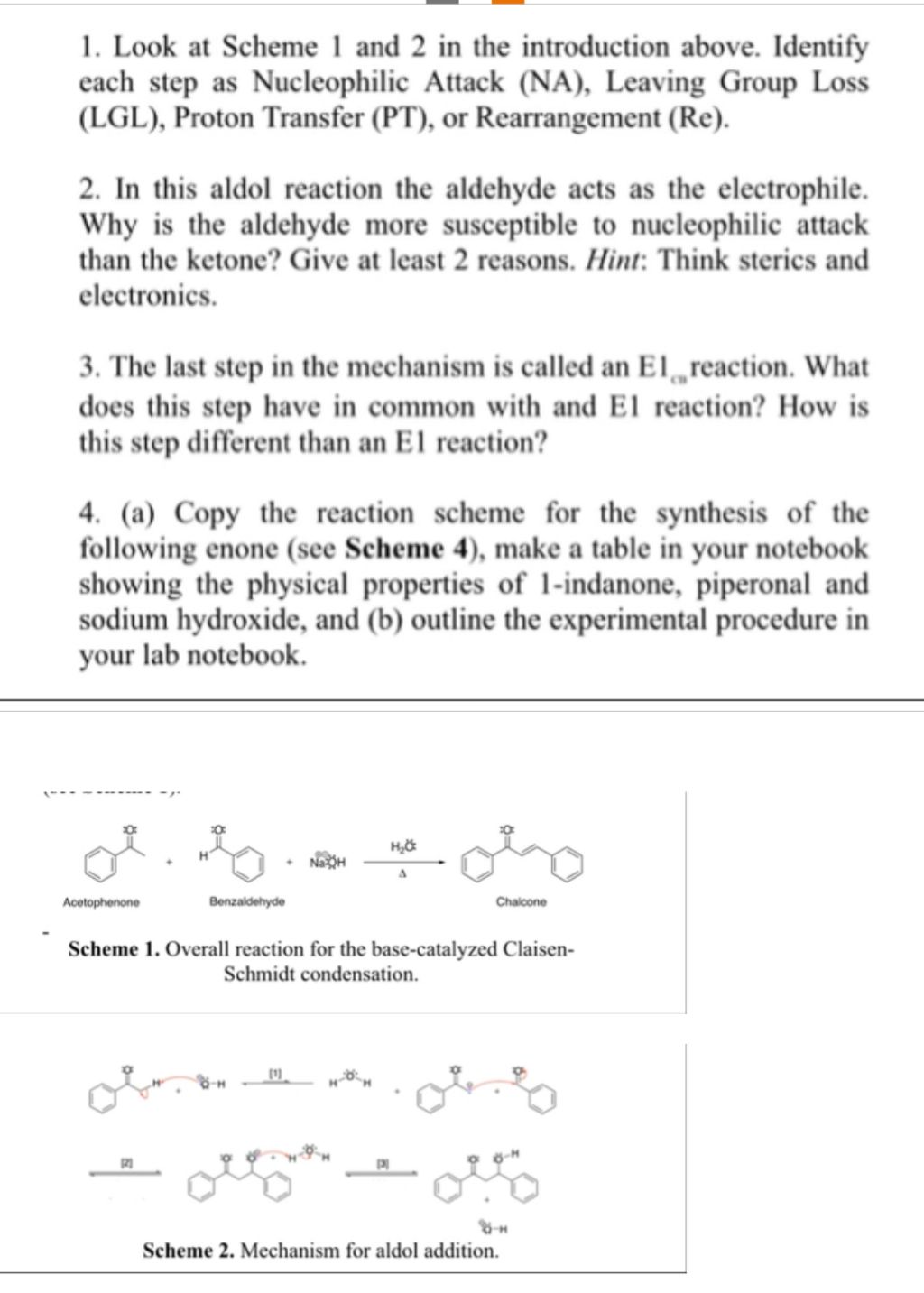
Give step-by-step solution with explanation and final answer:1. Look at Scheme 1 and 2 in the introduction above. Identify
cach step as Nucleophilic Attack (NA), Leaving Group Loss
(LGL), Proton Transfer (PT), or Rearrangement (Re).
2. In this aldol reaction the aldehyde acts as the electrophile.
Why is the aldehyde more susceptible to nucleophilic attack
than the ketone? Give at least 2 reasons. Hint: Think sterics and
electronics.
3. The last step in the mechanism is called an E1_ reaction. What
does this step have in common with and El reaction? How is
this step different than an E1 reaction?
4. (a) Copy the reaction scheme for the synthesis of the
following enone (see Scheme 4), make a table in your notebook
showing the physical properties of I-indanone, piperonal and
sodium hydroxide, and (b) outline the experimental procedure in
your lab notebook.
o X ws oo Pr
Cable s REEL
Acetophenone ‘Benzaidehyde Chaicone
"Scheme 1. Overall reaction for the base-catalyzed Claisen-
Schmidt condensation.
i Or o —da i JO. |
g*"’ ha "gg
- Ie ¢ , o » oo
oO O70
Gon
Scheme 2. Mechanism for aldol addition.
Question:
Give step-by-step solution with explanation and final answer:1. Look at Scheme 1 and 2 in the introduction above. Identify
cach step as Nucleophilic Attack (NA), Leaving Group Loss
(LGL), Proton Transfer (PT), or Rearrangement (Re).
2. In this aldol reaction the aldehyde acts as the electrophile.
Why is the aldehyde more susceptible to nucleophilic attack
than the ketone? Give at least 2 reasons. Hint: Think sterics and
electronics.
3. The last step in the mechanism is called an E1_ reaction. What
does this step have in common with and El reaction? How is
this step different than an E1 reaction?
4. (a) Copy the reaction scheme for the synthesis of the
following enone (see Scheme 4), make a table in your notebook
showing the physical properties of I-indanone, piperonal and
sodium hydroxide, and (b) outline the experimental procedure in
your lab notebook.
o X ws oo Pr
Cable s REEL
Acetophenone ‘Benzaidehyde Chaicone
"Scheme 1. Overall reaction for the base-catalyzed Claisen-
Schmidt condensation.
i Or o —da i JO. |
g*"’ ha "gg
- Ie ¢ , o » oo
oO O70
Gon
Scheme 2. Mechanism for aldol addition.
This is AI generated Response.
Asked by: Rahul
Created at: 2026-01-28 03:25:20
Final Answer:
RenderedRaw Text
Did you like this answer?
Let's address each question step-by-step, referencing **Scheme 1** and **Scheme 2** as shown in your images.
---
# 1. Identify Each Step (NA, LGL, PT, Re) in Scheme 2
Let's break down the steps in **Scheme 2** (Aldol Addition Mechanism):
## Step 1
- **Action:** The base (OH⁻) abstracts an α-hydrogen from acetophenone, forming an enolate ion.
- **Type:** **Proton Transfer (PT)**
## Step 2
- **Action:** The enolate (nucleophile) attacks the carbonyl carbon of benzaldehyde (electrophile).
- **Type:** **Nucleophilic Attack (NA)**
## Step 3
- **Action:** The resulting alkoxide ion is protonated by water, forming the β-hydroxy ketone (aldol).
- **Type:** **Proton Transfer (PT)**
## Step 4
- **Action:** Under heat, the β-hydroxy ketone eliminates water to form the α,β-unsaturated ketone (chalcone).
- **Type:** **Leaving Group Loss (LGL)** (since water leaves; this step is part of the E1cb mechanism)
---
# 2. Why Is Aldehyde More Susceptible to Nucleophilic Attack Than Ketone?
**Two main reasons:**
### a) **Steric Factors:**
- **Aldehyde:** Has one hydrogen and one alkyl/aryl group attached to the carbonyl carbon, so less steric hindrance.
- **Ketone:** Has two alkyl/aryl groups, causing more crowding and hindrance for the nucleophile.
### b) **Electronic Factors:**
- **Aldehyde:** Only one electron-donating group (R group), so carbonyl carbon is more **electron-deficient** and more electrophilic.
- **Ketone:** Two electron-donating groups reduce the partial positive charge on carbonyl carbon, making it less electrophilic.
---
# 3. E1cb vs. E1: Similarities and Differences
### **Commonality:**
- Both involve the **loss of a leaving group** (in this case, water) and formation of a double bond.
### **Differences:**
- **E1cb:** The **base removes a proton first** to generate a carbanion intermediate, then the leaving group departs.
- **E1:** The leaving group leaves first, forming a carbocation intermediate, which then loses a proton.
**Summary Table:**
| | E1cb | E1 |
|------------------|-------------------------------|------------------------------|
| Intermediate | Carbanion | Carbocation |
| First Step | Proton is removed | Leaving group departs |
| Second Step | Leaving group departs | Proton is removed |
| Example Here | Aldol condensation dehydration | Simple alcohol dehydration |
---
# 4. (a) Physical Properties Table for 1-Indanone, Piperonal, NaOH
| Compound | Molecular Formula | Molar Mass (g/mol) | Melting Point (°C) | Boiling Point (°C) | Appearance |
|---------------|------------------|--------------------|--------------------|--------------------|-------------------|
| 1-Indanone | C9H8O | 132.16 | 60-62 | 260-262 | White solid |
| Piperonal | C8H6O3 | 150.13 | 36-38 | 263 | White crystalline |
| Sodium Hydroxide | NaOH | 40.00 | 318 | 139 (decomposes) | White solid |
---
# 4. (b) Experimental Procedure Outline
1. **Mix Reactants:** Combine 1-indanone and piperonal in a flask.
2. **Add Base:** Add aqueous sodium hydroxide dropwise while stirring.
3. **Reaction:** Stir the mixture at room temperature (or gently heat if needed) for the required time.
4. **Workup:** Quench the reaction with water and acidify if needed.
5. **Isolation:** Collect the precipitate by filtration.
6. **Purification:** Recrystallize the product from ethanol or another suitable solvent.
7. **Dry Product:** Dry the purified enone and record yield and melting point.
---
## **Summary Table of Steps for Scheme 2**
| Step | Mechanism Step | Type |
|------|-----------------------|--------------------|
| 1 | Enolate formation | PT |
| 2 | Attack on aldehyde | NA |
| 3 | Protonation | PT |
| 4 | Dehydration | LGL (E1cb) |
---
**Let me know if you need a full mechanism drawing or more details for any step!**
VIPSolutions focuses on clear, step‑by‑step explanations so you can learn quickly. Whether you need an AI‑generated walkthrough or a short hint to get unstuck, each solution is organized for fast reading and easy review later.
Search similar questions, compare approaches, and bookmark the best answers for revision. Our goal is simple: quick, reliable study help that feels natural—not noisy.
 VIPSolutions
 1. Look at Scheme 1 and 2 in the introduction above. Identify
cach step as Nucleophilic Attack (NA), Leaving Group Loss
(LGL), Proton Transfer (PT), or Rearrangement (Re).
2. In this aldol reaction the aldehyde acts as the electrophile.
Why is the aldehyde more susceptible to nucleophilic attack
than the ketone? Give at least 2 reasons. Hint: Think sterics and
electronics.
3. The last step in the mechanism is called an E1_ reaction. What
does this step have in common with and El reaction? How is
this step different than an E1 reaction?
4. (a) Copy the reaction scheme for the synthesis of the
following enone (see Scheme 4), make a table in your notebook
showing the physical properties of I-indanone, piperonal and
sodium hydroxide, and (b) outline the experimental procedure in
your lab notebook.
o X ws oo Pr
Cable s REEL
Acetophenone ‘Benzaidehyde Chaicone
"Scheme 1. Overall reaction for the base-catalyzed Claisen-
Schmidt condensation.
i Or o —da i JO. |
g*"’ ha "gg
- Ie ¢ , o » oo
oO O70
Gon
Scheme 2. Mechanism for aldol addition.