VIPSolutions logo ✨ VIPSolutions

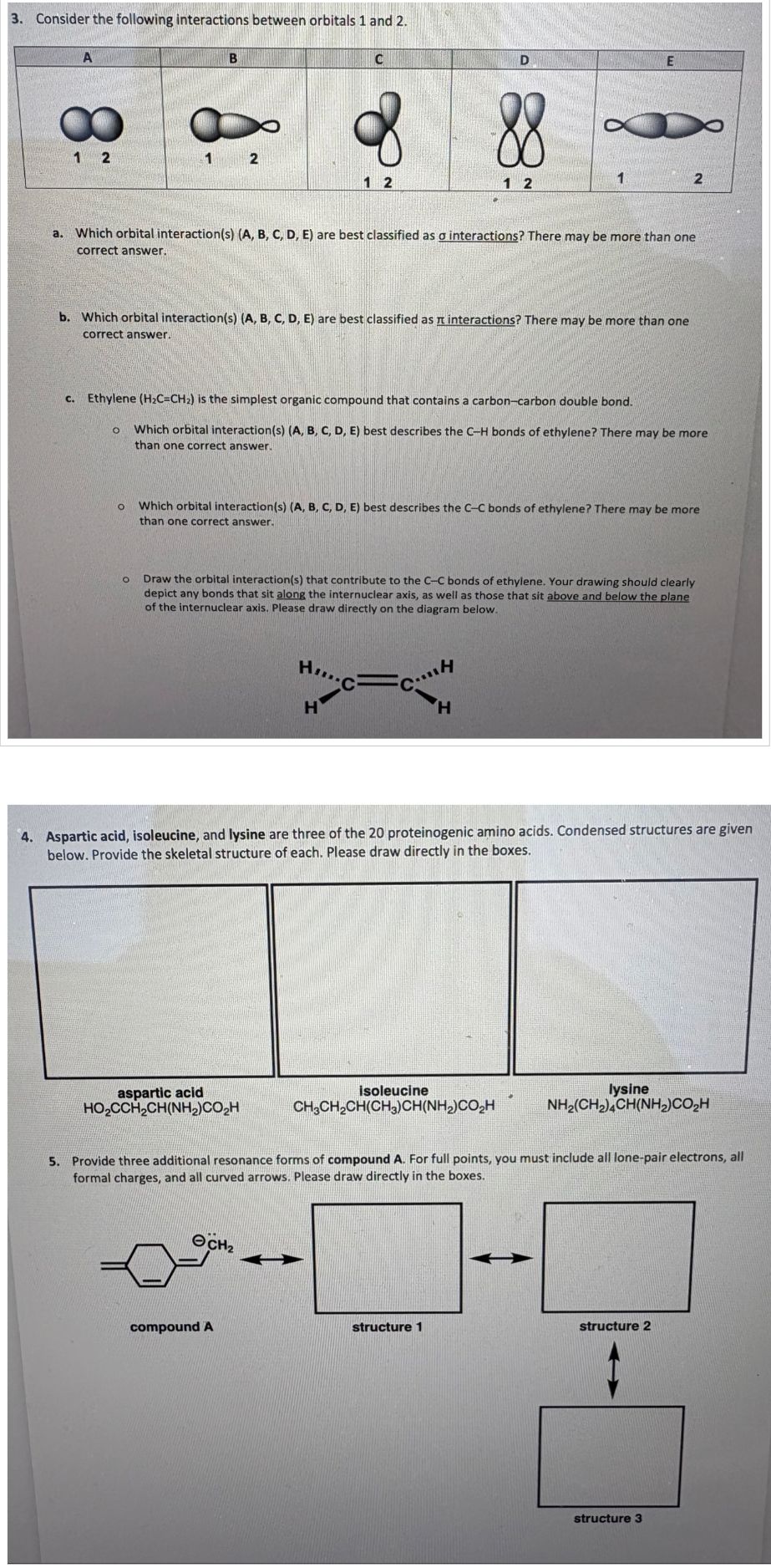
Give step-by-step solution with explanation and final answer:3. Consider the folowing Interactions between orbitals 1and 2. i fil | EH oe a ; hl I Bi 1 [Be li) i B12 i TH) i I ne | wT tn i Re] wor | — 1.2 12 eb en Be oC oe eo) (A,B, C,D, E) are best classified as g interactions? There. may be more than ane a il En es BE ce EE |B Whol mractont) (85. BB) ar best las as nractions? Thre maybe he Co Shenae EEE | 0 RES he TE a AE Jet EE Coe | Lo ce | a CGE Ce i ne i ia re aoe organic compound that contains a carbon-carbon double ond. a ee Ud vot 1,0. st ss srs rt Te 0 anon comactaagwer | TEE RE a i rim ERR RE Cone RR ne i \ dR (RRR EEE Ge i Hl hi RR LL I W i IL I Ll i Cl CLS re) (8 Fl brs eset the Co bonds Eien Sp es ih ! | [ne ada) ; Le UIC AE eh Ae i Aspartic acid, isaleucine, and lysine are three of the 20 proteinogenic amino acids. Condensed structures are given I ; below. Provide the skeletal structure of each, Please draw directly in the boxes. I i EE | a . | ssparticacid Isoleucine | [ET | HOLCCH,CHINH,COH CHACH,CH(CHS)CHNH,)COH NHACHICHNHICOH eE pee © 5. Provide three additonal resonance forms of compound A. For ull points, you must include al lone pai electrons, all © formal charges, and ll curved arrows. Please craw directly nthe boxes ih oo I Le a ff en (HE = Oo el wm Te EE TERE oN LL aa LH hrm ile EERE re HE iE i heim . nn LL Ih Cl fii bet ani hn dn i REA ltt AGAR Hil ji ps i EER

Question:

Give step-by-step solution with explanation and final answer:Uploaded Image3. Consider the folowing Interactions between orbitals 1and 2. i fil | EH oe a ; hl I Bi 1 [Be li) i B12 i TH) i I ne | wT tn i Re] wor | — 1.2 12 eb en Be oC oe eo) (A,B, C,D, E) are best classified as g interactions? There. may be more than ane a il En es BE ce EE |B Whol mractont) (85. BB) ar best las as nractions? Thre maybe he Co Shenae EEE | 0 RES he TE a AE Jet EE Coe | Lo ce | a CGE Ce i ne i ia re aoe organic compound that contains a carbon-carbon double ond. a ee Ud vot 1,0. st ss srs rt Te 0 anon comactaagwer | TEE RE a i rim ERR RE Cone RR ne i \ dR (RRR EEE Ge i Hl hi RR LL I W i IL I Ll i Cl CLS re) (8 Fl brs eset the Co bonds Eien Sp es ih ! | [ne ada) ; Le UIC AE eh Ae i Aspartic acid, isaleucine, and lysine are three of the 20 proteinogenic amino acids. Condensed structures are given I ; below. Provide the skeletal structure of each, Please draw directly in the boxes. I i EE | a . | ssparticacid Isoleucine | [ET | HOLCCH,CHINH,COH CHACH,CH(CHS)CHNH,)COH NHACHICHNHICOH eE pee © 5. Provide three additonal resonance forms of compound A. For ull points, you must include al lone pai electrons, all © formal charges, and ll curved arrows. Please craw directly nthe boxes ih oo I Le a ff en (HE = Oo el wm Te EE TERE oN LL aa LH hrm ile EERE re HE iE i heim . nn LL Ih Cl fii bet ani hn dn i REA ltt AGAR Hil ji ps i EER
This is AI generated Response.
Asked by: Rahul
Created at: 2026-01-28 03:22:40

Final Answer:

Rendered Raw Text
Did you like this answer?
Let's break down the questions **step by step** and provide detailed solutions. --- ## **3. Orbital Interactions** ### **a. Which orbital interaction(s) (A, B, C, D, E) are best classified as σ interactions?** **Sigma (σ) bonds** occur when orbitals overlap along the internuclear axis (end-to-end). - **A:** Two s orbitals overlap end-to-end (σ) - **B:** An s and a p orbital overlap end-to-end (σ) - **E:** Two p orbitals overlap end-to-end (σ) **Answer:** **A, B, E** --- ### **b. Which orbital interaction(s) (A, B, C, D, E) are best classified as π interactions?** **Pi (π) bonds** occur when p orbitals overlap side-by-side (above and below the axis). - **C:** Two p orbitals overlap side-by-side (π) - **D:** Two p orbitals overlap side-by-side, but out of phase (antibonding π*) **Answer:** **C, D** --- ### **c. Ethylene (H₂C=CH₂):** #### **i. Which orbital interaction(s) (A, B, C, D, E) best describe the C–H bonds of ethylene?** - **C–H bonds** are **σ bonds** formed by the overlap of an sp² (from C) and s (from H). So, **A (s-s overlap)** and **B (s-p overlap)** best represent this. **Answer:** **A, B** #### **ii. Which orbital interaction(s) (A, B, C, D, E) best describe the C–C bonds of ethylene?** - Ethylene has a **double bond (C=C)**: - One **σ bond** (sp²-sp² overlap, which is like E: p-p end-to-end) - One **π bond** (p-p side-by-side, like C) **Answer:** **C (π bond), E (σ bond)** #### **iii. Draw the orbital interactions that contribute to the C–C bonds of ethylene.** **Draw directly on the diagram:** - Draw a **σ bond** as an end-to-end overlap between two sp² orbitals along the axis. - Draw a **π bond** as a side-by-side overlap (above and below the plane) between two unhybridized p orbitals. --- ## **4. Skeletal Structures of Amino Acids** ### **Aspartic acid (HO₂CCH₂CH(NH₂)CO₂H)** - Draw a chain: O=C-OH | CH₂ | CH(NH₂) | COOH ### **Isoleucine (CH₃CH₂CH(CH₃)CH(NH₂)CO₂H)** - Draw a backbone: COOH—CH(NH₂)—CH(CH₃)—CH₂—CH₃ ### **Lysine (NH₂(CH₂)₄CH(NH₂)CO₂H)** - Draw a backbone: COOH—CH(NH₂)—(CH₂)₄—NH₂ --- ## **5. Resonance Forms of Compound A** - Move the negative charge and double bonds around the ring according to resonance rules. - Each resonance form should move the negative charge and the double bond by one position. - Show all lone pairs, formal charges, and curved arrows for electron movement. --- ### **Summary Table** | Question | Answer | |---------------------|-----------------------------------------------------| | 3a (σ interactions) | **A, B, E** | | 3b (π interactions) | **C, D** | | 3c (C-H bonds) | **A, B** | | 3c (C-C bonds) | **C, E** | | 4 (structures) | Draw skeletal structures as described above | | 5 (resonance) | Draw 3 resonance forms with charges/arrows shown | --- ### **Visuals** **(If you need the drawings for #4 and #5, let me know and I'll provide those structures as images!)** Let me know if you need direct drawings for any part!

📢 Instructions:

  • Ask anything relatd to above question only.
  • For new Question goto :

Study Help, Fast Answers

VIPSolutions focuses on clear, step‑by‑step explanations so you can learn quickly. Whether you need an AI‑generated walkthrough or a short hint to get unstuck, each solution is organized for fast reading and easy review later.

Search similar questions, compare approaches, and bookmark the best answers for revision. Our goal is simple: quick, reliable study help that feels natural—not noisy.