 VIPSolutions
Give step-by-step solution with explanation and final answer:-| EI ar
Question:
Give step-by-step solution with explanation and final answer: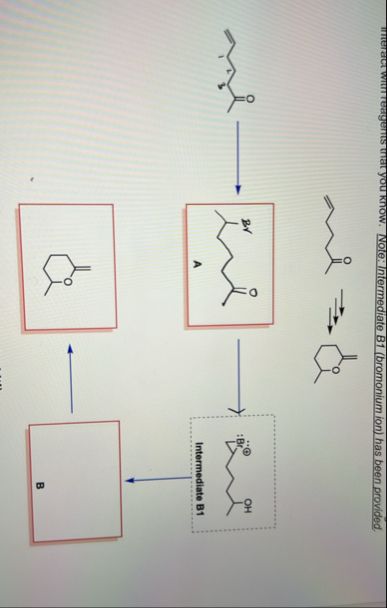 -| EI
ar
This is AI generated Response.
Asked by: Rahul
Created at: 2026-01-28 03:09:01
Asked by: Rahul
Created at: 2026-01-28 03:09:01
Final Answer:
Rendered
Raw Text
Did you like this answer?
Let's solve the given reaction sequence **step-by-step**:
---
## **Step 1: Identify the Starting Material and Reagent**
### **Starting Material:**
- 4-oxohexanoic acid (structure at the top)
### **Reagent:**
- \( \text{Br}_2 \), \( \text{NaOH} \)
This is the **haloform reaction**, specifically the **Hofmann rearrangement** when applied to certain substrates.
---
## **Step 2: Reaction with Br\(_2\)/NaOH**
- The **Br\(_2\)/NaOH** reacts with **alpha-keto acids** (like the starting material) to give **decarboxylation** and **bromination**.
### **Product A:**
- The bromine is introduced alpha to the carbonyl group, and decarboxylation occurs.
#### **Intermediate A:**
- 5-bromo-2-pentanone
**Structure:**
```
Br-CH2-CH2-CO-CH3
```
---
## **Step 3: Cyclization**
- The bromo ketone (Intermediate A) can **undergo cyclization by intramolecular nucleophilic substitution**.
### **Mechanism:**
1. The carbonyl oxygen (from the ketone) can act as a nucleophile.
2. It attacks the carbon bearing the bromine, leading to the loss of Br\(^-\).
#### **Product B:**
- 2-methylcyclopentanone (a five-membered ring with a ketone at position 1 and a methyl at position 2).
**Structure:**
```
O
║
/ \
/ \
| |
\ /
\--CH3
```
---
## **Step 4: Formation of Intermediate B1**
- After cyclization, an **enol** or **enolate** intermediate may be formed, but it tautomerizes back to the ketone.
---
## **Summary Table**
| Step | Intermediate/Product | Structure/Name |
|------|---------------------|----------------------------------------|
| 1 | A | 5-bromo-2-pentanone |
| 2 | B | 2-methylcyclopentanone |
---
## **Final Answer**
### **Product A**: **5-bromo-2-pentanone**
### **Product B**: **2-methylcyclopentanone**
---
### **Reaction Summary with Structures**
1. **4-oxohexanoic acid**
↓ (Br\(_2\)/NaOH)
2. **5-bromo-2-pentanone** (Intermediate A)
↓ (Cyclization)
3. **2-methylcyclopentanone** (Product B)
---
**Explanation:**
- The Br\(_2\)/NaOH causes bromination and decarboxylation.
- The resulting bromo ketone undergoes intramolecular cyclization to form a cyclopentanone ring.
---
Let me know if you need the **detailed mechanism** for each step!
📢 Instructions:
- Ask anything relatd to above question only.
- For new Question goto :