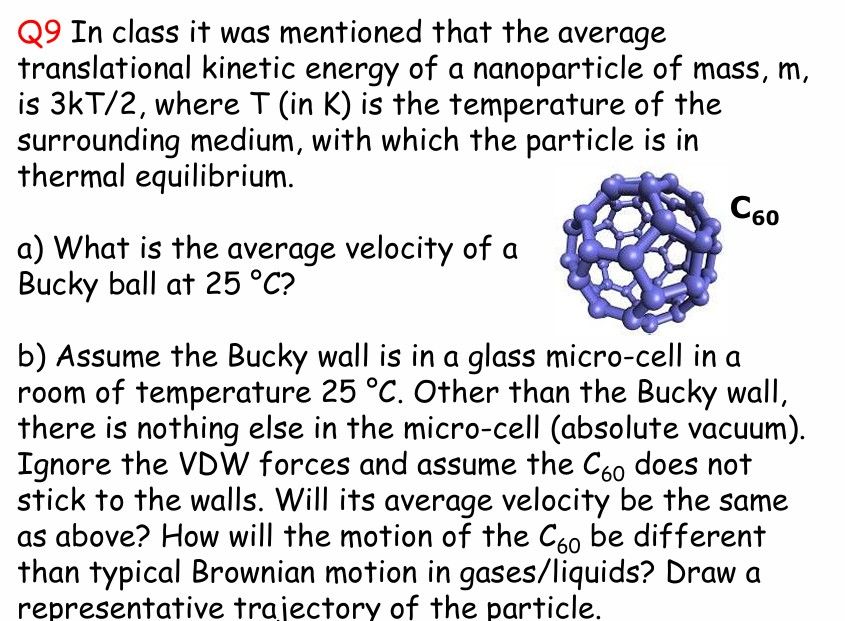
Give step-by-step solution with explanation and final answer:Q9 In class it was mentioned that the average
translational kinetic energy of a hanoparticle of mass, m,
is 3kT/2, where T (in K) is the temperature of the
surrounding medium, with which the particle is in
thermal equilibrium. Sab
ERNE
STIS Coo
a) What is the average velocity of a Sg) +
Bucky ball at 25 °C? RJA
De®
b) Assume the Bucky wall is in a glass micro-cell ina
room of temperature 25 °C. Other than the Bucky wall,
there is nothing else in the micro-cell (absolute vacuum).
Ignore the VDW forces and assume the C4q does not
stick to the walls. Will its average velocity be the same
as above? How will the motion of the Cg, be different
than typical Brownian motion in gases/liquids? Draw a
representative traiectory of the particle.
Question:
Give step-by-step solution with explanation and final answer:Q9 In class it was mentioned that the average
translational kinetic energy of a hanoparticle of mass, m,
is 3kT/2, where T (in K) is the temperature of the
surrounding medium, with which the particle is in
thermal equilibrium. Sab
ERNE
STIS Coo
a) What is the average velocity of a Sg) +
Bucky ball at 25 °C? RJA
De®
b) Assume the Bucky wall is in a glass micro-cell ina
room of temperature 25 °C. Other than the Bucky wall,
there is nothing else in the micro-cell (absolute vacuum).
Ignore the VDW forces and assume the C4q does not
stick to the walls. Will its average velocity be the same
as above? How will the motion of the Cg, be different
than typical Brownian motion in gases/liquids? Draw a
representative traiectory of the particle.
This is AI generated Response.
Asked by: Rahul
Created at: 2026-01-28 03:06:07
Final Answer:
RenderedRaw Text
Did you like this answer?
# Solution to Q9
Let's solve each part step-by-step.
---
## a) **Average velocity of a Bucky ball at 25°C**
### **Given:**
- Average kinetic energy = \( \frac{3kT}{2} \)
- Mass of nanoparticle = \( m \)
- Temperature \( T = 25^\circ \text{C} = 298 \text{ K} \)
- \( C_{60} \) (Bucky ball) has molecular mass: \( 60 \times 12 = 720 \) amu
- 1 amu \( = 1.66 \times 10^{-27} \) kg
- Boltzmann constant \( k = 1.38 \times 10^{-23} \) J/K
### **Step 1: Calculate the mass of one Bucky ball**
\[
m = 720 \times 1.66 \times 10^{-27} \ \text{kg}
\]
\[
m = 1.195 \times 10^{-24} \ \text{kg}
\]
---
### **Step 2: Relate kinetic energy to velocity**
The average translational kinetic energy is:
\[
\frac{1}{2} m v^2 = \frac{3}{2} kT
\]
\[
v^2 = \frac{3kT}{m}
\]
\[
v = \sqrt{\frac{3kT}{m}}
\]
---
### **Step 3: Plug in the values**
\[
v = \sqrt{\frac{3 \times 1.38 \times 10^{-23} \times 298}{1.195 \times 10^{-24}}}
\]
\[
= \sqrt{\frac{1.23318 \times 10^{-20}}{1.195 \times 10^{-24}}}
\]
\[
= \sqrt{1.032 \times 10^{4}}
\]
\[
= 101.6 \ \text{m/s}
\]
**Final Answer (a):**
> The average velocity of a Bucky ball at 25°C is **~102 m/s**.
---
## b) **Bucky ball in a vacuum micro-cell**
### **Scenario:**
- Bucky ball in a glass micro-cell, at 25°C, but in vacuum (no other particles).
- Ignore van der Waals (VDW) forces.
- Will its average velocity be the same as above?
---
### **Explanation:**
- In the first case, the Bucky ball is in thermal equilibrium with the medium (gas/liquid), so it has a thermal velocity as calculated above.
- In the vacuum (second case), there are **no collisions** with other particles, so the Bucky ball cannot exchange energy with the environment.
- If initially at rest, it will **remain at rest**; if given some initial velocity, it will continue at that velocity (no friction).
- **Average velocity will NOT be the same as above** — it will be constant, determined by initial conditions, not by temperature.
- **No Brownian motion** will be seen, since Brownian motion arises from collisions with molecules in the medium.
---
### **Trajectory Comparison:**
#### - **In Gas/Liquid (Brownian motion):**
- The Bucky ball’s path is a **random walk** due to continuous collisions with molecules.
- Path: Jagged, erratic (see example sketch below).
#### - **In Vacuum (Micro-cell):**
- The Bucky ball travels in a **straight line** until it hits a wall, then bounces (elastic collision).
- Path: Straight lines between wall bounces (see example sketch below).
---
#### **Trajectory Sketch:**
```plaintext
Brownian motion (Gas/Liquid): Vacuum (Micro-cell):
_/\__/\_/\/\_/\/\_\_/ -------------------
/ \_/ \_/ | |
/ /\_/ \/ /\ \ | \ / |
\_/\/ \_/ \/ \_/ | \_______/ |
| |
-------------------
```
---
### **Summary Table**
| Case | Average Velocity | Path/Trajectory |
|--------------------|-----------------|---------------------------|
| Gas/Liquid | ~102 m/s | Random, Brownian motion |
| Vacuum (Micro-cell)| Undefined/Constant | Straight lines between walls |
---
## **Final Answers**
### **a)**
- The average velocity of a Bucky ball at 25°C is **~102 m/s**.
### **b)**
- In a vacuum, the Bucky ball will **not exhibit the same average velocity** as above; its velocity will be constant (set by initial conditions).
- The motion will be **straight-line** between elastic collisions with the walls, unlike the **random Brownian motion** seen in gas/liquid.
- **Trajectory:** Straight lines with bounces at the walls (not random walk).
VIPSolutions focuses on clear, step‑by‑step explanations so you can learn quickly. Whether you need an AI‑generated walkthrough or a short hint to get unstuck, each solution is organized for fast reading and easy review later.
Search similar questions, compare approaches, and bookmark the best answers for revision. Our goal is simple: quick, reliable study help that feels natural—not noisy.
 VIPSolutions
 Q9 In class it was mentioned that the average
translational kinetic energy of a hanoparticle of mass, m,
is 3kT/2, where T (in K) is the temperature of the
surrounding medium, with which the particle is in
thermal equilibrium. Sab
ERNE
STIS Coo
a) What is the average velocity of a Sg) +
Bucky ball at 25 °C? RJA
De®
b) Assume the Bucky wall is in a glass micro-cell ina
room of temperature 25 °C. Other than the Bucky wall,
there is nothing else in the micro-cell (absolute vacuum).
Ignore the VDW forces and assume the C4q does not
stick to the walls. Will its average velocity be the same
as above? How will the motion of the Cg, be different
than typical Brownian motion in gases/liquids? Draw a
representative traiectory of the particle.