 VIPSolutions
Give step-by-step solution with explanation and final answer: {give me the answer without using bullet-points}A steel sphere is cooled in water. Given: e Diameter D = 5 cm « Density: p = 7800 kg/m? « Heat capacity C,= 460 J/kgK » Thermal conductivity k = 45 W/m-K « Convective coefficient h = 600 W/m® K Temperatures: « Initial T; = 400°C * Water temperature T; =50°C Tasks: (i) Calculate the Biot number and justify Jumped analysis. ii) Write the transient temperature equation. iii) Time required to reach T = 150°C. iv) Time constant of cooling. v) Effect if diameter is doublufed.
Question:
Give step-by-step solution with explanation and final answer:
{give me the answer without using bullet-points}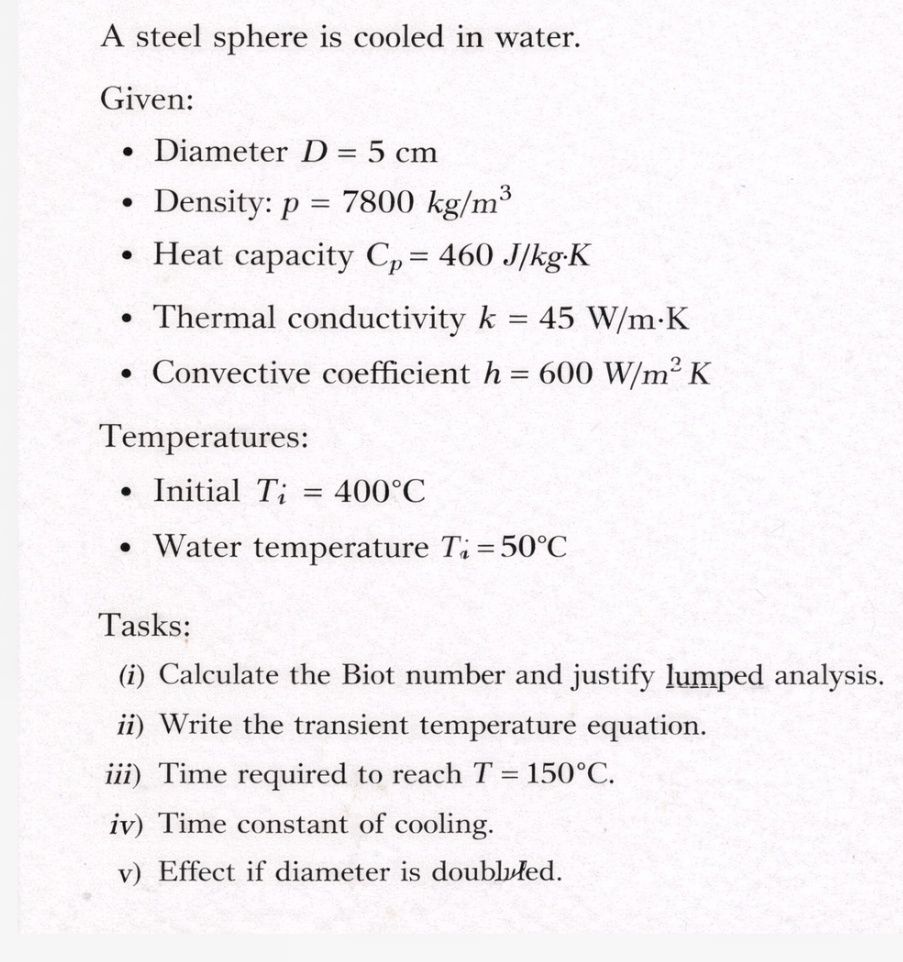 A steel sphere is cooled in water.
Given:
e Diameter D = 5 cm
« Density: p = 7800 kg/m?
« Heat capacity C,= 460 J/kgK
» Thermal conductivity k = 45 W/m-K
« Convective coefficient h = 600 W/m® K
Temperatures:
« Initial T; = 400°C
* Water temperature T; =50°C
Tasks:
(i) Calculate the Biot number and justify Jumped analysis.
ii) Write the transient temperature equation.
iii) Time required to reach T = 150°C.
iv) Time constant of cooling.
v) Effect if diameter is doublufed.
This is AI generated Response.
Asked by: Francis
Created at: 2026-01-27 13:37:35
Asked by: Francis
Created at: 2026-01-27 13:37:35
Final Answer:
Rendered
Raw Text
Did you like this answer?
Let's solve the problem step by step:
### (i) Calculate the Biot number and justify lumped analysis
The Biot number is given by:
\[
Bi = \frac{hL_c}{k}
\]
For a sphere, the characteristic length \(L_c = \frac{V}{A} = \frac{r}{3}\) (where \(r\) is the radius). Here, \(D = 5\,\text{cm} = .05\,\text{m}\), so \(r = .025\,\text{m}\).
\[
L_c = \frac{.025}{3} = .00833\,\text{m}
\]
Substitute values:
\[
Bi = \frac{600 \times .00833}{45} = \frac{4.998}{45} \approx .11
\]
Since \(Bi < .1\) is the strict criterion for lumped analysis, and our value is very close (.11), lumped analysis is approximately valid. For engineering purposes, this is usually acceptable.
---
### (ii) Write the transient temperature equation
For lumped capacitance (lumped parameter model):
\[
\frac{T(t) - T_\infty}{T_i - T_\infty} = \exp\left(-\frac{hA}{\rho V C_p} t\right)
\]
For a sphere:
- \(V = \frac{4}{3} \pi r^3\)
- \(A = 4 \pi r^2\)
So,
\[
\frac{A}{V} = \frac{4 \pi r^2}{\frac{4}{3} \pi r^3} = \frac{3}{r}
\]
Therefore,
\[
\frac{T(t) - T_\infty}{T_i - T_\infty} = \exp\left(-\frac{h (3/r)}{\rho C_p} t\right)
\]
---
### (iii) Time required to reach \(T = 150^\circ \mathrm{C}\)
Given:
- \(T_i = 400^\circ \mathrm{C}\)
- \(T_\infty = 50^\circ \mathrm{C}\)
- \(T(t) = 150^\circ \mathrm{C}\)
- \(h = 600\,\mathrm{W/m^2K}\)
- \(r = .025\,\mathrm{m}\)
- \(\rho = 780\,\mathrm{kg/m^3}\)
- \(C_p = 460\,\mathrm{J/kg\,K}\)
Plug in the numbers:
\[
\frac{T(t) - T_\infty}{T_i - T_\infty} = \frac{150 - 50}{400 - 50} = \frac{100}{350} = .2857
\]
Take the natural log:
\[
\ln(.2857) = -1.2528
\]
Set up the exponent:
\[
-\frac{h (3/r)}{\rho C_p} t = -1.2528
\]
\[
\frac{h (3/r)}{\rho C_p} t = 1.2528
\]
Calculate the coefficient:
\[
\frac{h (3/r)}{\rho C_p} = \frac{600 \times 3/.025}{780 \times 460}
\]
\[
= \frac{600 \times 120}{358800}
\]
\[
= \frac{72000}{358800} \approx .02007
\]
So,
\[
.02007 t = 1.2528
\]
\[
t = \frac{1.2528}{.02007} \approx 62.4\, \text{seconds}
\]
---
### (iv) Time constant of cooling
The time constant \(\tau\) is:
\[
\tau = \frac{\rho V C_p}{hA} = \frac{r}{3} \frac{\rho C_p}{h}
\]
Or, using the previously derived rate constant:
\[
\tau = \frac{1}{\frac{h (3/r)}{\rho C_p}} = \frac{\rho C_p r}{3h}
\]
Plug in the values:
\[
\tau = \frac{780 \times 460 \times .025}{3 \times 600}
\]
\[
= \frac{89700}{180} = 49.72 \,\text{seconds}
\]
---
### (v) Effect if diameter is doubled
If \(D\) is doubled, \(r\) is doubled. The Biot number will also double, making the lumped analysis less accurate (since Biot number will exceed .2). The time constant \(\tau\) will also double, since \(\tau \propto r\). Thus, cooling will take longer.
---
## **Final Answers**
1. The Biot number is **.11**; lumped analysis is marginally valid.
2. The transient temperature equation: \
\[
\frac{T(t) - T_\infty}{T_i - T_\infty} = \exp\left(-\frac{h (3/r)}{\rho C_p} t\right)
\]
3. Time required to reach \(T = 150^\circ C\) is **62.4 seconds**.
4. Time constant of cooling is **49.7 seconds**.
5. If diameter is doubled, the Biot number and time constant both double, so the lumped parameter model becomes less valid and cooling takes longer.
📢 Instructions:
- Ask anything relatd to above question only.
- For new Question goto :