 VIPSolutions
Give step-by-step solution with explanation and final answer: {give me the answer without using bullet-points}An adiabatic packed bed reactor (PBR) is used for the complex network A — B (exothermic), A — C (endothermic), and B — D (exothermic). The objective is to maximize B production and manage the temperature profile to prevent runaway and minimize C formation. Fao, To Governing Equations & Data dF; _ ; yall INSULATION Jw = vrs fori=A4,B,C,D Cen = an dT —X5 riAHp pore b) dT _ —2.j=1784R; ADIABATIC 7 A425 ¢ (Endo) V aw YP, FChi k: 7 BD (Exo) 7 71 =k1Ca, 12 = koCy, 73 = k3Cp with k; = kjo exp(—E;/RT) VU dessssssassss] % f=) i Kesesisticsies Z| Fo = 100 mol/s, Ty = 450 K 7 SESECEEOEEE I~ CATALYST BED (W) AH AHpgy = —60, AHgy = +40, AHgg = —80 kJ/mol Ey = 80, Ey = 120, E3 = 60 kJ/mol Fa, Fy, Fo, Fp, T Cpa =Cpp=Cpc=Cpp = 150 J/(mol K) 1.1 Derive the specific differential mole balance equations for Fg and Fy in terms of the rate laws and flow rates. 1.2 Calculate the initial temperature gradient (dT'/dW at W = 0) given the inlet conditions and parameter values. 1.3 Sketch the qualitative concentration profiles (Fy, Fp, Fr, Fp vs. W) along the reactor length. 1.4 Plot the qualitative temperature profile (T vs. W) and identify the location of the “hot spot”.
Question:
Give step-by-step solution with explanation and final answer:
{give me the answer without using bullet-points}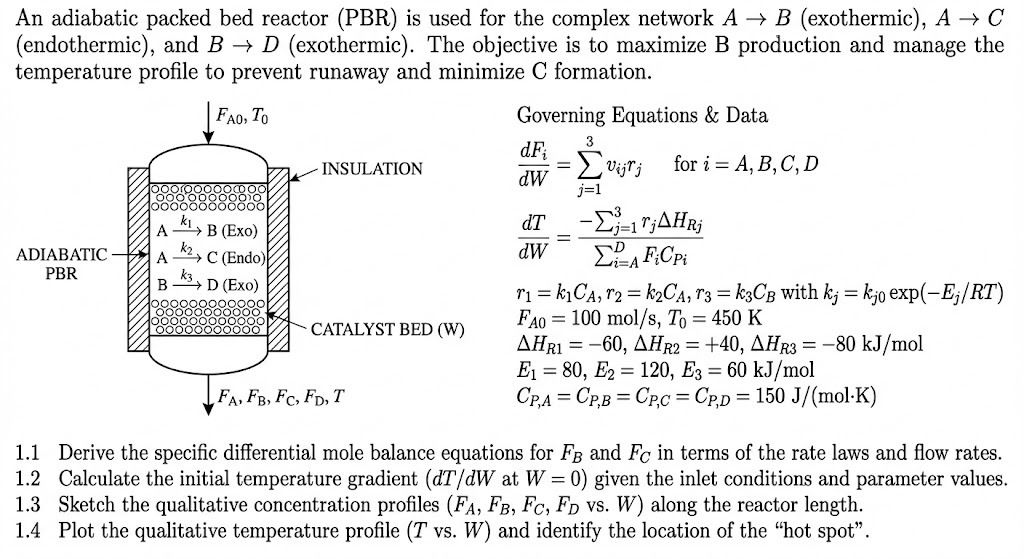 An adiabatic packed bed reactor (PBR) is used for the complex network A — B (exothermic), A — C
(endothermic), and B — D (exothermic). The objective is to maximize B production and manage the
temperature profile to prevent runaway and minimize C formation.
Fao, To Governing Equations & Data
dF; _ ;
yall INSULATION Jw = vrs fori=A4,B,C,D
Cen =
an dT —X5 riAHp
pore b) dT _ —2.j=1784R;
ADIABATIC 7 A425 ¢ (Endo) V aw YP, FChi
k:
7 BD (Exo) 7 71 =k1Ca, 12 = koCy, 73 = k3Cp with k; = kjo exp(—E;/RT)
VU dessssssassss] % f=) i
Kesesisticsies Z| Fo = 100 mol/s, Ty = 450 K
7 SESECEEOEEE I~ CATALYST BED (W)
AH AHpgy = —60, AHgy = +40, AHgg = —80 kJ/mol
Ey = 80, Ey = 120, E3 = 60 kJ/mol
Fa, Fy, Fo, Fp, T Cpa =Cpp=Cpc=Cpp = 150 J/(mol K)
1.1 Derive the specific differential mole balance equations for Fg and Fy in terms of the rate laws and flow rates.
1.2 Calculate the initial temperature gradient (dT'/dW at W = 0) given the inlet conditions and parameter values.
1.3 Sketch the qualitative concentration profiles (Fy, Fp, Fr, Fp vs. W) along the reactor length.
1.4 Plot the qualitative temperature profile (T vs. W) and identify the location of the “hot spot”.
Asked by: Francis
Created at: 2026-01-27 12:04:14
Final Answer:
📢 Instructions:
- Ask anything relatd to above question only.
- For new Question goto :