 VIPSolutions
Give step-by-step solution with explanation and final answer: {give me the answer without using bullet-points}5. Suppose the gas above the soda in a bottle of soda is pure CO, at a pressure of 2 atm. a. Calculate the [CO4q)] at 25 °C. The Kyi coz at 25 °C is 10-46 M/atm. b. Calculate the pH of the soda. Start with the following chemical reaction and realize the solution will be somewhat acidic. For your calculations, assume that the carbonate (i.e., COs*) concentration is negligible which means you can also disregard the second acid dissociation expression involving COs? COjq + H20 — HCOy + H* Kg; = 1063
Question:
Give step-by-step solution with explanation and final answer:
{give me the answer without using bullet-points}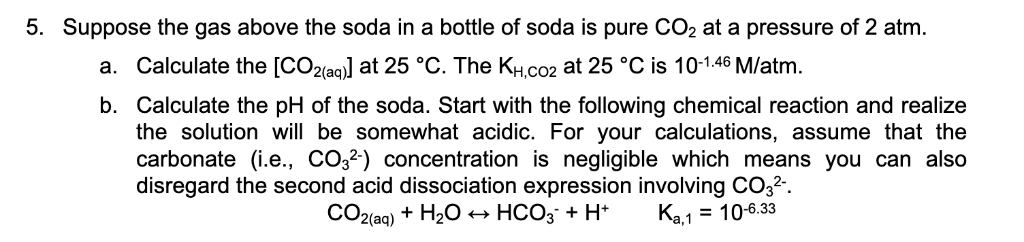 5. Suppose the gas above the soda in a bottle of soda is pure CO, at a pressure of 2 atm.
a. Calculate the [CO4q)] at 25 °C. The Kyi coz at 25 °C is 10-46 M/atm.
b. Calculate the pH of the soda. Start with the following chemical reaction and realize
the solution will be somewhat acidic. For your calculations, assume that the
carbonate (i.e., COs*) concentration is negligible which means you can also
disregard the second acid dissociation expression involving COs?
COjq + H20 — HCOy + H* Kg; = 1063
This is AI generated Response.
Asked by: Francis
Created at: 2026-01-27 10:44:22
Asked by: Francis
Created at: 2026-01-27 10:44:22
Final Answer:
Rendered
Raw Text
Did you like this answer?
Let's solve the problem step-by-step:
---
## (a) Calculate \([CO_2(aq)]\) at 25°C
We use **Henry's Law**:
\[
[CO_2(aq)] = K_H \times P_{CO_2}
\]
Given:
- \( K_{H,CO_2} = 10^{-1.46} \) M/atm
- \( P_{CO_2} = 2 \) atm
Calculate \( K_H \):
\[
K_H = 10^{-1.46} \approx .0347 \text{ M/atm}
\]
Now calculate \([CO_2(aq)]\):
\[
[CO_2(aq)] = .0347 \times 2 = .0694 \text{ M}
\]
**Final answer for (a):**
\[
\boxed{[CO_2(aq)] = .0694 \text{ M}}
\]
---
## (b) Calculate the pH of the soda
The relevant equilibrium is:
\[
CO_2(aq) + H_2O \leftrightarrow HCO_3^- + H^+ \quad K_{a,1} = 10^{-6.33}
\]
Let \( x = [H^+] = [HCO_3^-] \) produced. The initial concentration of \( CO_2(aq) \) is \( .0694 \) M, and at equilibrium, it will be \( .0694 - x \).
The equilibrium expression:
\[
K_{a,1} = \frac{[HCO_3^-][H^+]}{[CO_2(aq)]}
\]
\[
10^{-6.33} = \frac{x^2}{.0694 - x}
\]
Since \( K_{a,1} \) is small, \( x \ll .0694 \), so \( .0694 - x \approx .0694 \):
\[
10^{-6.33} = \frac{x^2}{.0694}
\]
\[
x^2 = 10^{-6.33} \times .0694
\]
First, calculate \( 10^{-6.33} \):
\[
10^{-6.33} \approx 4.68 \times 10^{-7}
\]
Now,
\[
x^2 = (4.68 \times 10^{-7}) \times .0694 = 3.247 \times 10^{-8}
\]
\[
x = \sqrt{3.247 \times 10^{-8}} \approx 1.8 \times 10^{-4} \text{ M}
\]
Now, pH is:
\[
pH = -\log_{10}(x) = -\log_{10}(1.8 \times 10^{-4}) \approx 3.74
\]
**Final answer for (b):**
\[
\boxed{pH = 3.74}
\]
---
### **Summary of Answers**
(a) \([CO_2(aq)] = .0694\) M
(b) \(pH = 3.74\)
📢 Instructions:
- Ask anything relatd to above question only.
- For new Question goto :