 VIPSolutions
Give step-by-step solution with explanation and final answer:Problem 3 A second order system has for transfer function] 6 Gs)=5—— 5s +s+8 Sketch the unit step response providing the values for Te, Ts, Css, Cay, and the percent overshoot.
Question:
Give step-by-step solution with explanation and final answer: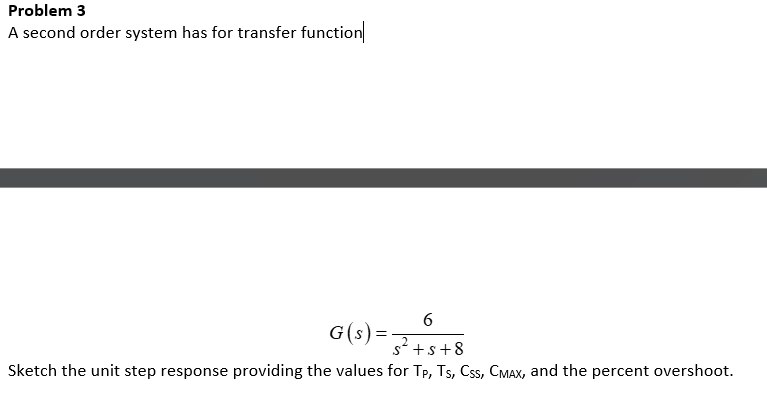 Problem 3
A second order system has for transfer function]
6
Gs)=5——
5s +s+8
Sketch the unit step response providing the values for Te, Ts, Css, Cay, and the percent overshoot.
This is AI generated Response.
Asked by: Alok Kumar
Created at: 2026-01-27 08:35:12
Asked by: Alok Kumar
Created at: 2026-01-27 08:35:12
Final Answer:
Rendered
Raw Text
Did you like this answer?
Let's solve the problem step-by-step:
---
## 1. **Given Transfer Function**
\[
G(s) = \frac{6}{s^2 + s + 8}
\]
---
## 2. **Standard Second-Order System Form**
The standard form is:
\[
G(s) = \frac{\omega_n^2}{s^2 + 2\zeta\omega_n s + \omega_n^2}
\]
Comparing:
- \( \omega_n^2 = 8 \implies \omega_n = \sqrt{8} = 2.828 \)
- \( 2\zeta\omega_n = 1 \implies \zeta = \frac{1}{2\omega_n} = \frac{1}{2 \times 2.828} = .177 \)
But numerator is 6, not 8. For step response, we need the closed-loop transfer function for a unit step input:
\[
C(s) = G(s) \cdot \frac{1}{s} = \frac{6}{s(s^2 + s + 8)}
\]
But the final value depends on the DC gain:
- \( G() = \frac{6}{8} = .75 \)
---
## 3. **Step Response Characteristics**
### **(a) Steady-State Value, \(C_{SS}\):**
By Final Value Theorem:
\[
C_{ss} = \lim_{s \to } s \cdot \frac{6}{s(s^2 + s + 8)} = \frac{6}{8} = .75
\]
### **(b) Damping Ratio (\(\zeta\)) and Natural Frequency (\(\omega_n\)):**
Already found:
- \( \omega_n = 2.828 \)
- \( \zeta = .177 \)
### **(c) Peak Time (\(T_P\)):**
\[
T_P = \frac{\pi}{\omega_n \sqrt{1-\zeta^2}}
\]
Calculate:
\[
\sqrt{1-\zeta^2} = \sqrt{1-(.177)^2} = .984
\]
\[
T_P = \frac{\pi}{2.828 \times .984} = \frac{3.142}{2.783} = 1.13 \, \text{sec}
\]
### **(d) Settling Time (\(T_S\)):**
(For 2% criterion)
\[
T_S = \frac{4}{\zeta \omega_n}
\]
\[
T_S = \frac{4}{.177 \times 2.828} = \frac{4}{.5} = 8 \, \text{sec}
\]
### **(e) Percent Overshoot (\%OS):**
\[
\%OS = e^{-\frac{\zeta \pi}{\sqrt{1-\zeta^2}}} \times 100\%
\]
\[
\frac{\zeta \pi}{\sqrt{1-\zeta^2}} = \frac{.177 \times 3.142}{.984} = .565
\]
\[
\%OS = e^{-.565} \times 100\% = .568 \times 100\% = 56.8\%
\]
### **(f) Maximum Value (\(C_{MAX}\)):**
\[
C_{MAX} = C_{SS} \times \left(1 + \frac{\%OS}{100}\right) = .75 \times (1 + .568) = .75 \times 1.568 = 1.176
\]
---
## 4. **Summary Table**
| Quantity | Value |
|---------------------|-----------|
| \(T_P\) | 1.13 sec |
| \(T_S\) | 8 sec |
| \(C_{SS}\) | .75 |
| \(C_{MAX}\) | 1.176 |
| Percent Overshoot | 56.8% |
---
## 5. **Sketch** (Description)
- **Starts at **, rises quickly
- **Overshoots** the final value (.75) to a peak (\(\approx 1.18\))
- **Oscillates** and settles at .75 after about 8 sec
---
### **Final Answers**
\[
\boxed{
\begin{aligned}
&\text{Peak Time, } T_P = 1.13\,\text{sec} \\
&\text{Settling Time, } T_S = 8\,\text{sec} \\
&\text{Steady-State Value, } C_{SS} = .75 \\
&\text{Maximum Value, } C_{MAX} = 1.176 \\
&\text{Percent Overshoot} = 56.8\%
\end{aligned}
}
\]
---
**Let me know if you want a plot of the step response!**
📢 Instructions:
- Ask anything relatd to above question only.
- For new Question goto :