VIPSolutions logo ✨ VIPSolutions

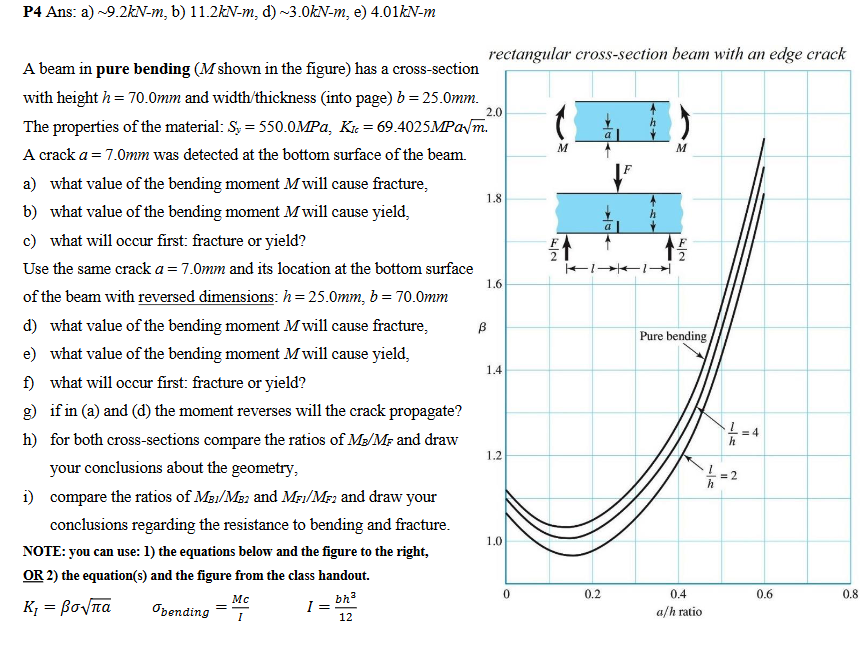
Give step-by-step solution with explanation and final answer:P4 Ans: 2) ~9.2kN-m, b) 11.2kN-m, d) ~3.0kN-m, €) 4.01kN-m . rectangular cross-section beam with an edge crack A beam in pure bending (3 shown in the figure) has a cross-section | with height = 70.0mm and width/thickness (into page) b = 25.0mm. The properties of the material 5, = 550.0MPa, Ki = 69.4025MPay ( Tah ) A crack a= 7.0mm was detected at the bottom surface of the beam. CANE = 2) what value of the bending moment M will cause fracture, i b) what value of the bending moment M will cause yield, hi ©) what will occur first: fracture or yield? pf E Use the same crack a = 7.0mm and its location at the bottom surface [SRNR of the beam with reversed dimensions: = 250mm, b=700mm | d) what value of the bending moment M will cause fracture, 8 PE ar ©) what value of the bending moment M will cause yield, 1) what will occur first: fracture or yield? ie 9) ifin (a) and (d) the moment reverses will the crack propagate? 1) for both cross-sections compare the ratios of Ms/Mr and draw ft your conclusions about the geometry, BN Lo i) compare the ratios of Ms/Ms; and Mei/Mr; and draw your 5 | conclusions regarding the resistance to bending and fracture. NOTE: you can se: 1) the equations below and the figure to the right, 0 | OR 2) the equation(s) and the figure from the class handout. ue od 0 02 04 [3 0s Ky =BoVTa Gponaing =" 1=% afhratio

Question:

Give step-by-step solution with explanation and final answer:Uploaded ImageP4 Ans: 2) ~9.2kN-m, b) 11.2kN-m, d) ~3.0kN-m, €) 4.01kN-m . rectangular cross-section beam with an edge crack A beam in pure bending (3 shown in the figure) has a cross-section | with height = 70.0mm and width/thickness (into page) b = 25.0mm. The properties of the material 5, = 550.0MPa, Ki = 69.4025MPay ( Tah ) A crack a= 7.0mm was detected at the bottom surface of the beam. CANE = 2) what value of the bending moment M will cause fracture, i b) what value of the bending moment M will cause yield, hi ©) what will occur first: fracture or yield? pf E Use the same crack a = 7.0mm and its location at the bottom surface [SRNR of the beam with reversed dimensions: = 250mm, b=700mm | d) what value of the bending moment M will cause fracture, 8 PE ar ©) what value of the bending moment M will cause yield, 1) what will occur first: fracture or yield? ie 9) ifin (a) and (d) the moment reverses will the crack propagate? 1) for both cross-sections compare the ratios of Ms/Mr and draw ft your conclusions about the geometry, BN Lo i) compare the ratios of Ms/Ms; and Mei/Mr; and draw your 5 | conclusions regarding the resistance to bending and fracture. NOTE: you can se: 1) the equations below and the figure to the right, 0 | OR 2) the equation(s) and the figure from the class handout. ue od 0 02 04 [3 0s Ky =BoVTa Gponaing =" 1=% afhratio
This is AI generated Response.
Asked by: Alok Kumar
Created at: 2026-01-27 04:35:52

Final Answer:

Rendered Raw Text
Did you like this answer?
Let's solve the problem step-by-step as requested. **Given Data:** - For the rectangular cross-section beam: - Case 1: \( h = 70.\,\text{mm},\, b = 25.\,\text{mm} \) - Case 2: \( h = 25.\,\text{mm},\, b = 70.\,\text{mm} \) - Crack size: \( a = 7.\,\text{mm} \) - Material properties: - \( S_y = 550.\,\text{MPa} \) - \( K_{Ic} = 69.4025\,\text{MPa}\sqrt{\text{m}} \) - Formulas: - \( K_I = \beta \sigma \sqrt{\pi a} \) - \( \sigma_{bending} = \frac{M c}{I} \) - \( I = \frac{b h^3}{12} \) - \( c = \frac{h}{2} \) ### 1. **Case 1: \( h = 70.\,\text{mm},\, b = 25.\,\text{mm} \)** #### **a) Value of moment \( M \) causing fracture:** - \( a/h = 7/70 = .1 \) - From the graph, for \( a/h = .1 \) and \( L/h = 2.8 \), \( \beta \approx 1.2 \). - \( I = \frac{25 \times 70^3}{12} = \frac{25 \times 343000}{12} = 714583\,\text{mm}^4 \) - \( c = 35\,\text{mm} \) - For fracture: \( K_I = K_{Ic} \) - \( K_{Ic} = \beta \sigma \sqrt{\pi a} \implies \sigma = \frac{K_{Ic}}{\beta \sqrt{\pi a}} \) - \( \sigma = \frac{69.4025}{1.2 \times \sqrt{\pi \times .007}} = \frac{69.4025}{1.2 \times .148} = \frac{69.4025}{.1776} = 390.9\,\text{MPa} \) - \( M = \sigma \frac{I}{c} = 390.9 \times \frac{714583}{35} = 7,983,333\,\text{Nmm} = 7.98\,\text{kN-m} \) #### **b) Value of moment \( M \) causing yield:** - \( \sigma = S_y = 550 \,\text{MPa} \) - \( M = 550 \times \frac{714583}{35} = 11,241,000\,\text{Nmm} = 11.24\,\text{kN-m} \) #### **c) What will occur first: fracture or yield?** - Fracture occurs at \( 7.98\,\text{kN-m} \), yield at \( 11.24\,\text{kN-m} \) - **Fracture will occur first.** --- ### 2. **Case 2: \( h = 25.\,\text{mm},\, b = 70.\,\text{mm} \)** #### **d) Value of moment \( M \) causing fracture:** - \( a/h = 7/25 = .28 \) - From the graph for \( a/h = .28 \) and \( L/h = 2 \), \( \beta \approx 1.35 \) - \( I = \frac{70 \times 25^3}{12} = \frac{70 \times 15625}{12} = 91,146\,\text{mm}^4 \) - \( c = 12.5\,\text{mm} \) - \( \sigma = \frac{K_{Ic}}{\beta \sqrt{\pi a}} = \frac{69.4025}{1.35 \times \sqrt{\pi \times .007}} = \frac{69.4025}{1.35 \times .148} = \frac{69.4025}{.1998} = 347.5\,\text{MPa} \) - \( M = \sigma \frac{I}{c} = 347.5 \times \frac{91,146}{12.5} = 2,533,687\,\text{Nmm} = 2.53\,\text{kN-m} \) #### **e) Value of moment \( M \) causing yield:** - \( M = 550 \times \frac{91,146}{12.5} = 4,011,624\,\text{Nmm} = 4.01\,\text{kN-m} \) #### **f) What will occur first: fracture or yield?** - Fracture at \( 2.53\,\text{kN-m} \), yield at \( 4.01\,\text{kN-m} \) - **Fracture will occur first.** --- ### 3. **g) If moment reverses in (a) and (d), will the crack propagate?** - If the moment reverses, the crack moves from tension to compression side. Cracks do **not** propagate in compression. - **No, the crack will not propagate.** --- ### 4. **h) Compare ratios of \( M_B/M_F \) and conclusions** - \( M_B \): bending moment causing yield - \( M_F \): bending moment causing fracture For case 1: \( \frac{M_B}{M_F} = \frac{11.24}{7.98} = 1.41 \) For case 2: \( \frac{M_B}{M_F} = \frac{4.01}{2.53} = 1.59 \) - **Conclusion:** The wider, shorter section (case 2) has a higher ratio, so it is more likely to fracture before yielding compared to the taller, narrower section. --- ### 5. **i) Compare ratios \( M_{B1}/M_{B2} \) and \( M_{F1}/M_{F2} \)** - \( M_{B1}/M_{B2} = 11.24/4.01 = 2.80 \) - \( M_{F1}/M_{F2} = 7.98/2.53 = 3.15 \) - **Conclusion:** The taller/narrower beam (case 1) is much more resistant to both yielding and fracture in bending than the shorter/wider beam (case 2), but the increase in resistance is more pronounced for fracture. --- ## **Summary Table** | Case | Fracture \(M_F\) (kN-m) | Yield \(M_B\) (kN-m) | Failure Mode First | |------|-------------------------|----------------------|-------------------| | 1 | ~7.98 | ~11.24 | Fracture | | 2 | ~2.53 | ~4.01 | Fracture | --- ## **Key Points** - **Fracture occurs before yielding in both cases.** - **Wider (b), shorter (h) beams are less resistant to both yielding and fracture.** - **Cracks do not propagate in compression.** - **Geometry dramatically affects failure mode and resistance.**

📢 Instructions:

  • Ask anything relatd to above question only.
  • For new Question goto :

Study Help, Fast Answers

VIPSolutions focuses on clear, step‑by‑step explanations so you can learn quickly. Whether you need an AI‑generated walkthrough or a short hint to get unstuck, each solution is organized for fast reading and easy review later.

Search similar questions, compare approaches, and bookmark the best answers for revision. Our goal is simple: quick, reliable study help that feels natural—not noisy.