 VIPSolutions
Give step-by-step solution with explanation and final answer:14. For each compound: I. Label/identify the p orbitals that contribute fo resonance (highlight, circle, etc.) IL. Provide ALL the reasonable resonance structures. ll. Rank the resonance structures from greatest contribution fo least. IV. Provide the hybrid. [4] ~i AN a | [4 ) be ES 0, . 0%
Question:
Give step-by-step solution with explanation and final answer: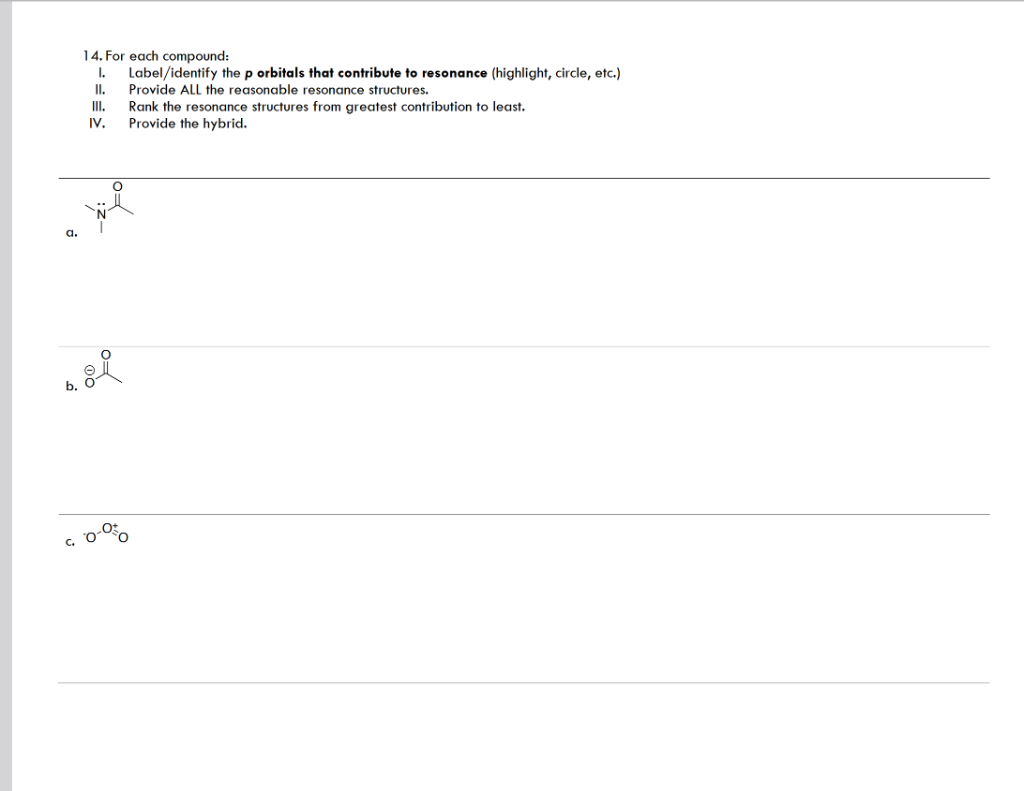 14. For each compound:
I. Label/identify the p orbitals that contribute fo resonance (highlight, circle, etc.)
IL. Provide ALL the reasonable resonance structures.
ll. Rank the resonance structures from greatest contribution fo least.
IV. Provide the hybrid.
[4]
~i AN
a |
[4
)
be ES
0,
. 0%
This is AI generated Response.
Asked by: Rahul
Created at: 2026-01-27 03:41:20
Asked by: Rahul
Created at: 2026-01-27 03:41:20
Final Answer:
Rendered
Raw Text
Did you like this answer?
Let's address each compound step-by-step, as per the instructions:
---
## **a. Acetamide (CH₃CONH₂)**
### **I. p Orbitals Contributing to Resonance**
- The carbonyl carbon and oxygen (C=O) both have unhybridized p orbitals.
- The nitrogen has a lone pair in a p orbital, which can overlap with the π system.
### **II. Resonance Structures**
1. **Major structure (normal Lewis):**
```
O
||
C — N
```
(lone pairs on O and N)
2. **Resonance structure:**
```
O⁻
|
C=N⁺
```
(lone pairs on O and N, double bond between C and N, O has one more lone pair, N has no lone pairs and a formal + charge)
### **III. Ranking Resonance Structures**
- **1st (greatest contribution):** Structure 1 (all atoms have full octet, charges minimized)
- **2nd:** Structure 2 (charge separation, less stable)
### **IV. Hybridization**
- **Carbonyl C:** sp²
- **Oxygen:** sp²
- **Nitrogen:** sp²
---
## **b. Acetate Ion (CH₃CO₂⁻)**
### **I. p Orbitals Contributing to Resonance**
- Both oxygens and the carbonyl carbon have unhybridized p orbitals.
### **II. Resonance Structures**
1. **Structure 1:** Negative charge on left O, double bond to right O
2. **Structure 2:** Negative charge on right O, double bond to left O
### **III. Ranking Resonance Structures**
- **Both structures are equivalent** (contribute equally).
### **IV. Hybridization**
- **Carbonyl C:** sp²
- **Oxygens:** sp²
---
## **c. Ozone (O₃)**
### **I. p Orbitals Contributing to Resonance**
- All three oxygens have p orbitals involved in π bonding.
### **II. Resonance Structures**
1. **Structure 1:** O⁻–O⁺=O
2. **Structure 2:** O=O⁺–O⁻
### **III. Ranking Resonance Structures**
- **Both structures are equivalent** (contribute equally).
### **IV. Hybridization**
- **Central O:** sp²
- **Terminal Os:** sp²
---
### **Summary Table**
| Compound | p Orbitals (atoms) | Resonance Structures | Ranking | Hybridization |
|---------------------|----------------------|--------------------------------------------------------|------------------------|-----------------------|
| Acetamide (a) | C=O, N | O=C–N ↔ O⁻–C=N⁺ | 1 > 2 | C, O, N: sp² |
| Acetate (b) | both O, C | [O⁻–C=O] ↔ [O=C–O⁻] | Equal | C, O: sp² |
| Ozone (c) | all three O | O⁻–O⁺=O ↔ O=O⁺–O⁻ | Equal | all O: sp² |
---
If you need the resonance structures drawn out, let me know!
📢 Instructions:
- Ask anything relatd to above question only.
- For new Question goto :