 VIPSolutions
Give step-by-step solution with explanation and final answer: {give me the answer without using bullet-points}HAAN i Tn FEHR bo hit Li Bl i A Tate i A A i fig i" 3 } LIN A HER MEER « [. ¥ RNY Tomato pulp, without skins and seeds, has a solid content of 6% by weight. This is used. - to produce tomato paste with 28% solids. The evaporator has a capacity of 1000 kg/hy. Determine which of the following option is feasible for the production of 28% solid content paste: a- by feedingall pulp to the evaporator. b- first production of 32% solid content paste which is then blended with 6% pulp by-passing the evaporator d — (LRA PATRAS } HAAN i ANT A HE TRL LIANE HE IR A hn wl | i hi fn Lh RAR ERE
Question:
Give step-by-step solution with explanation and final answer:
{give me the answer without using bullet-points}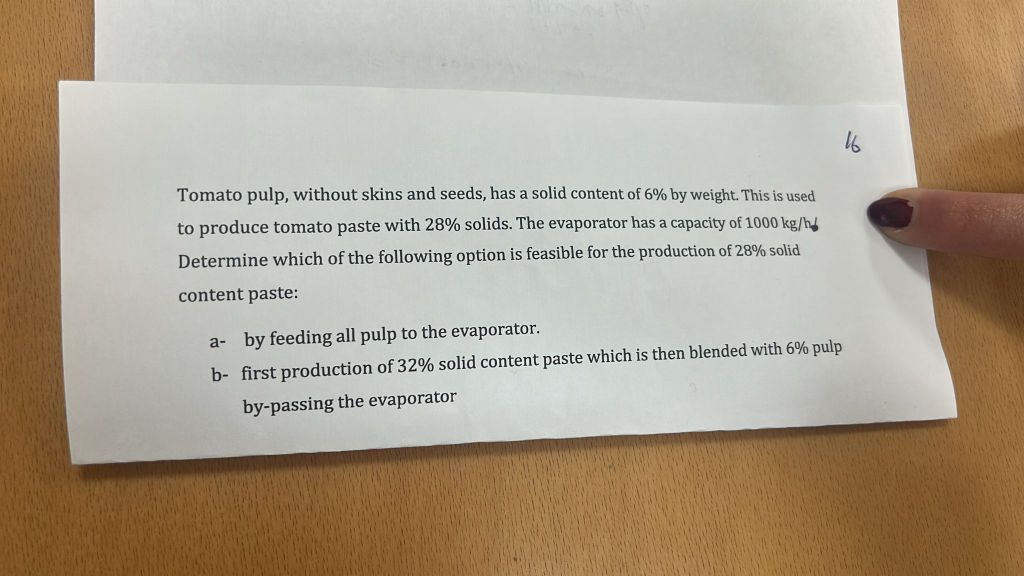 HAAN
i Tn
FEHR bo
hit Li Bl
i A Tate
i A A i fig i" 3
} LIN A
HER
MEER
« [.
¥ RNY
Tomato pulp, without skins and seeds, has a solid content of 6% by weight. This is used. -
to produce tomato paste with 28% solids. The evaporator has a capacity of 1000 kg/hy.
Determine which of the following option is feasible for the production of 28% solid
content paste:
a- by feedingall pulp to the evaporator.
b- first production of 32% solid content paste which is then blended with 6% pulp
by-passing the evaporator d
— (LRA PATRAS }
HAAN i ANT A
HE TRL
LIANE
HE IR A hn
wl | i hi
fn Lh RAR ERE
This is AI generated Response.
Asked by: Francis
Created at: 2026-01-26 20:21:53
Asked by: Francis
Created at: 2026-01-26 20:21:53
Final Answer:
Rendered
Raw Text
Did you like this answer?
Let's solve the problem step by step:
**Given:- Tomato pulp (without skins/se): **6% solids by weight- Desired product: **28 solids by weight- Evaporator capacity: **100 kg/h**
- Two options to consider
### Option (a): Feed all pulp to the evaporator
Let the feed rate to the evaporator be **F** (kg/h). The evaporator output product is **P** (kg/h) with 28% solids.
Solids in feed = .06F
Solids in product = .28P
At steady state, solids in = solids out:
.06F = .28P
So, P = (.06/.28)F = .2143F
Total mass to evaporator = F
But, evaporator capacity = 100 kg/h
So, F = 100 kg/h (maximum feed possible)
Thus, the output product P = .2143 × 100 = **214.3 kg/h** at 28% solids.
**Conclusion for (a):**
You can only produce 214.3 kg/h of 28% paste by feeding all the pulp (100 kg/h) into the evaporator, due to the low starting solids (6%).
### Option (b): Produce 32% paste, then blend with 6% pulp
Let’s assume we get **x** kg/h of 32% paste from the evaporator and blend it with **y** kg/h of 6% pulp (bypassed).
Final blend: (x + y) kg/h at 28% solids.
Total solids in blend = .32x + .06y
Total mass = x + y
Overall solids fraction = .28
Set up the equation:
.32x + .06y = .28(x + y)
.32x + .06y = .28x + .28y
.32x - .28x = .28y - .06y
.04x = .22y
x/y = .22/.04 = 5.5
Thus, for every 5.5 kg of 32% paste, you need 1 kg of 6% pulp.
Evaporator handles only the portion to be concentrated to 32%. Let’s say the evaporator runs at **maximum capacity**: 100 kg/h feed.
Let’s find how much 32% paste you get from 100 kg/h of 6% pulp input (to evaporator):
Solids in: 100 × .06 = 60 kg
Let product = x kg/h at 32% solids
.32x = 60
x = 60/.32 = 187.5 kg/h (32% paste output from evaporator)
For blending, y = x/5.5 = 187.5/5.5 = 34.1 kg/h (6% pulp to blend)
Total product = x + y = 187.5 + 34.1 = **221.6 kg/h** at 28% solids
**Compare with option (a):**
- Option (a): 214.3 kg/h
- Option (b): 221.6 kg/h
### **Final Answer:**
Option **(b)** is more feasible for producing 28% solid content paste, since it yields more product (221.6 kg/h) than option (a) (214.3 kg/h) when using an evaporator of 100 kg/h capacity.
📢 Instructions:
- Ask anything relatd to above question only.
- For new Question goto :