 VIPSolutions
Give step-by-step solution with explanation and final answer:| ge
Question:
Give step-by-step solution with explanation and final answer: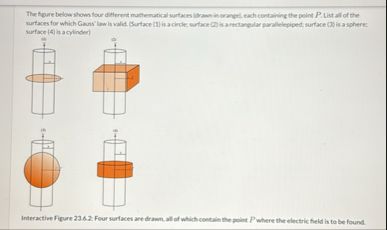 | ge
This is AI generated Response.
Asked by: Rahul
Created at: 2026-01-26 04:46:56
Asked by: Rahul
Created at: 2026-01-26 04:46:56
Final Answer:
Rendered
Raw Text
Did you like this answer?
Let's break down the problem step by step.
---
## **Step 1: Understanding Gauss's Law**
**Gauss's Law** states:
\[
\oint_S \vec{E} \cdot d\vec{A} = \frac{q_{\text{enc}}}{\epsilon_}
\]
where \(S\) is a **closed surface**.
**Key Point:**
Gauss's Law is valid (can be applied) only for **closed surfaces** (surfaces that fully enclose a volume).
---
## **Step 2: Analyzing Each Surface**
Let's look at each surface as described:
1. **Surface (1): Circle**
- A flat, 2D surface (not closed).
- **Not a closed surface.**
2. **Surface (2): Rectangular Parallelepiped (Box)**
- A closed 3D box.
- **Closed surface.**
3. **Surface (3): Sphere**
- A closed 3D surface.
- **Closed surface.**
4. **Surface (4): Cylinder**
- A closed 3D surface (assuming it includes the curved surface and both top and bottom bases).
- **Closed surface.**
---
## **Step 3: Listing Valid Surfaces**
**Gauss's Law is valid for:**
- Surface (2): Rectangular parallelepiped (box)
- Surface (3): Sphere
- Surface (4): Cylinder
**Not valid for:**
- Surface (1): Circle (not closed)
---
## **Step 4: Final Answer**
### **Final Answer**
> **Gauss's Law is valid for surfaces 2 (rectangular parallelepiped), 3 (sphere), and 4 (cylinder).**
---
### **Summary Table**
| Surface Number | Shape | Closed Surface? | Gauss's Law Valid? |
|----------------|---------------------------|-----------------|--------------------|
| 1 | Circle | No | No |
| 2 | Rectangular parallelepiped| Yes | Yes |
| 3 | Sphere | Yes | Yes |
| 4 | Cylinder | Yes | Yes |
---
**Only surfaces 2, 3, and 4 are valid for applying Gauss's Law.**
📢 Instructions:
- Ask anything relatd to above question only.
- For new Question goto :