 VIPSolutions
Give step-by-step solution with explanation and final answer:3: Draw resonance structures for the following compounds (do not create new charges!) (9 points) a a) OH HNN b) NH; “0 OH HO 0 E o 5) Rea Ee d O o ANN
Question:
Give step-by-step solution with explanation and final answer: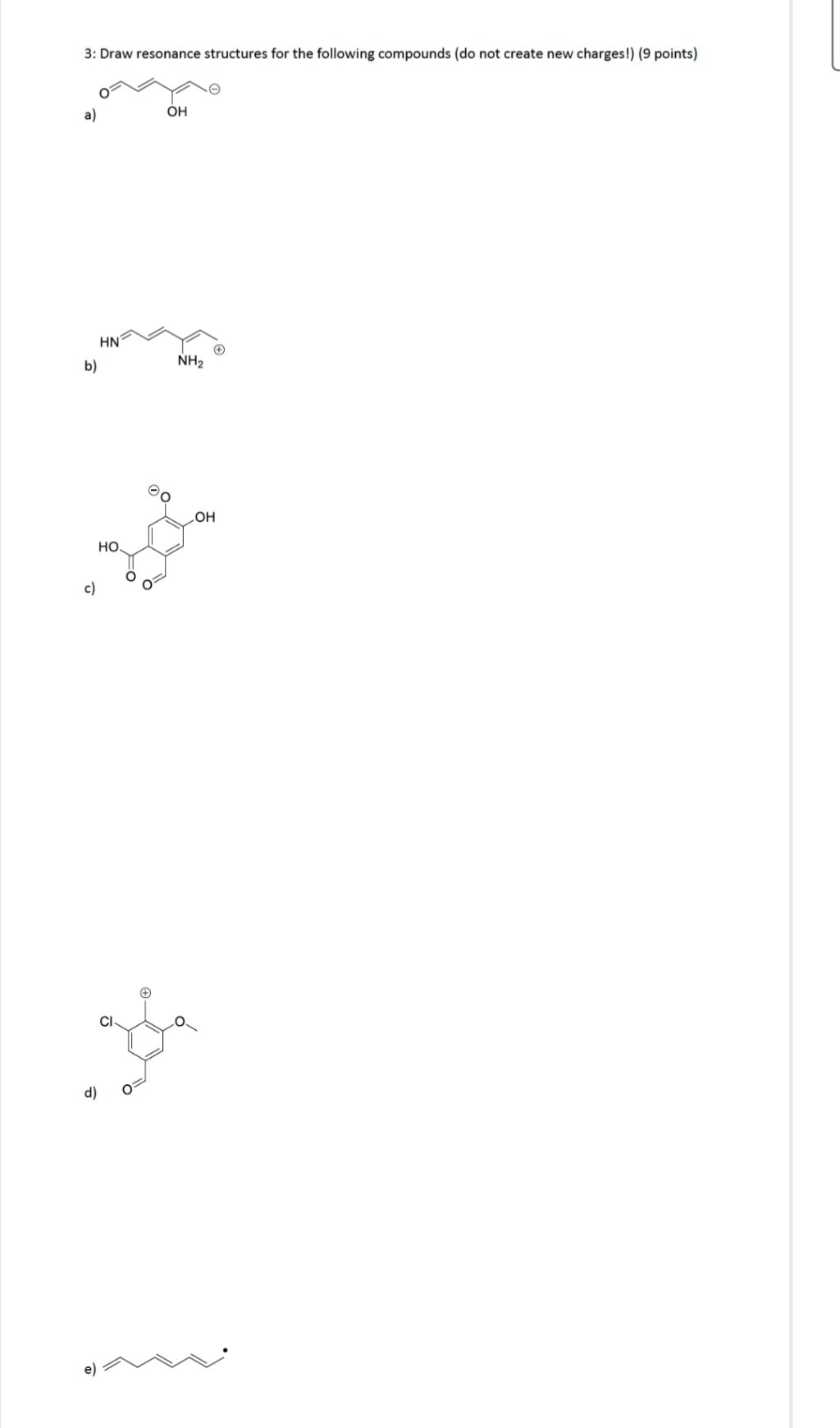 3: Draw resonance structures for the following compounds (do not create new charges!) (9 points)
a
a) OH
HNN
b) NH;
“0
OH
HO
0
E o
5)
Rea
Ee
d O
o ANN
This is AI generated Response.
Asked by: Rahul
Created at: 2026-01-26 04:39:26
Asked by: Rahul
Created at: 2026-01-26 04:39:26
Final Answer:
Rendered
Raw Text
Did you like this answer?
Let's solve each part step by step, explaining resonance structure movement. **Key principle:** Move electrons (lone pairs or pi bonds) without creating new charges.
---
## a)
**Structure:**
- A carboxylate ion with an OH group and a negative charge on the oxygen.
**Resonance:**
- The negative charge on the oxygen can be delocalized to the other oxygen via the pi bond.
### Step-by-step:
1. Move the lone pair from the negatively charged O into a pi bond between C and O.
2. Move the pi bond between C and the neutral O to that O as a lone pair.
### **Structures:**
```
O- O
| ||
C—C—C—OH ↔ C—C—C—OH
| |
O O-
```
- The negative charge flips between the two oxygens.
---
## b)
**Structure:**
- Imine (C=N), with NH₂ and NH substituents, and a positive charge on terminal N.
**Resonance:**
- Lone pair from NH can form a double bond to C, pushing the C=N pi bond to the N with a positive charge.
### Step-by-step:
1. Move lone pair from NH to form a double bond to C.
2. Move the pi bond between C and N to the terminal N, neutralizing its charge.
### **Structures:**
```
HN=C—CH=NH₂⁺ ↔ HN⁺—C=CH—NH₂
| |
(pi bond moves) (positive charge moves)
```
- The positive charge shifts from terminal N to the NH group.
---
## c)
**Structure:**
- Aromatic ring with two OH groups and two carboxylate groups (negatively charged O's).
**Resonance:**
- Each carboxylate group can delocalize its negative charge between the two oxygens (as in part a).
### Step-by-step:
1. For each carboxylate, the negative charge is delocalized between the two O's.
### **Structures:**
- Draw both resonance forms for each COO⁻ group as in (a).
---
## d)
**Structure:**
- Benzene ring with Cl, OCH₃, and formyl group (CHO), and positive charge on the ring.
**Resonance:**
- The positive charge in the aromatic ring can delocalize via the pi system.
### Step-by-step:
1. Move double bonds around the ring to show the positive charge at different positions.
### **Structures:**
- Draw 3 resonance forms, shifting the positive charge (as a carbocation) around the ring.
---
## e)
**Structure:**
- Conjugated diene chain with a radical (single electron) at the end.
**Resonance:**
- Radical can be delocalized across the conjugated system.
### Step-by-step:
1. Move single electron and pi bonds along the chain.
### **Structures:**
```
CH₂=CH—CH=CH—CH₂• ↔ CH₂•—CH=CH—CH=CH₂ ↔ CH₂=CH•—CH=CH—CH₃
```
- Radical appears at different carbons through resonance.
---
## **Summary Table**
| Compound | Resonance Movement | Structures (examples) |
|----------|-------------------------------|--------------------------------------|
| a | Charge between O atoms | [O⁻—C=O] ↔ [O=C—O⁻] |
| b | Charge between N atoms | [HN=C—CH=NH₂⁺] ↔ [HN⁺—C=CH—NH₂] |
| c | Charge between O in COO⁻ | As in (a) for each COO⁻ |
| d | Positive charge on ring | Move + around benzene ring |
| e | Radical along chain | [CH₂=CH—CH=CH—CH₂•] ↔ ... |
If you want the drawings, let me know!
📢 Instructions:
- Ask anything relatd to above question only.
- For new Question goto :