 VIPSolutions
Give step-by-step solution with explanation and final answer:Draw the product of the reaction shown below. Ignore inorganic byproducts. 8 I CuCl JoTTTTEEEEEER | E H 1 (") brag To Pan i Drawing H - ' ' RE ELE Atoms, Bonds on and Rings Ells Draw or tap a new bond to see « fi suggestions. Undo i © el e Done yV SN
Question:
Give step-by-step solution with explanation and final answer: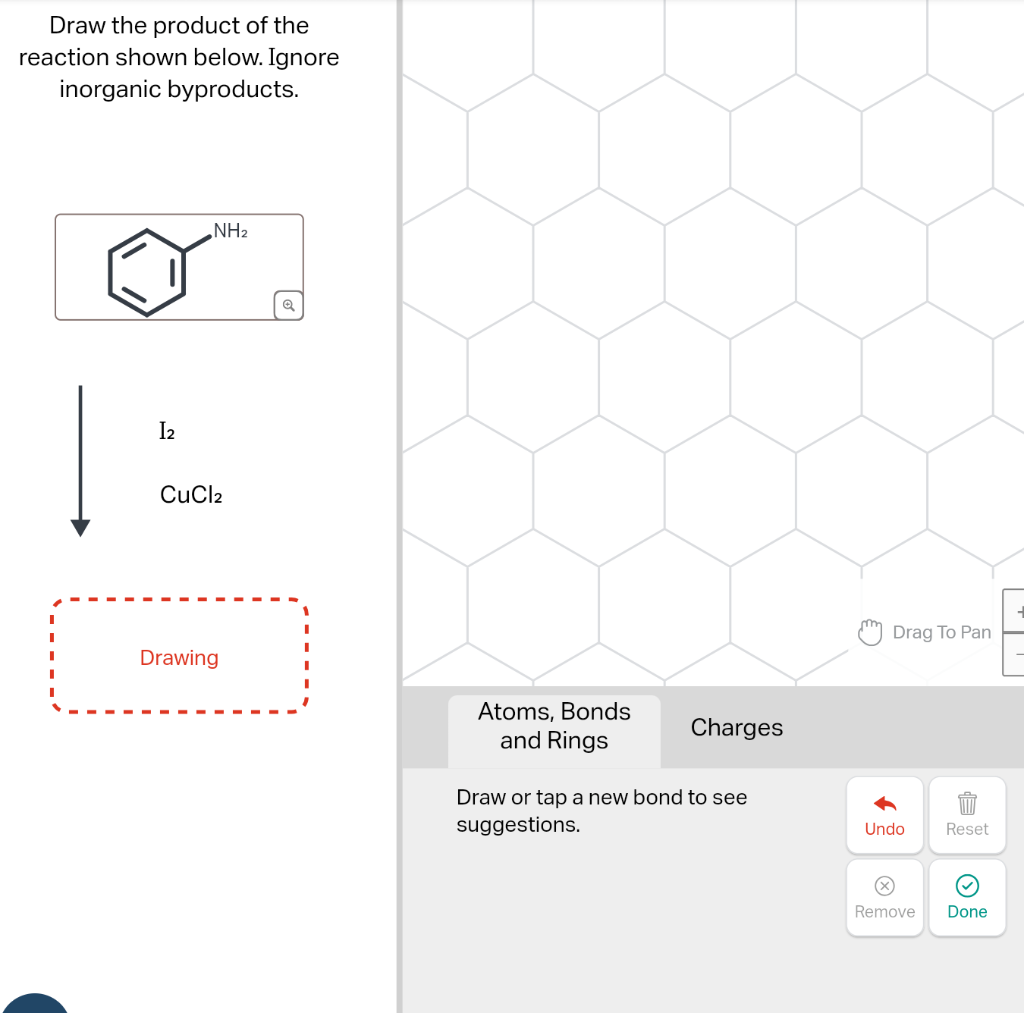 Draw the product of the
reaction shown below. Ignore
inorganic byproducts.
8
I
CuCl
JoTTTTEEEEEER | E
H 1 (") brag To Pan
i Drawing H -
'
'
RE ELE Atoms, Bonds on
and Rings Ells
Draw or tap a new bond to see « fi
suggestions. Undo
i ©
el e Done
yV SN
This is AI generated Response.
Asked by: Rahul
Created at: 2026-01-26 04:03:49
Asked by: Rahul
Created at: 2026-01-26 04:03:49
Final Answer:
Rendered
Raw Text
Did you like this answer?
Let's break down the reaction step-by-step:
## Step 1: Identify the starting material
- The starting material is **aniline** (C₆H₅NH₂).
## Step 2: Identify the reagents and their role
- **I₂ (iodine)**
- **CuCl₂ (copper(II) chloride)**
- These reagents together are used for the **Sandmeyer reaction**, which converts an amine group (–NH₂) on a benzene ring to a halogen (in this case, iodine).
## Step 3: Reaction mechanism
1. **Diazotization**: The aniline is first converted to a diazonium salt (C₆H₅N₂⁺Cl⁻) using nitrous acid (not explicitly shown, but usually occurs in situ with CuCl₂ as a catalyst).
2. **Substitution**: The diazonium group (–N₂⁺) is replaced by an iodine atom (I) using I₂ and CuCl₂.
## Step 4: Draw the product
- The product will be **iodobenzene** (C₆H₅I).
### Structure of the product:
- A benzene ring with an iodine atom attached to one of the carbons (where the NH₂ group was originally attached).
---
## **Final Answer**
### The product is **iodobenzene**:
```
I
|
/-----\
| |
| |
\-----/
```
Or in line structure:
- A benzene ring with an Iodine (I) substituent.
**Summary:**
**Aniline** + I₂, CuCl₂ ⟶ **Iodobenzene** (C₆H₅I)
(The NH₂ group is replaced by an I atom on the benzene ring.)
📢 Instructions:
- Ask anything relatd to above question only.
- For new Question goto :