 VIPSolutions
Give step-by-step solution with explanation and final answer:Rank the compounds from highest (1) to lowest (4) yield as products of the reaction below. i) NaNH, Q [1 ii) MeCl G.N ? ‘Bu o | o o PP Bu -” ] o o SRN ‘Bu [T= | o [¢} 2 Bu (+) © o PN. Suggest the best starting material for the transformation below. i)1eq.Br, HQ , - Br il) HOBr LAK ?2 —> Br Br AN AL J
Question:
Give step-by-step solution with explanation and final answer: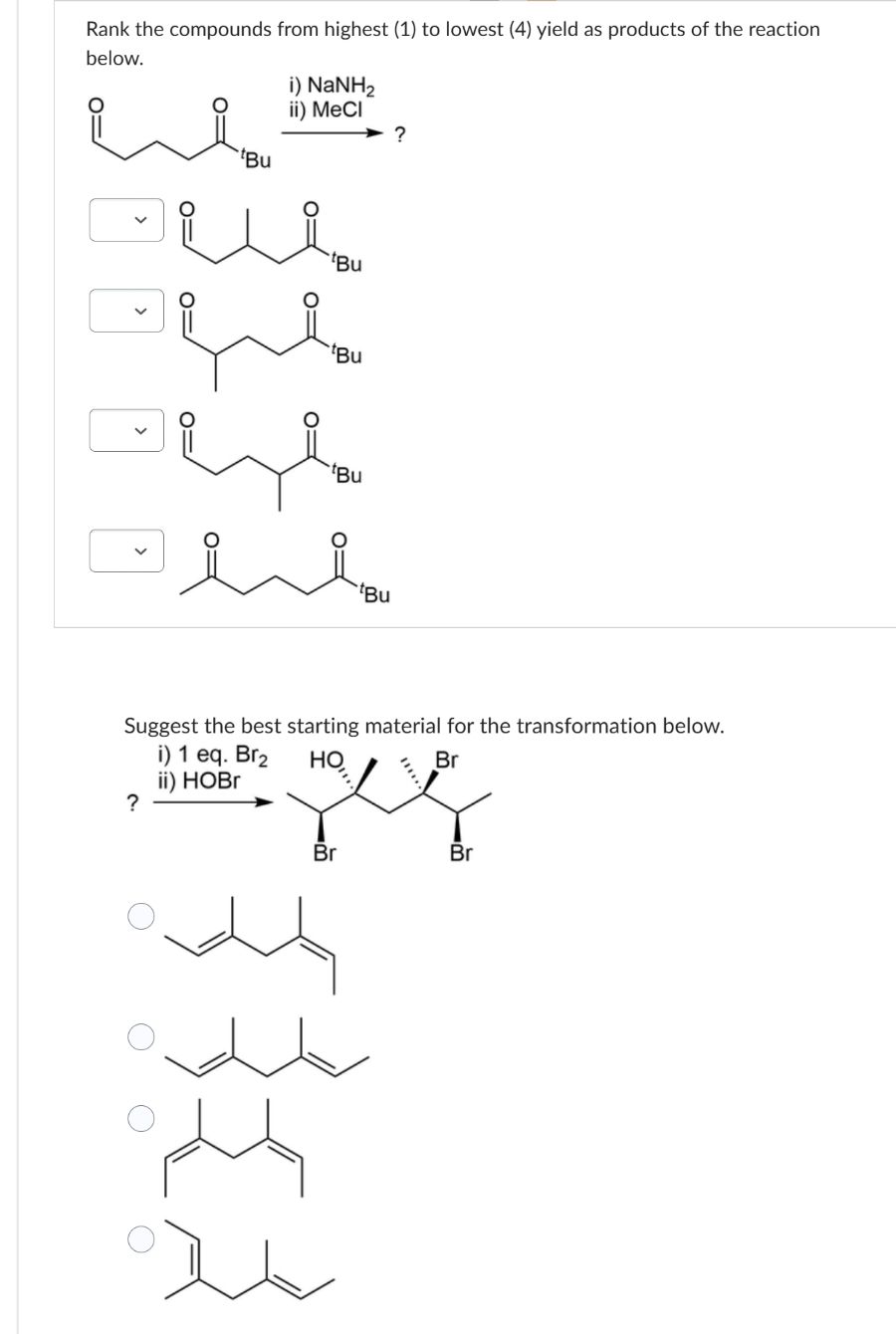 Rank the compounds from highest (1) to lowest (4) yield as products of the reaction
below.
i) NaNH,
Q [1 ii) MeCl
G.N ?
‘Bu
o | o o
PP
Bu
-” ] o o
SRN
‘Bu
[T= | o [¢}
2
Bu
(+) © o
PN.
Suggest the best starting material for the transformation below.
i)1eq.Br, HQ , - Br
il) HOBr LAK
?2 —>
Br Br
AN
AL
J
This is AI generated Response.
Asked by: Rahul
Created at: 2026-01-26 03:41:04
Asked by: Rahul
Created at: 2026-01-26 03:41:04
Final Answer:
Rendered
Raw Text
Did you like this answer?
Let's solve each problem step by step:
---
## **First Question: Ranking the Compounds by Yield**
### **Step 1: Reaction Mechanism**
- The reagents are **NaNH₂** (a strong base, forms enolate) and **MeCl** (alkylates the enolate).
- The starting molecule is a diketone with a bulky tert-butyl group.
### **Step 2: Enolate Formation**
- NaNH₂ will deprotonate the most acidic α-hydrogen (next to a carbonyl).
- The tert-butyl group is very bulky and will hinder deprotonation/alkylation at the α-position next to it (steric hindrance).
- The methyl group (MeCl) will alkylate the enolate at the position where the enolate is formed.
### **Step 3: Product Analysis**
- Highest yield will be from the least hindered (least sterically crowded) position.
- Lowest yield will be from the most hindered position (adjacent to tBu).
#### **Products:**
Let's assign numbers to the options (from top to bottom):
1. Methyl group added at the least hindered α-position (furthest from tBu).
2. Methyl group added at the central position (between the carbonyls).
3. Methyl group added at the position next to tBu (most hindered).
4. Methyl group added at the terminal position (at the end, not alpha to a carbonyl).
#### **Ranking:**
- **1 (Highest):** α-position between two carbonyls (most acidic, least hindered)
- **2:** α-position next to the methyl (slightly hindered)
- **3:** α-position next to the tBu (most hindered)
- **4 (Lowest):** At the terminal position (least acidic, not preferred)
So the order (from highest to lowest yield) is:
**Top to bottom: 2, 1, 3, 4**
---
## **Second Question: Best Starting Material for the Transformation**
### **Step 1: Analyze the Product**
- The product has two Br atoms and a hydroxyl group added to a cyclohexane ring system.
### **Step 2: Reaction Mechanism**
- **Br₂ (1 eq):** Forms a bromonium ion with one alkene.
- **HOBr:** Adds Br and OH across a double bond (halohydrin formation).
### **Step 3: Identify the Structure**
- The product is a dibromohydrin from an **alkene** precursor.
### **Step 4: Match with Starting Materials**
- The correct starting material must have **two double bonds** in positions that match the addition pattern.
Looking at the options:
- The structure that allows for both a bromonium and halohydrin formation at the correct positions is the **second option from the top** (it has the correct diene system for the transformation).
---
## **Final Answers**
### **1. Rank the compounds from highest (1) to lowest (4) yield:**
- **(2) > (1) > (3) > (4)**
### **2. Best starting material for the transformation:**
- **Second structure from the top** (with two double bonds at the correct positions).
---
### **Summary Table**
| Question | Answer |
|----------|--------------------------------------------------------------------|
| 1 | Yields (top to bottom): **2, 1, 3, 4** |
| 2 | Best starting material: **Second option from the top** |
📢 Instructions:
- Ask anything relatd to above question only.
- For new Question goto :