 VIPSolutions
Give step-by-step solution with explanation and final answer:Predict the major product of the reactions below. i) 1 eq. HBr XX ii) BH iii) H,0,, ag. NaOH 5 —— OH Br” : HO Br HO. ©) ) HO
Question:
Give step-by-step solution with explanation and final answer: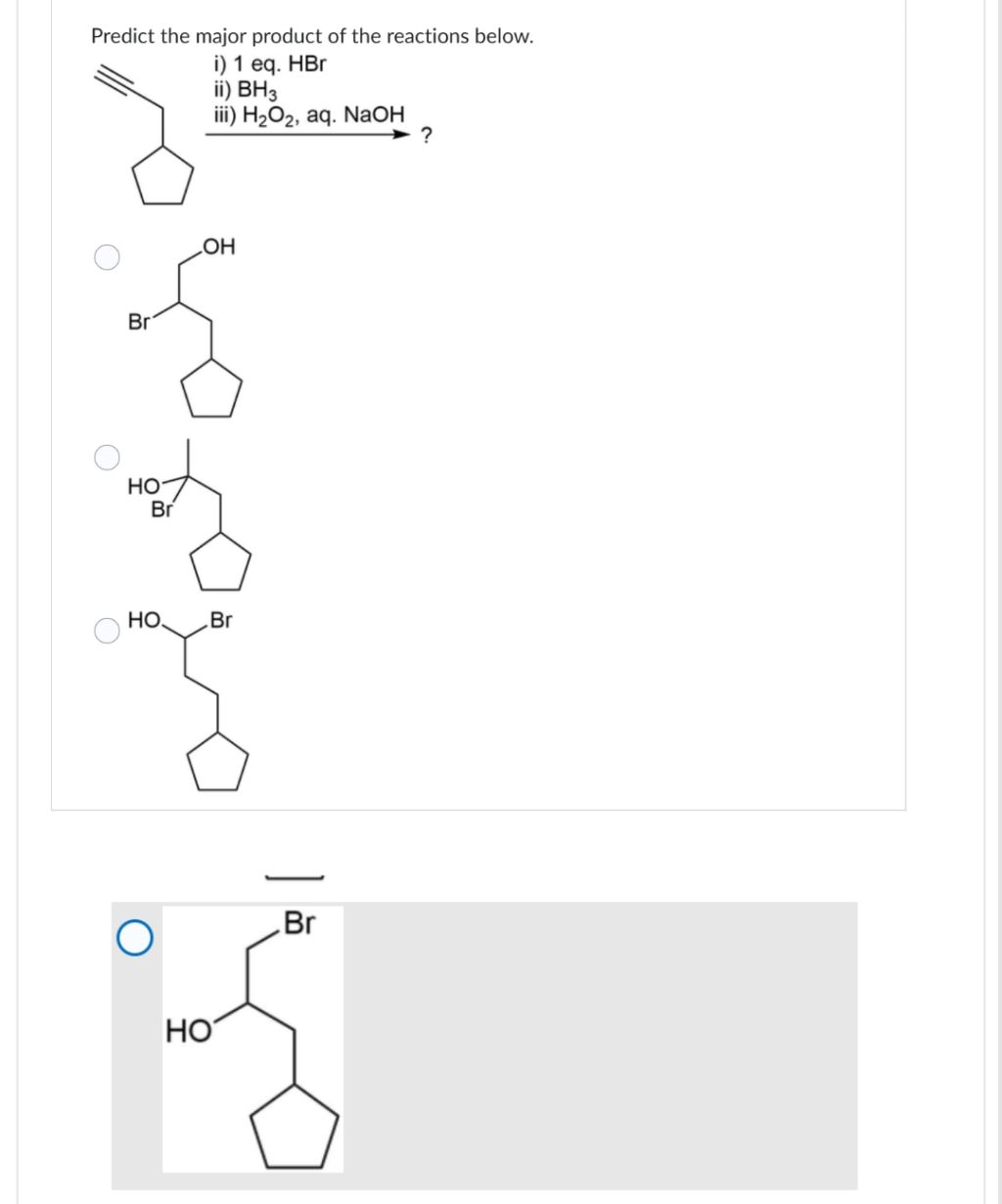 Predict the major product of the reactions below.
i) 1 eq. HBr
XX ii) BH
iii) H,0,, ag. NaOH 5
——
OH
Br” :
HO
Br
HO.
©) )
HO
This is AI generated Response.
Asked by: Rahul
Created at: 2026-01-26 03:35:09
Asked by: Rahul
Created at: 2026-01-26 03:35:09
Final Answer:
Rendered
Raw Text
Did you like this answer?
Let's break down the reaction sequence step by step:
## **Step 1: 1 eq. HBr (Hydrobromic Acid)**
- The starting compound is a cyclopentyl group attached to a terminal alkyne.
- Addition of 1 equivalent of HBr to a terminal alkyne gives a **Markovnikov addition** of Br, so Br adds to the more substituted carbon of the alkyne, forming a bromo-alkene.
**Product after Step 1:**
Cyclopentyl–CH=CH–Br (bromo-alkene, Br at the internal carbon, H at the terminal carbon)
---
## **Step 2: BH₃ (Hydroboration)**
- Hydroboration-oxidation of an alkene is **anti-Markovnikov** and adds an OH to the less substituted carbon (the terminal carbon in this case).
---
## **Step 3: H₂O₂, aq. NaOH (Oxidation)**
- This step replaces the boron with an OH group, maintaining the anti-Markovnikov addition.
**Final Product:**
- The product will have a Br at the internal carbon and an OH at the terminal carbon, both on the former alkyne chain.
- The structure: Cyclopentyl–CH(OH)–CH₂Br.
---
## **Matching With the Choices**
From the image, the **correct structure is:**
- Cyclopentyl group attached to a carbon with **OH** (secondary alcohol), which is attached to a carbon with **Br** (primary bromo group).
So, the selected answer at the bottom of the image is **correct**.
## **Final Answer**
The major product is:
```
Br
|
Cyclopentyl—CH—CH2—OH
```
Or more clearly, as shown in the selected answer:
- The **OH** is on the carbon directly attached to cyclopentane.
- The **Br** is on the next carbon.
**Explanation Recap:**
1. HBr adds Br to the internal carbon (Markovnikov).
2. Hydroboration-oxidation adds OH to the terminal carbon (anti-Markovnikov).
3. The product is cyclopentyl-CH(OH)-CH₂Br.
**Correct Option:** The one with **OH on the cyclopentyl carbon and Br on the next carbon** (selected option).
📢 Instructions:
- Ask anything relatd to above question only.
- For new Question goto :