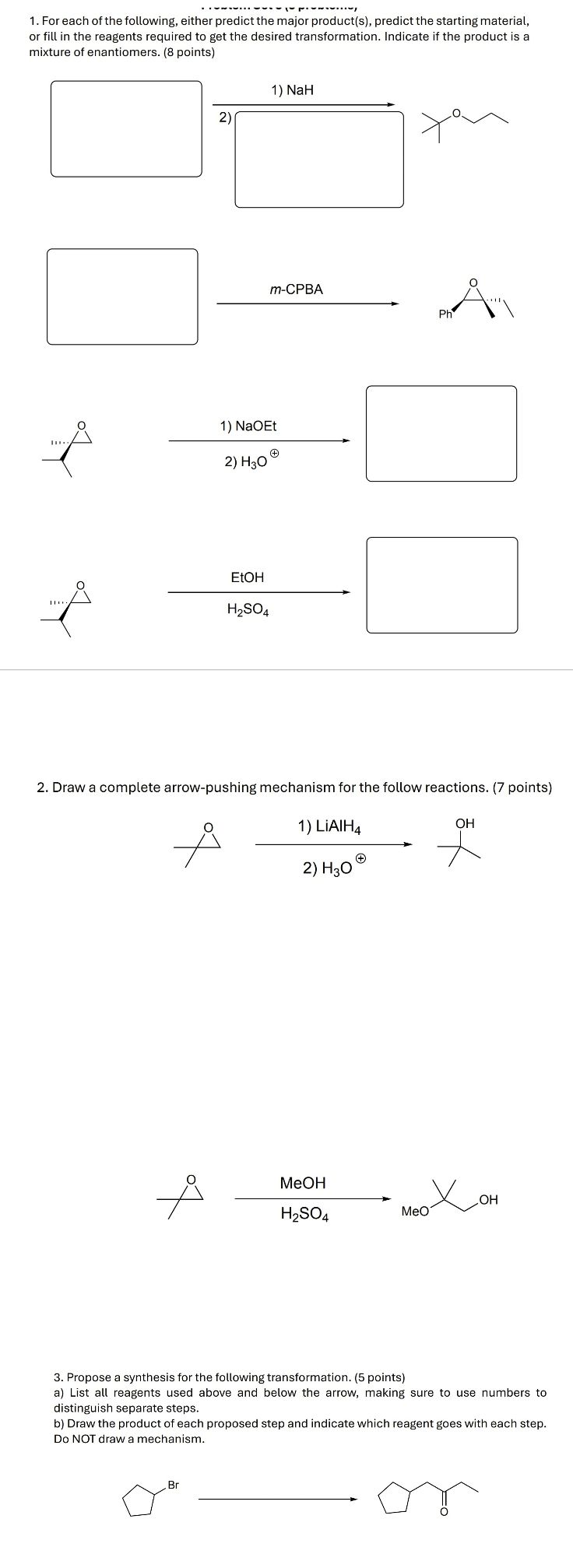
Give step-by-step solution with explanation and final answer:1. For each of the following, either predict the major product(s), predict the starting material,
or fill in the reagents required to get the desired transformation. Indicate if the product is a
mixture of enantiomers. (8 points)
1) NaH
1]
m-CPBA A
PH BY
0 1) NaOEt
®
re 2) H;0
° EtOH
Ee HpS04
2. Draw a complete arrow-pushing mechanism for the follow reactions. (7 points)
fo} 1) LiAlH4 OH
/ ® / ~
2) H30
IL MeOH
AE 5
H,S0, MeO
3. Propose a synthesis for the following transformation. (5 points)
a) List all reagents used above and below the arrow, making sure to use numbers to
distinguish separate steps.
b) Draw the product of each proposed step and indicate which reagent goes with each step.
Do NOT draw a mechanism.
) am
a !
Question:
Give step-by-step solution with explanation and final answer:1. For each of the following, either predict the major product(s), predict the starting material,
or fill in the reagents required to get the desired transformation. Indicate if the product is a
mixture of enantiomers. (8 points)
1) NaH
1]
m-CPBA A
PH BY
0 1) NaOEt
®
re 2) H;0
° EtOH
Ee HpS04
2. Draw a complete arrow-pushing mechanism for the follow reactions. (7 points)
fo} 1) LiAlH4 OH
/ ® / ~
2) H30
IL MeOH
AE 5
H,S0, MeO
3. Propose a synthesis for the following transformation. (5 points)
a) List all reagents used above and below the arrow, making sure to use numbers to
distinguish separate steps.
b) Draw the product of each proposed step and indicate which reagent goes with each step.
Do NOT draw a mechanism.
) am
a !
This is AI generated Response.
Asked by: Rahul
Created at: 2026-01-26 02:58:35
Final Answer:
RenderedRaw Text
Did you like this answer?
Let's solve each part step-by-step:
---
## 1. Predict Products or Fill Reagents
### a. Blank → 1) NaH 2) ? → Product:
**Product:** 
- **Explanation:** The product is an ether (Williamson ether synthesis). To get this, you need a tert-butyl alcohol and ethyl bromide (or chloride).
- **Starting material:** tert-butanol (**t-BuOH**)
- **Reagent 2:** Ethyl bromide (**EtBr**)
**Filled reaction:**
```
t-BuOH --1) NaH 2) EtBr--> t-BuOEt
```
---
### b. Product of m-CPBA with the given structure:
- **m-CPBA** is used for epoxidation of alkenes.
- The starting material must be a **trans-stilbene** (trans-1,2-diphenylethene).
**Starting material:**

**Product:** The epoxide shown is achiral, so **not a mixture of enantiomers**.
---
### c. Blank → 1) NaOEt 2) H₃O⁺ → Product:
- The product is a **β-keto ester** from a Claisen condensation.
**Starting material:** Ethyl acetate
**Product:**
Ethyl acetoacetate

---
### d. Given: β-ketone + EtOH, H₂SO₄ → Product?
- This is **acetal formation**.
**Product:**
_2CH_3})
---
## 2. Mechanism (LiAlH₄ reduction of a cyclopentanone)
**Mechanism:**
1. **Nucleophilic Attack:** LiAlH₄ donates a hydride to the carbonyl carbon, breaking the C=O π bond and forming an alkoxide.
2. **Protonation:** Acidic workup (H₃O⁺) protonates the alkoxide to give the alcohol.
**Arrow pushing:**
- Hydride from AlH₄⁻ attacks carbonyl C, electrons go to O.
- Proton from H₃O⁺ protonates the O⁻ to give OH.
**Product:** Cyclopentanol.
---
## 3. Synthesis Proposal
**Transformation:** Cyclopentyl bromide → cyclopentanone
**Steps:**
1. **Nucleophilic substitution to form nitrile:**
- Reagent: NaCN, DMSO (SN2)
- Product: cyclopentyl nitrile
2. **Hydrolysis of nitrile to carboxylic acid:**
- Reagent: H₃O⁺, heat
- Product: cyclopentanoic acid
3. **Conversion of acid to ketone (via acid chloride and Friedel-Crafts acylation):**
- a. SOCl₂ (to form acid chloride)
- b. AlCl₃ (to form cyclopentanone via ketone formation)
**Summary Table:**
| Step | Reagent/Condition | Product |
|------|-------------------------|--------------------------|
| 1 | NaCN, DMSO | cyclopentyl nitrile |
| 2 | H₃O⁺, heat | cyclopentanoic acid |
| 3a | SOCl₂ | cyclopentanoyl chloride |
| 3b | AlCl₃ | cyclopentanone |
---
### **Let me know if you need the structures drawn or more detailed mechanisms!**
Question:
Then solved
This is AI generated Response.
Asked by: Rahul
Created at: 2026-01-26 03:00:01
Final Answer:
RenderedRaw Text
Did you like this answer?
# Organic Chemistry Problem Solution
This document presents a step-by-step solution to the provided organic chemistry problems.
---
## 1. Predict Products or Fill Reagents
### a. Reaction with NaH
- **Reagents:**
- 1) NaH
- 2) Ethyl bromide (EtBr)
- **Starting Material:** tert-butanol (t-BuOH)
- **Product:** Ethyl tert-butyl ether (t-BuOEt)
**Reaction:**
```
t-BuOH --1) NaH 2) EtBr--> t-BuOEt
```
### b. Reaction with m-CPBA
- **Starting Material:** Trans-stilbene (trans-1,2-diphenylethene)
- **Product:** Epoxide (achiral, not a mixture of enantiomers)
### c. Reaction with NaOEt and H₃O⁺
- **Reagents:**
- 1) NaOEt
- 2) H₃O⁺
- **Starting Material:** Ethyl acetate
- **Product:** Ethyl acetoacetate
**Reaction:**
```
Ethyl acetate --1) NaOEt 2) H₃O⁺--> Ethyl acetoacetate
```
### d. Reaction of β-ketone with EtOH and H₂SO₄
- **Product:** Acetal (diethyl acetal of the β-ketone)
---
## 2. Mechanism for LiAlH₄ Reduction
### Steps of the Mechanism:
1. **Nucleophilic Attack:** LiAlH₄ donates a hydride (H⁻) to the carbonyl carbon of cyclopentanone, breaking the C=O bond and forming an alkoxide.
2. **Protonation:** The alkoxide is protonated by H₃O⁺ during workup, resulting in the formation of cyclopentanol.
**Product:** Cyclopentanol
---
## 3. Synthesis Proposal
### Transformation: Cyclopentyl bromide → Cyclopentanone
### Steps:
1. **Forming Nitrile:**
- **Reagents:** NaCN, DMSO
- **Product:** Cyclopentyl nitrile
2. **Hydrolysis to Carboxylic Acid:**
- **Reagents:** H₃O⁺, heat
- **Product:** Cyclopentanoic acid
3. **Converting Acid to Ketone:**
- a. **Reagent:** SOCl₂ (to form acid chloride)
- b. **Reagent:** AlCl₃ (to form cyclopentanone)
### Summary Table of Reagents and Products:
| Step | Reagent/Condition | Product |
|------|-------------------------|--------------------------|
| 1 | NaCN, DMSO | Cyclopentyl nitrile |
| 2 | H₃O⁺, heat | Cyclopentanoic acid |
| 3a | SOCl₂ | Cyclopentanoyl chloride |
| 3b | AlCl₃ | Cyclopentanone |
---
This structured solution provides clarity for each part of the problem, ensuring a comprehensive understanding of the reactions and mechanisms involved.
VIPSolutions focuses on clear, step‑by‑step explanations so you can learn quickly. Whether you need an AI‑generated walkthrough or a short hint to get unstuck, each solution is organized for fast reading and easy review later.
Search similar questions, compare approaches, and bookmark the best answers for revision. Our goal is simple: quick, reliable study help that feels natural—not noisy.
 VIPSolutions
 1. For each of the following, either predict the major product(s), predict the starting material,
or fill in the reagents required to get the desired transformation. Indicate if the product is a
mixture of enantiomers. (8 points)
1) NaH
1]
m-CPBA A
PH BY
0 1) NaOEt
®
re 2) H;0
° EtOH
Ee HpS04
2. Draw a complete arrow-pushing mechanism for the follow reactions. (7 points)
fo} 1) LiAlH4 OH
/ ® / ~
2) H30
IL MeOH
AE 5
H,S0, MeO
3. Propose a synthesis for the following transformation. (5 points)
a) List all reagents used above and below the arrow, making sure to use numbers to
distinguish separate steps.
b) Draw the product of each proposed step and indicate which reagent goes with each step.
Do NOT draw a mechanism.
) am
a !