 VIPSolutions
Give step-by-step solution with explanation and final answer:Consider the structure below (ignore gravity); Z, / Cc » $2 A < Yr] Qe \e {a © WW..b pg: > A v4 \ b N \6, 6, Afr” A Cr) a. Draw the overall free body diagram; state the number of unknown reactions and the total number of equations available from equilibrium. (2 pts) b. Draw the free body diagrams for members AC and AB; state the number of unknown reactions and the total number of equations you have from equilibrium. (5 pts) c. Write out all equilibrium equations (do not solve for the unknown forces!) (5 pts)
Question:
Give step-by-step solution with explanation and final answer: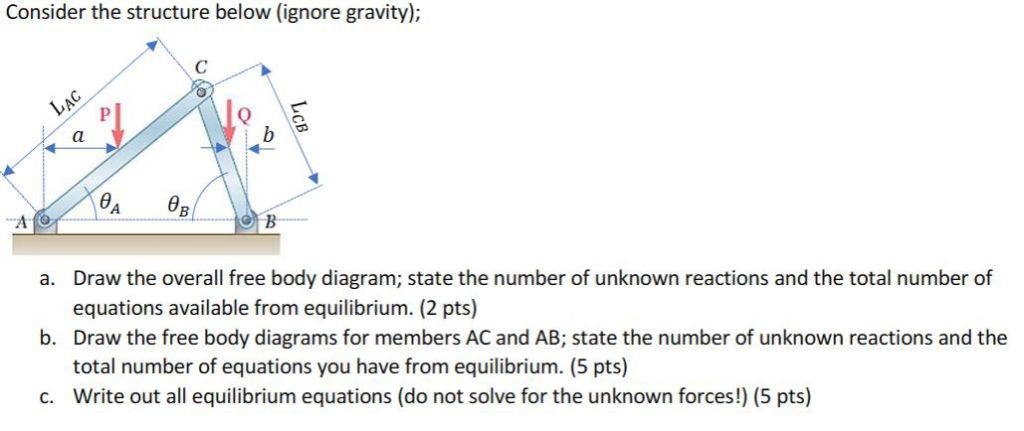 Consider the structure below (ignore gravity);
Z,
/ Cc »
$2 A <
Yr] Qe \e
{a © WW..b
pg: >
A v4 \ b
N \6, 6,
Afr” A Cr)
a. Draw the overall free body diagram; state the number of unknown reactions and the total number of
equations available from equilibrium. (2 pts)
b. Draw the free body diagrams for members AC and AB; state the number of unknown reactions and the
total number of equations you have from equilibrium. (5 pts)
c. Write out all equilibrium equations (do not solve for the unknown forces!) (5 pts)
This is AI generated Response.
Asked by: Rahul
Created at: 2026-01-26 02:40:21
Asked by: Rahul
Created at: 2026-01-26 02:40:21
Final Answer:
Rendered
Raw Text
Did you like this answer?
Let's solve each part step by step:
---
## a) **Overall Free Body Diagram (FBD)**
**Step 1: Draw the FBD**
- **At A (Pin Support):**
- Two reaction components: \(A_x\) and \(A_y\).
- **At B (Pin Support):**
- Two reaction components: \(B_x\) and \(B_y\).
- **At C (Pin Joint):**
- Internal forces between members (but for overall FBD, don't show internal forces).
- **External Loads:**
- Vertical force \(P\) at distance \(a\) from A.
- Vertical force \(Q\) at distance \(b\) from B.
**Diagram:**
```markdown
- Node A: Reaction forces \(A_x\), \(A_y\)
- Node B: Reaction forces \(B_x\), \(B_y\)
- Node C: External forces \(P\) (down), \(Q\) (down)
```
**Step 2: Number of Unknown Reactions**
- \(A_x, A_y, B_x, B_y\) = **4 unknowns**
**Step 3: Number of Equilibrium Equations**
- 2D system ⇒ \( \sum F_x = \), \( \sum F_y = \), \( \sum M = \) (**3 equations**)
---
## b) **FBDs for Members AC and CB**
### **Member AC**
- Isolate AC.
- At A: Pin support → \(A_x, A_y\)
- At C: Pin joint → Reaction forces from CB (let's call them \(C_{AC,x}, C_{AC,y}\))
**Unknowns for AC:**
- \(A_x, A_y, C_{AC,x}, C_{AC,y}\) (**4 unknowns**)
**Equilibrium Equations:**
- \( \sum F_x = \)
- \( \sum F_y = \)
- \( \sum M_A = \) (**3 equations**)
---
### **Member CB**
- At B: Pin support → \(B_x, B_y\)
- At C: Pin joint → Reaction forces from AC (opposite to those on AC, by Newton's 3rd law)
**Unknowns for CB:**
- \(B_x, B_y, C_{CB,x}, C_{CB,y}\) (**4 unknowns**; \(C_{CB,x} = -C_{AC,x}\), \(C_{CB,y} = -C_{AC,y}\))
**Equilibrium Equations:**
- \( \sum F_x = \)
- \( \sum F_y = \)
- \( \sum M_B = \) (**3 equations**)
---
## c) **Write Out All Equilibrium Equations**
### **For the Whole Structure**
\[
\begin{align*}
\sum F_x &: A_x + B_x = \\
\sum F_y &: A_y + B_y - P - Q = \\
\sum M_A &: -P \cdot a - Q \cdot (L_{AC} \cos\theta_A + b) + B_y \cdot (L_{AC} \cos\theta_A + L_{CB} \cos\theta_B) - B_x \cdot (L_{AC} \sin\theta_A + L_{CB} \sin\theta_B) = \\
\end{align*}
\]
(*You may need to adjust the moment arms based on the exact geometry; the form above illustrates the general approach.*)
---
### **For Member AC**
\[
\begin{align*}
\sum F_x &: A_x + C_{AC,x} = \\
\sum F_y &: A_y + C_{AC,y} - P = \\
\sum M_A &: -P \cdot a + C_{AC,x} \cdot L_{AC} \sin\theta_A + C_{AC,y} \cdot L_{AC} \cos\theta_A = \\
\end{align*}
\]
---
### **For Member CB**
\[
\begin{align*}
\sum F_x &: B_x + C_{CB,x} = \\
\sum F_y &: B_y + C_{CB,y} - Q = \\
\sum M_B &: -Q \cdot b + C_{CB,x} \cdot L_{CB} \sin\theta_B + C_{CB,y} \cdot L_{CB} \cos\theta_B = \\
\end{align*}
\]
---
## **Summary Table**
| Part | Unknowns | Equilibrium Equations |
|--------------|----------|----------------------|
| Whole Struct | 4 | 3 |
| AC | 4 | 3 |
| CB | 4 | 3 |
---
## **Final Answers (Concise):**
### a)
- **Draw the FBD** (as described above).
- **Unknown reactions:** 4 (\(A_x, A_y, B_x, B_y\))
- **Equilibrium Equations:** 3
### b)
- **Draw FBDs for AC and CB** (as described).
- **Unknown reactions per member:** 4
- **Equilibrium Equations per member:** 3
### c)
- **Equilibrium equations:** (as written above for the whole structure and each member).
---
**Let me know if you need the actual FBD sketches!**
Question:
Then solved
This is AI generated Response.
Asked by: Rahul
Created at: 2026-01-26 02:41:41
Asked by: Rahul
Created at: 2026-01-26 02:41:41
Final Answer:
Rendered
Raw Text
Did you like this answer?
# Solution to Structural Analysis Problem
## a) Overall Free Body Diagram (FBD)
### Step 1: Draw the FBD
- **At Point A (Pin Support):**
- Reaction forces: \(A_x\) (horizontal), \(A_y\) (vertical).
- **At Point B (Pin Support):**
- Reaction forces: \(B_x\) (horizontal), \(B_y\) (vertical).
- **At Point C (Pin Joint):**
- Internal forces between members (not detailed in overall FBD).
- **External Loads:**
- Vertical force \(P\) acting downwards at distance \(a\) from A.
- Vertical force \(Q\) acting downwards at distance \(b\) from B.
### Diagram Representation
```plaintext
- Node A: Reaction forces \(A_x, A_y\)
- Node B: Reaction forces \(B_x, B_y\)
- Node C: External forces \(P\) (down), \(Q\) (down)
```
### Step 2: Number of Unknown Reactions
- Total unknowns: \(A_x, A_y, B_x, B_y\) = **4 unknowns**
### Step 3: Number of Equilibrium Equations
- For a 2D system: 3 equilibrium equations available:
- \( \sum F_x = 0 \)
- \( \sum F_y = 0 \)
- \( \sum M = 0 \)
---
## b) Free Body Diagrams for Members AC and CB
### Member AC
- **At Point A:**
- Reaction forces: \(A_x, A_y\)
- **At Point C:**
- Internal forces from member CB (denote as \(C_{AC,x}, C_{AC,y}\)).
#### Unknowns for AC:
- Unknowns: \(A_x, A_y, C_{AC,x}, C_{AC,y}\) = **4 unknowns**
#### Equilibrium Equations:
- For Member AC:
- \( \sum F_x = 0 \)
- \( \sum F_y = 0 \)
- \( \sum M_A = 0 \)
---
### Member CB
- **At Point B:**
- Reaction forces: \(B_x, B_y\)
- **At Point C:**
- Internal forces from member AC (opposite to those on AC).
#### Unknowns for CB:
- Unknowns: \(B_x, B_y, C_{CB,x}, C_{CB,y}\) = **4 unknowns** (with \(C_{CB,x} = -C_{AC,x}\) and \(C_{CB,y} = -C_{AC,y}\))
#### Equilibrium Equations:
- For Member CB:
- \( \sum F_x = 0 \)
- \( \sum F_y = 0 \)
- \( \sum M_B = 0 \)
---
## c) Write Out All Equilibrium Equations
### For the Whole Structure
\[
\begin{align*}
\sum F_x &: A_x + B_x = 0 \\
\sum F_y &: A_y + B_y - P - Q = 0 \\
\sum M_A &: -P \cdot a - Q \cdot d + B_y \cdot L - B_x \cdot h = 0 \\
\end{align*}
\]
(*Where \(d\), \(L\), and \(h\) depend on the geometry of the structure.*)
---
### For Member AC
\[
\begin{align*}
\sum F_x &: A_x + C_{AC,x} = 0 \\
\sum F_y &: A_y + C_{AC,y} - P = 0 \\
\sum M_A &: -P \cdot a + C_{AC,x} \cdot L_{AC} \sin(\theta_A) + C_{AC,y} \cdot L_{AC} \cos(\theta_A) = 0 \\
\end{align*}
\]
---
### For Member CB
\[
\begin{align*}
\sum F_x &: B_x + C_{CB,x} = 0 \\
\sum F_y &: B_y + C_{CB,y} - Q = 0 \\
\sum M_B &: -Q \cdot b + C_{CB,x} \cdot L_{CB} \sin(\theta_B) + C_{CB,y} \cdot L_{CB} \cos(\theta_B) = 0 \\
\end{align*}
\]
---
## Summary Table
| Part | Unknowns | Equilibrium Equations |
|--------------|----------|-----------------------|
| Whole Struct | 4 | 3 |
| AC | 4 | 3 |
| CB | 4 | 3 |
---
## Final Answers
### a)
- **Overall FBD:** Drawn as described.
- **Unknown reactions:** 4 (\(A_x, A_y, B_x, B_y\))
- **Equilibrium Equations:** 3
### b)
- **Member AC FBD:** Drawn as described.
- **Unknown reactions per member:** 4
- **Equilibrium Equations per member:** 3
### c)
- **Equilibrium equations:** Written above for the whole structure and each member.
---
Let me know if you need further clarification or additional details!
📢 Instructions:
- Ask anything relatd to above question only.
- For new Question goto :