Give step-by-step solution with explanation and final answer:
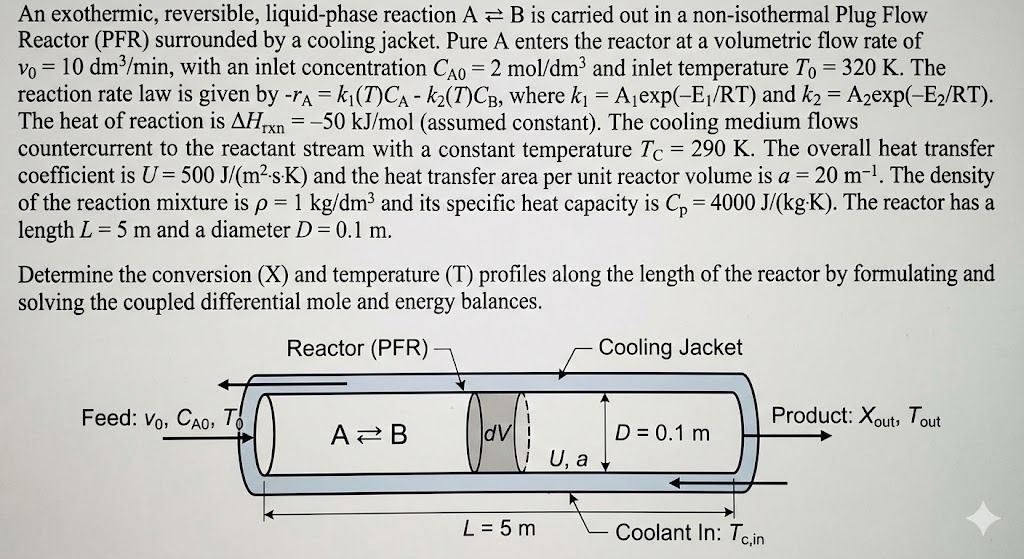
(give me answer without using bullet-points)An exothermic, reversible, liquid-phase reaction A = B is carried out in a non-isothermal Plug Flow
Reactor (PFR) surrounded by a cooling jacket. Pure A enters the reactor at a volumetric flow rate of
vo = 10 dm*min, with an inlet concentration Cx = 2 mol/dm? and inlet temperature Ty = 320 K. The
reaction rate law is given by -r = k;(T)Cy - ky(T)Cp, where k; = A exp(—E{/RT) and k, = Azexp(-E/RT).
The heat of reaction is AH, = —50 kJ/mol (assumed constant). The cooling medium flows
countercurrent to the reactant stream with a constant temperature 7c = 290 K. The overall heat transfer
coefficient is U= 500 J/(m?sK) and the heat transfer area per unit reactor volume is a = 20 m™!. The density
of the reaction mixture is p = 1 kg/dm? and its specific heat capacity is C;, =4000 J/(kgK). The reactor has a
length L = 5 m and a diameter D = 0.1 m.
Determine the conversion (X) and temperature (T) profiles along the length of the reactor by formulating and
solving the coupled differential mole and energy balances.
Reactor (PFR) Cooling Jacket
\ i
Feed: vy, Cao, Tg A=B beonm \ Product: Xu, Tout
\ I Ua /]
—
L=5m Coolant In: Tj,
Question:
Give step-by-step solution with explanation and final answer:
(give me answer without using bullet-points)An exothermic, reversible, liquid-phase reaction A = B is carried out in a non-isothermal Plug Flow
Reactor (PFR) surrounded by a cooling jacket. Pure A enters the reactor at a volumetric flow rate of
vo = 10 dm*min, with an inlet concentration Cx = 2 mol/dm? and inlet temperature Ty = 320 K. The
reaction rate law is given by -r = k;(T)Cy - ky(T)Cp, where k; = A exp(—E{/RT) and k, = Azexp(-E/RT).
The heat of reaction is AH, = —50 kJ/mol (assumed constant). The cooling medium flows
countercurrent to the reactant stream with a constant temperature 7c = 290 K. The overall heat transfer
coefficient is U= 500 J/(m?sK) and the heat transfer area per unit reactor volume is a = 20 m™!. The density
of the reaction mixture is p = 1 kg/dm? and its specific heat capacity is C;, =4000 J/(kgK). The reactor has a
length L = 5 m and a diameter D = 0.1 m.
Determine the conversion (X) and temperature (T) profiles along the length of the reactor by formulating and
solving the coupled differential mole and energy balances.
Reactor (PFR) Cooling Jacket
\ i
Feed: vy, Cao, Tg A=B beonm \ Product: Xu, Tout
\ I Ua /]
—
L=5m Coolant In: Tj,
This is AI generated Response.
Asked by: Francis
Created at: 2026-01-25 22:08:04
Final Answer:
RenderedRaw Text
Did you like this answer?
Let's break down the solution step by step, focusing on setting up the coupled **mole** and **energy balance** equations for the non-isothermal PFR (Plug Flow Reactor):
---
## **Step 1: Mole Balance for Species A**
For a PFR, the mole balance on A is:
\[
\frac{dF_A}{dV} = r_A
\]
where \( F_A = C_A v_ \), and \( r_A \) is the rate of consumption of A (note: \( r_A < \)).
Given rate law:
\[
-r_A = k_1(T)C_A - k_2(T)C_B
\]
with
\[
k_1(T) = A_1 \exp\left(-\frac{E_1}{RT}\right)\\
k_2(T) = A_2 \exp\left(-\frac{E_2}{RT}\right)
\]
Define **conversion** \( X \) at any position:
\[
X = \frac{C_{A} - C_A}{C_{A}}
\]
So,
\[
C_A = C_{A}(1-X)
\]
For a 1:1 stoichiometry, \( C_B = C_{A}X \).
Substitute into the rate law:
\[
-r_A = k_1(T)C_{A}(1-X) - k_2(T)C_{A}X
\]
Plug into mole balance:
\[
\frac{dF_A}{dV} = r_A
\]
But \( F_A = C_A v_ = v_ C_{A}(1-X) \), so:
\[
\frac{d}{dV}[v_ C_{A}(1-X)] = r_A
\]
Since \( v_ \) is constant (liquid phase, constant density):
\[
-v_ C_{A} \frac{dX}{dV} = -k_1(T)C_{A}(1-X) + k_2(T)C_{A}X
\]
\[
\frac{dX}{dV} = \frac{k_1(T)(1-X) - k_2(T)X}{v_}
\]
---
## **Step 2: Energy Balance**
The general energy balance for a differential element \( dV \) is:
\[
\frac{d}{dV}(\rho v_ C_p T) = -r_A(-\Delta H_{rxn}) - Ua(T - T_C)
\]
Since \( \rho \) is constant and \( v_ \) is constant:
\[
\rho v_ C_p \frac{dT}{dV} = -r_A(-\Delta H_{rxn}) - Ua(T - T_C)
\]
Recall \( r_A \) (already derived above):
\[
r_A = -[k_1(T)C_{A}(1-X) - k_2(T)C_{A}X]
\]
So the energy balance becomes:
\[
\rho v_ C_p \frac{dT}{dV} = [k_1(T)C_{A}(1-X) - k_2(T)C_{A}X](-\Delta H_{rxn}) - Ua(T - T_C)
\]
---
## **Step 3: Substitute Known Values**
Given values:
- \( v_ = 10 \) dm³/min = \( 1.67 \times 10^{-4} \) m³/s (since 1 dm³ = 10⁻³ m³, 1 min = 60 s)
- \( C_{A} = 2 \) mol/dm³ = \( 200 \) mol/m³
- \( T_ = 320 \) K
- \( \Delta H_{rxn} = -50 \) kJ/mol = \(-50,000\) J/mol
- \( T_C = 290 \) K
- \( U = 500 \) J/(m²·s·K)
- \( a = 20 \) m⁻¹
- \( \rho = 1 \) kg/dm³ = 100 kg/m³
- \( C_p = 400 \) J/(kg·K)
- \( L = 5 \) m, \( D = .1 \) m
---
## **Step 4: Write Final ODEs**
Define \( V = \text{reactor volume} \), but for a PFR, \( dV = A dx \), with \( x \) the length coordinate. The total reactor volume is \( V_{tot} = \pi(D^2/4)L \).
So the coupled ODEs are:
\[
\frac{dX}{dV} = \frac{k_1(T)(1-X) - k_2(T)X}{v_}
\]
\[
\frac{dT}{dV} = \frac{[k_1(T)(1-X) - k_2(T)X](-\Delta H_{rxn}) - Ua(T - T_C)}{\rho v_ C_p}
\]
Where:
\[
k_1(T) = A_1 \exp\left(-\frac{E_1}{RT}\right)
\]
\[
k_2(T) = A_2 \exp\left(-\frac{E_2}{RT}\right)
\]
Initial conditions at \( V = \):
\[
X() = , \quad T) = T_ = 320\,K
\]
---
## **Step 5: Final Answer (System to Solve)**
The conversion \( X \) and temperature \( T \) profiles are determined by **numerically integrating** the following coupled ODEs from \( V = \) to \( V = V_{tot} \):
\[
\boxed{
\begin{align*}
\frac{dX}{dV} &= \frac{k_1(T)(1-X) - k_2(T)X}{v_} \\[1.5em]
\frac{dT}{dV} &= \frac{[k_1(T)(1-X) - k_2(T)X](-\Delta H_{rxn}) - Ua(T - T_C)}{\rho v_ C_p}
\end{align*}
}
\]
with initial conditions:
\[
X() = ,\quad T() = 320\, \text{K}
\]
Where each parameter is known or defined above. These equations, along with the rate constants' temperature dependence, are what you solve (typically with a computational tool) to get \( X_{out} \) and \( T_{out} \) at the reactor exit (\( V = V_{tot} \)).
VIPSolutions focuses on clear, step‑by‑step explanations so you can learn quickly. Whether you need an AI‑generated walkthrough or a short hint to get unstuck, each solution is organized for fast reading and easy review later.
Search similar questions, compare approaches, and bookmark the best answers for revision. Our goal is simple: quick, reliable study help that feels natural—not noisy.
 VIPSolutions
 An exothermic, reversible, liquid-phase reaction A = B is carried out in a non-isothermal Plug Flow
Reactor (PFR) surrounded by a cooling jacket. Pure A enters the reactor at a volumetric flow rate of
vo = 10 dm*min, with an inlet concentration Cx = 2 mol/dm? and inlet temperature Ty = 320 K. The
reaction rate law is given by -r = k;(T)Cy - ky(T)Cp, where k; = A exp(—E{/RT) and k, = Azexp(-E/RT).
The heat of reaction is AH, = —50 kJ/mol (assumed constant). The cooling medium flows
countercurrent to the reactant stream with a constant temperature 7c = 290 K. The overall heat transfer
coefficient is U= 500 J/(m?sK) and the heat transfer area per unit reactor volume is a = 20 m™!. The density
of the reaction mixture is p = 1 kg/dm? and its specific heat capacity is C;, =4000 J/(kgK). The reactor has a
length L = 5 m and a diameter D = 0.1 m.
Determine the conversion (X) and temperature (T) profiles along the length of the reactor by formulating and
solving the coupled differential mole and energy balances.
Reactor (PFR) Cooling Jacket
\ i
Feed: vy, Cao, Tg A=B beonm \ Product: Xu, Tout
\ I Ua /]
—
L=5m Coolant In: Tj,