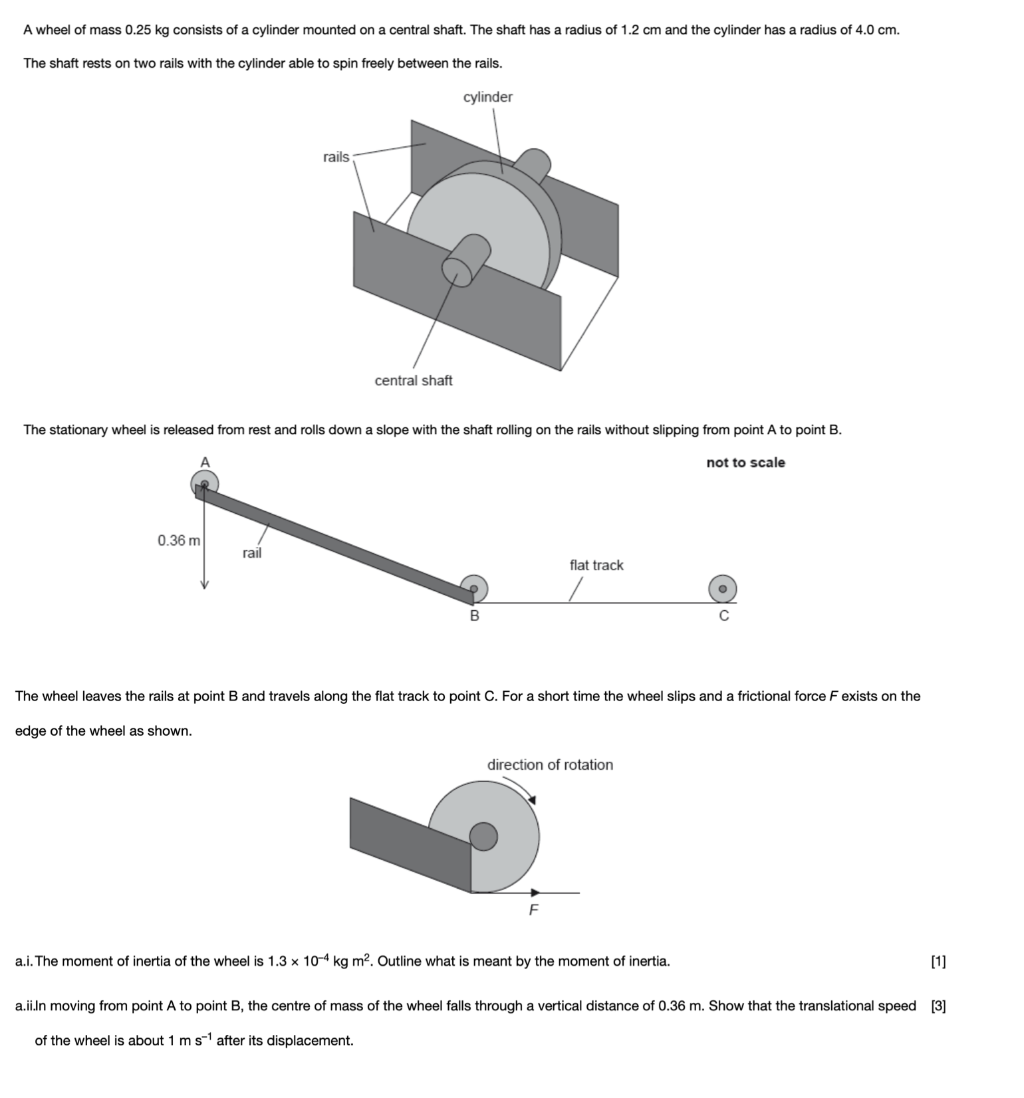
Give step-by-step solution with explanation and final answer:A wheel of mass 0.25 kg consists of a cylinder mounted on a central shaft. The shaft has a radius of 1.2 om and the cylinder has a radius of 4.0 om.
‘The shaft rests on two rails with the cylinder able to spin freely between the rails.
cylinder
a
central shaft
‘The stationary wheel s released from rest and rolls down a slope with the shaft rolling on the rails without slipping from point A to point B.
A not to scale
036m
rail
flat track
B c
The wheel leaves the rails at point B and travels along the flat track to point C. For a short time the wheel slips and a frictional force F exists on the
edge of the wheel as shown.
direction of rotation
F
a.i.The moment of inertia of the wheel is 1.3 x 10⁻⁴ kg m?. Outline what is meant by the moment of inertia. [i]
aiiin moving from point A to point B, the centre of mass of the wheel falls through a vertical distance of 0.36 m. Show that the translational speed [3]
of the wheel is about 1 m 5” after its displacement.
Question:
Give step-by-step solution with explanation and final answer:A wheel of mass 0.25 kg consists of a cylinder mounted on a central shaft. The shaft has a radius of 1.2 om and the cylinder has a radius of 4.0 om.
‘The shaft rests on two rails with the cylinder able to spin freely between the rails.
cylinder
a
central shaft
‘The stationary wheel s released from rest and rolls down a slope with the shaft rolling on the rails without slipping from point A to point B.
A not to scale
036m
rail
flat track
B c
The wheel leaves the rails at point B and travels along the flat track to point C. For a short time the wheel slips and a frictional force F exists on the
edge of the wheel as shown.
direction of rotation
F
a.i.The moment of inertia of the wheel is 1.3 x 10⁻⁴ kg m?. Outline what is meant by the moment of inertia. [i]
aiiin moving from point A to point B, the centre of mass of the wheel falls through a vertical distance of 0.36 m. Show that the translational speed [3]
of the wheel is about 1 m 5” after its displacement.
This is AI generated Response.
Asked by: Rahul
Created at: 2026-01-25 20:18:34
Final Answer:
RenderedRaw Text
Did you like this answer?
Let's work through the questions step by step.
---
## a.i. **Outline what is meant by the moment of inertia.**
**Answer:**
The **moment of inertia** of a body is a measure of how difficult it is to change its rotational motion about a particular axis. It depends on the mass of the object and how that mass is distributed relative to the axis of rotation. Mathematically, for discrete masses, it is given by:
\[
I = \sum m_i r_i^2
\]
where \( m_i \) is the mass of the \(i\)th particle and \( r_i \) is its perpendicular distance from the axis of rotation.
---
## a.ii. **Show that the translational speed of the wheel is about 1 m/s after rolling down a vertical distance of .36 m.**
### **Step 1: Conservation of Energy**
When the wheel is released, it has gravitational potential energy and no kinetic energy. When it reaches point B, its potential energy is converted into translational and rotational kinetic energy.
- **Initial energy at A:**
\[
E_{\text{potential}} = mgh
\]
- **Final energy at B:**
- Translational kinetic energy: \(\frac{1}{2}mv^2\)
- Rotational kinetic energy: \(\frac{1}{2}I\omega^2\)
So, energy conservation gives:
\[
mgh = \frac{1}{2}mv^2 + \frac{1}{2}I\omega^2
\]
### **Step 2: Relationship Between Translational and Rotational Velocity**
Since the wheel rolls without slipping, the velocity \(v\) of the center of mass is related to the angular velocity \(\omega\):
\[
v = r_{\text{shaft}}\omega
\]
where \( r_{\text{shaft}} = .012 \) m.
### **Step 3: Substitute and Solve**
Substitute \(\omega = \frac{v}{r_{\text{shaft}}}\) into the energy equation:
\[
mgh = \frac{1}{2}mv^2 + \frac{1}{2}I\left(\frac{v}{r_{\text{shaft}}}\right)^2
\]
Given:
- \( m = .25 \) kg
- \( h = .36 \) m
- \( I = 1.3 \times 10^{-4} \) kg m\(^2\)
- \( r_{\text{shaft}} = .012 \) m
- \( g = 9.8 \) m/s\(^2\)
Plug in the values:
\[
.25 \times 9.8 \times .36 = \frac{1}{2} \times .25 \times v^2 + \frac{1}{2} \times 1.3 \times 10^{-4} \times \left(\frac{v}{.012}\right)^2
\]
Calculate the left side:
\[
.25 \times 9.8 \times .36 = .882 \text{ J}
\]
Now the right side:
- \(\frac{1}{2} \times .25 = .125\)
- \(\frac{1}{2} \times 1.3 \times 10^{-4} = 6.5 \times 10^{-5}\)
The rotational term:
\[
\left(\frac{v}{.012}\right)^2 = \frac{v^2}{.000144}
\]
So,
\[
.882 = .125v^2 + 6.5 \times 10^{-5} \times \frac{v^2}{.000144}
\]
Calculate the second term:
\[
\frac{6.5 \times 10^{-5}}{.000144} = .4514
\]
So,
\[
.882 = .125v^2 + .4514v^2
\]
\[
.882 = (.125 + .4514)v^2
\]
\[
.882 = .5764v^2
\]
\[
v^2 = \frac{.882}{.5764} = 1.53
\]
\[
v = \sqrt{1.53} \approx 1.24 \text{ m/s}
\]
---
### **Conclusion**
- The calculated speed is about **1.2 m/s**, which is close to the stated “about 1 m/s.”
- **Thus, the translational speed after rolling down .36 m is about 1 m/s.**
---
## **Summary Table**
| Quantity | Value |
|-----------------|-------------|
| Mass \(m\) | .25 kg |
| Height \(h\) | .36 m |
| Inertia \(I\) | \(1.3 \times 10^{-4}\) kg·m² |
| Shaft radius \(r\) | .012 m |
| Speed \(v\) | \(\approx 1.2\) m/s |
---
Let me know if you'd like the next part of the problem solved!
VIPSolutions focuses on clear, step‑by‑step explanations so you can learn quickly. Whether you need an AI‑generated walkthrough or a short hint to get unstuck, each solution is organized for fast reading and easy review later.
Search similar questions, compare approaches, and bookmark the best answers for revision. Our goal is simple: quick, reliable study help that feels natural—not noisy.
 VIPSolutions
 A wheel of mass 0.25 kg consists of a cylinder mounted on a central shaft. The shaft has a radius of 1.2 om and the cylinder has a radius of 4.0 om.
‘The shaft rests on two rails with the cylinder able to spin freely between the rails.
cylinder
a
central shaft
‘The stationary wheel s released from rest and rolls down a slope with the shaft rolling on the rails without slipping from point A to point B.
A not to scale
036m
rail
flat track
B c
The wheel leaves the rails at point B and travels along the flat track to point C. For a short time the wheel slips and a frictional force F exists on the
edge of the wheel as shown.
direction of rotation
F
a.i.The moment of inertia of the wheel is 1.3 x 10⁻⁴ kg m?. Outline what is meant by the moment of inertia. [i]
aiiin moving from point A to point B, the centre of mass of the wheel falls through a vertical distance of 0.36 m. Show that the translational speed [3]
of the wheel is about 1 m 5” after its displacement.