VIPSolutions logo ✨ VIPSolutions

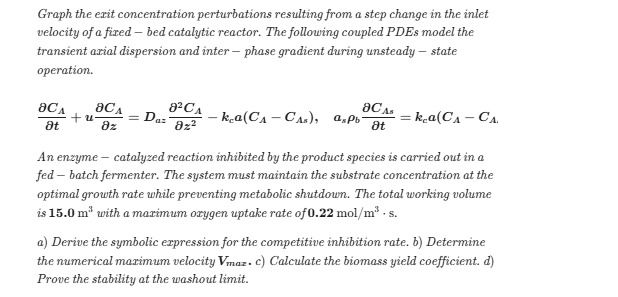
Give step-by-step solution with explanation and final answer: (Give me answer without using bullet-points)Graph the exit concentration perturbations resulting from a step change in the inlet velocity ofa fired — bed catalytic reactor. The following coupled PDEs model the transient arial dispersion and inter — phase gradient during unsteady — state operation. 8C, | 8C. | #0. 9Cu _ To Hug = Dut — ka(Ca— Ca). aun pt =kea(Ca— Ca An enzyme — catalysed reaction inhibited bythe product species i carried outin a fed — batch fermenter. The system must maintain the substrate concentration at the optimal grouth rate while preventing metabolic shutdoun. The total working volume 515.0 m" with a mazimum orygen uptake rate of0.22 mol/m® +s. a) Derive the symbolic expression for the competitive inhibition rate. b) Determine the numerical mazimum velocity Visa. c) Calculate the biomass yield coefficient. d) Prove the stability at the washout limit.
Question:

Give step-by-step solution with explanation and final answer: (Give me answer without using bullet-points)Uploaded ImageGraph the exit concentration perturbations resulting from a step change in the inlet velocity ofa fired — bed catalytic reactor. The following coupled PDEs model the transient arial dispersion and inter — phase gradient during unsteady — state operation. 8C, | 8C. | #0. 9Cu _ To Hug = Dut — ka(Ca— Ca). aun pt =kea(Ca— Ca An enzyme — catalysed reaction inhibited bythe product species i carried outin a fed — batch fermenter. The system must maintain the substrate concentration at the optimal grouth rate while preventing metabolic shutdoun. The total working volume 515.0 m" with a mazimum orygen uptake rate of0.22 mol/m® +s. a) Derive the symbolic expression for the competitive inhibition rate. b) Determine the numerical mazimum velocity Visa. c) Calculate the biomass yield coefficient. d) Prove the stability at the washout limit.

This is AI generated Response.
Asked by: Francis
Created at: 2026-01-25 08:39:29

Final Answer:

Rendered Raw Text
Did you like this answer?
Let's break down the solution step-by-step for each part of the question: --- ## **a) Derive the symbolic expression for the competitive inhibition rate** For a competitive inhibition in enzyme kinetics, the rate equation is: \[ v = \frac{V_{max}[S]}{K_m \left(1 + \frac{[I]}{K_i}\right) + [S]} \] Where: - \( [S] \) = Substrate concentration - \( [I] \) = Inhibitor (product) concentration - \( V_{max} \) = Maximum reaction rate - \( K_m \) = Michaelis-Menten constant - \( K_i \) = Inhibition constant This equation shows how the presence of the inhibitor increases the apparent \( K_m \) (but not \( V_{max} \)), thus reducing the rate. --- ## **b) Determine the numerical maximum velocity \( V_{max} \)** Given Data: - Maximum oxygen uptake rate = \( .22 \) mol/m³·s - Working volume = \( 15. \) m³ The maximum rate in terms of total moles per second: \[ V_{max,\,total} = (\text{max uptake rate}) \times (\text{volume}) = .22 \, \frac{\text{mol}}{\text{m}^3 \cdot \text{s}} \times 15. \, \text{m}^3 = 3.3 \, \frac{\text{mol}}{\text{s}} \] If asked for per volume, it's \( .22 \) mol/m³·s. --- ## **c) Calculate the biomass yield coefficient** The biomass yield coefficient (\( Y_X/S \)) is defined as: \[ Y_{X/S} = \frac{\text{mass of cells formed}}{\text{mass of substrate consumed}} \] This is typically determined experimentally or given. If you have oxygen as the limiting substrate, and assuming you have the substrate yield coefficient on oxygen (\( Y_{X/O_2} \)), you would use that value: \[ Y_{X/O_2} = \frac{\Delta X}{\Delta O_2} \] If not provided, you might need extra data (e.g., grams of biomass formed per mole of oxygen consumed). For example, if for every mole of \( O_2 \) consumed, .5 grams of biomass is produced, \[ Y_{X/O_2} = .5 \, \text{g biomass/mol O}_2 \] --- ## **d) Prove the stability at the washout limit** In a continuous stirred tank reactor (CSTR), washout occurs when the dilution rate \( D \) exceeds the maximum specific growth rate \( \mu_{max} \): \[ D = \frac{F}{V} \] At washout (\( D = \mu_{max} \)), the biomass concentration approaches zero. To analyze stability, consider the balance: \[ \frac{dX}{dt} = (\mu - D)X \] At washout, \( \mu = D \), so: \[ \frac{dX}{dt} = \] If \( D > \mu_{max} \), \( \frac{dX}{dt} < \) and biomass will decrease to zero (stable washout point). If \( D < \mu_{max} \), biomass can be maintained. Thus, the washout point is **stable**—any perturbation that decreases biomass will continue to drive it to zero. --- ### **Summary of Answers** a) The competitive inhibition rate is \( v = \frac{V_{max}[S]}{K_m(1 + \frac{[I]}{K_i}) + [S]} \) b) The numerical maximum velocity \( V_{max} \) is \( .22 \) mol/m³·s, or \( 3.3 \) mol/s for the total reactor c) The biomass yield coefficient \( Y_{X/O_2} \) is calculated as \( \frac{\Delta X}{\Delta O_2} \), with a numerical value requiring more data d) The washout point is stable; for \( D > \mu_{max} \), biomass decays to zero and does not recover If you need the graphing of PDEs or more details on the reactor model, let me know!

📢 Instructions:

  • Ask anything relatd to above question only.
  • For new Question goto :

Study Help, Fast Answers

VIPSolutions focuses on clear, step‑by‑step explanations so you can learn quickly. Whether you need an AI‑generated walkthrough or a short hint to get unstuck, each solution is organized for fast reading and easy review later.

Search similar questions, compare approaches, and bookmark the best answers for revision. Our goal is simple: quick, reliable study help that feels natural—not noisy.