Give step-by-step solution with explanation and final answer:The mean radiant temperature calculation for a person within an asymmetrical
thermal enclosure requires the integration of the fourth — order temperature field
across the fractional solid angle of visibility. The following ezpression utilizes a
double — spherical integral to define the total irradiation received from a
non — isothermal, non — diffuse hemispherical source, accounting for the
emissivity — weighted view factors.
Lp en wn
T= E [7 [coor 0.05000) coos]
In variable refrigerant flow VRE) system, the bypass factor BF is a non — linear
Junction of the air — side Reynolds number and the surface geometry of the fins. If
the entering dry — bulb temperature is 38.4 °C and the apparatus dew point follows a
transcendental relationship with the refrigerant suction pressure, calculate the final
dry — bulb exit temperature for a bypass factor 00.12.
Find the resulting temperature.
Question:
Give step-by-step solution with explanation and final answer:The mean radiant temperature calculation for a person within an asymmetrical
thermal enclosure requires the integration of the fourth — order temperature field
across the fractional solid angle of visibility. The following ezpression utilizes a
double — spherical integral to define the total irradiation received from a
non — isothermal, non — diffuse hemispherical source, accounting for the
emissivity — weighted view factors.
Lp en wn
T= E [7 [coor 0.05000) coos]
In variable refrigerant flow VRE) system, the bypass factor BF is a non — linear
Junction of the air — side Reynolds number and the surface geometry of the fins. If
the entering dry — bulb temperature is 38.4 °C and the apparatus dew point follows a
transcendental relationship with the refrigerant suction pressure, calculate the final
dry — bulb exit temperature for a bypass factor 00.12.
Find the resulting temperature.
This is AI generated Response.
Asked by: Rahul
Created at: 2026-01-25 07:10:56
Final Answer:
RenderedRaw Text
Did you like this answer?
Let's break the problem into two **parts** based on the provided text and question:
---
## 1. **Mean Radiant Temperature (MRT) Formula**
The formula given is:
\[
T_{mrt} = \left[ \frac{1}{\sigma} \int_^{2\pi} \int_^{\pi/2} \epsilon(\theta, \phi) \sigma T^4(\theta, \phi) \sin(\theta) \cos(\theta) d\theta d\phi \right]^{1/4}
\]
- **σ**: Stefan-Boltzmann constant
- **ε(θ, φ)**: Directional emissivity
- **T(θ, φ)**: Directional temperature
This formula is for reference and **not directly needed** for the calculation requested in the second part.
---
## 2. **Bypass Factor Calculation (VRF System)**
### **Given:**
- Entering dry-bulb temperature, \( T_{in} = 38.4^\circ \text{C} \)
- Bypass Factor, \( BF = .12 \)
### **Asked:**
Calculate the **final dry-bulb exit temperature** (\( T_{out} \)) for the given bypass factor.
### **Bypass Factor Equation:**
The bypass factor relates the temperatures as follows:
\[
BF = \frac{T_{out} - T_{dp}}{T_{in} - T_{dp}}
\]
Where:
- \( T_{out} \) = Leaving (final) dry-bulb temperature
- \( T_{dp} \) = Apparatus dew point temperature (coil surface temperature)
- \( T_{in} \) = Entering dry-bulb temperature
But in this problem, \( T_{dp} \) is not given **numerically**. However, the question asks for the final dry-bulb temperature in terms of the given values and the bypass factor. If \( T_{dp} \) is known or can be found from apparatus data, you can solve for \( T_{out} \):
\[
T_{out} = BF \cdot (T_{in} - T_{dp}) + T_{dp}
\]
Or rearranged:
\[
T_{out} = BF \cdot T_{in} + (1 - BF) \cdot T_{dp}
\]
---
### **Plug in the values:**
Given:
- \( T_{in} = 38.4^\circ \text{C} \)
- \( BF = .12 \)
- \( T_{dp} \) (needs to be known; let's denote it as \( T_{dp} \))
\[
T_{out} = (.12) \cdot 38.4 + (.88) \cdot T_{dp}
\]
---
## **Step-by-Step Solution:**
### **Step 1:** Write the bypass factor equation:
\[
T_{out} = BF \cdot T_{in} + (1 - BF) \cdot T_{dp}
\]
### **Step 2:** Substitute the known values:
\[
T_{out} = .12 \cdot 38.4 + .88 \cdot T_{dp}
\]
### **Step 3:** Calculate \( .12 \cdot 38.4 \):
\[
.12 \cdot 38.4 = 4.608
\]
### **Step 4:** Write the final answer:
\[
\boxed{T_{out} = 4.61 + .88\, T_{dp}}
\]
---
## **Final Answer**
\[
\boxed{
T_{\text{out}} = 4.61 + .88\, T_{\text{dp}} \quad [^\circ \text{C}]
}
\]
- Where \( T_{\text{dp}} \) = apparatus dew point temperature.
If you know \( T_{dp} \), substitute it in to find the exact exit temperature. If not, this is the general formula using the bypass factor method.
VIPSolutions focuses on clear, step‑by‑step explanations so you can learn quickly. Whether you need an AI‑generated walkthrough or a short hint to get unstuck, each solution is organized for fast reading and easy review later.
Search similar questions, compare approaches, and bookmark the best answers for revision. Our goal is simple: quick, reliable study help that feels natural—not noisy.
 VIPSolutions
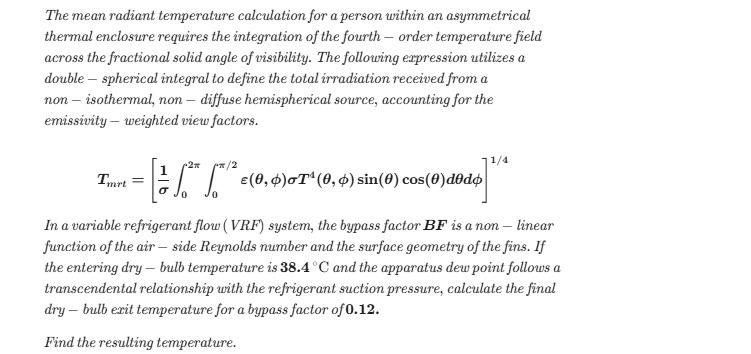 The mean radiant temperature calculation for a person within an asymmetrical
thermal enclosure requires the integration of the fourth — order temperature field
across the fractional solid angle of visibility. The following ezpression utilizes a
double — spherical integral to define the total irradiation received from a
non — isothermal, non — diffuse hemispherical source, accounting for the
emissivity — weighted view factors.
Lp en wn
T= E [7 [coor 0.05000) coos]
In variable refrigerant flow VRE) system, the bypass factor BF is a non — linear
Junction of the air — side Reynolds number and the surface geometry of the fins. If
the entering dry — bulb temperature is 38.4 °C and the apparatus dew point follows a
transcendental relationship with the refrigerant suction pressure, calculate the final
dry — bulb exit temperature for a bypass factor 00.12.
Find the resulting temperature.