Give step-by-step solution with explanation and final answer:
Take a
=
0
.
5
m and M
=
6
0
kg
.
Calculate the support reaction Ax
[
N
]
Calculate the support reaction Ay
[
N
]
Calculate the support reaction Ey
[
N
]
Find the internal normal force NAB at the midpoint of segment AB
[
N
]
Find the internal shear force VAB at the midpoint of segment AB
[
N
]
Find the internal bending moment MAB at the midpoint of segment AB
[
N
-
m
]
Find the internal normal force NBE at the midpoint of segment BE
[
N
]
Find the internal shear force VBE at the midpoint of segment BE
[
N
]
Find the internal bending moment MBE at the midpoint of segment BE
[
N
-
m
]
.
Problem
3
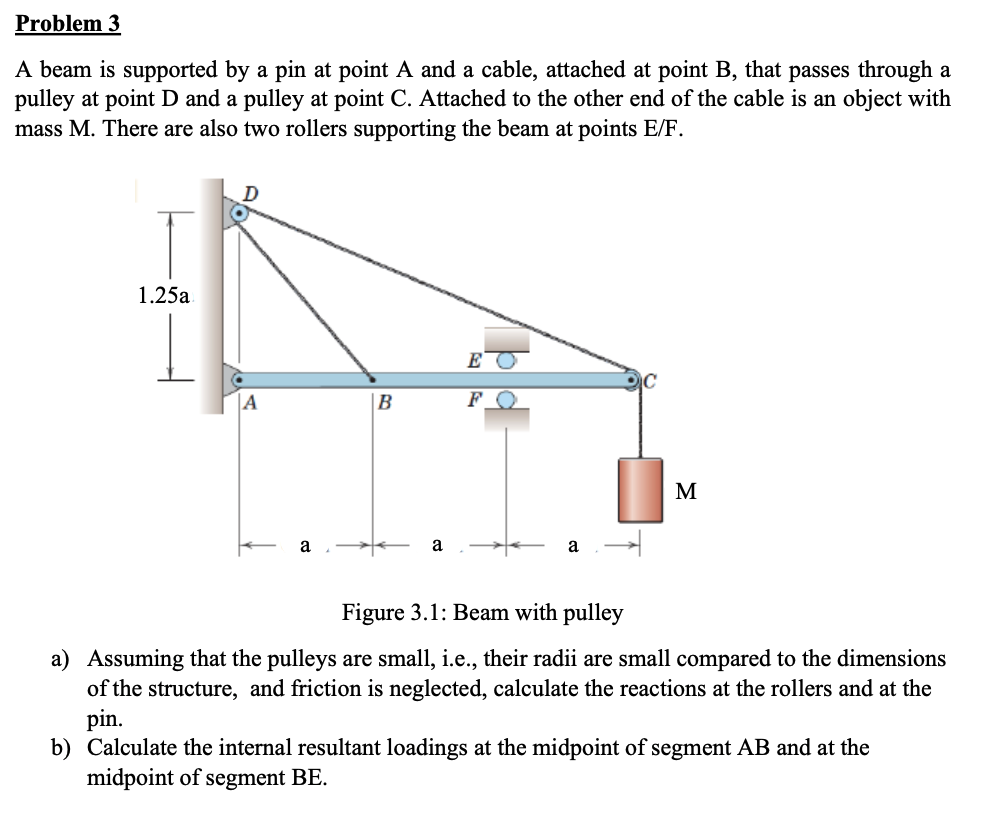
A beam is supported by a pin at point A and a cable, attached at point B
,
that passes through a pulley at point D and a pulley at point C
.
Attached to the other end of the cable is an object with mass M
.
There are also two rollers supporting the beam at points
\
(
\
mathrm
{
E
}
/
\
mathrm
{
F
}
\
)
.
Figure
3
.
1
: Beam with pulley
a
)
Assuming that the pulleys are small, i
.
e
.
,
their radii are small compared to the dimensions of the structure, and friction is neglected, calculate the reactions at the rollers and at the pin.
b
)
Calculate the internal resultant loadings at the midpoint of segment AB and at the midpoint of segment BE
.
student submitted image, transcription availableProblem 3
A beam is supported by a pin at point A and a cable, attached at point B, that passes through a
pulley at point D and a pulley at point C. Attached to the other end of the cable is an object with
mass M. There are also two rollers supporting the beam at points E/F.
D
1.25a
| —
a BIC
A B FO
M
f— a. a —f~— a —
Figure 3.1: Beam with pulley
a) Assuming that the pulleys are small, i.e., their radii are small compared to the dimensions
of the structure, and friction is neglected, calculate the reactions at the rollers and at the
pin.
b) Calculate the internal resultant loadings at the midpoint of segment AB and at the
midpoint of segment BE.
Question:
Give step-by-step solution with explanation and final answer:
Take a
=
0
.
5
m and M
=
6
0
kg
.
Calculate the support reaction Ax
[
N
]
Calculate the support reaction Ay
[
N
]
Calculate the support reaction Ey
[
N
]
Find the internal normal force NAB at the midpoint of segment AB
[
N
]
Find the internal shear force VAB at the midpoint of segment AB
[
N
]
Find the internal bending moment MAB at the midpoint of segment AB
[
N
-
m
]
Find the internal normal force NBE at the midpoint of segment BE
[
N
]
Find the internal shear force VBE at the midpoint of segment BE
[
N
]
Find the internal bending moment MBE at the midpoint of segment BE
[
N
-
m
]
.
Problem
3
A beam is supported by a pin at point A and a cable, attached at point B
,
that passes through a pulley at point D and a pulley at point C
.
Attached to the other end of the cable is an object with mass M
.
There are also two rollers supporting the beam at points
\
(
\
mathrm
{
E
}
/
\
mathrm
{
F
}
\
)
.
Figure
3
.
1
: Beam with pulley
a
)
Assuming that the pulleys are small, i
.
e
.
,
their radii are small compared to the dimensions of the structure, and friction is neglected, calculate the reactions at the rollers and at the pin.
b
)
Calculate the internal resultant loadings at the midpoint of segment AB and at the midpoint of segment BE
.
student submitted image, transcription availableProblem 3
A beam is supported by a pin at point A and a cable, attached at point B, that passes through a
pulley at point D and a pulley at point C. Attached to the other end of the cable is an object with
mass M. There are also two rollers supporting the beam at points E/F.
D
1.25a
| —
a BIC
A B FO
M
f— a. a —f~— a —
Figure 3.1: Beam with pulley
a) Assuming that the pulleys are small, i.e., their radii are small compared to the dimensions
of the structure, and friction is neglected, calculate the reactions at the rollers and at the
pin.
b) Calculate the internal resultant loadings at the midpoint of segment AB and at the
midpoint of segment BE.
This is AI generated Response.
Asked by: Alok Kumar
Created at: 2026-01-25 04:51:59
Final Answer:
RenderedRaw Text
Did you like this answer?
Let's solve the problem step by step using statics principles. We'll denote \( a = .5 \) m and \( M = 60 \) kg.
We will use \( g = 9.81 \) m/s² for gravity.
## **Step 1: Free Body Diagram and Forces**
### **Key Points:**
- \( A \): Pin support (reactions \( A_x \), \( A_y \))
- \( E/F \): Roller support (vertical reaction \( E_y \))
- \( B \): Cable attached, force \( T \) in cable (acts at angle)
- Cable passes over pulleys at \( D \) and \( C \), hangs mass \( M \) at \( C \)
- Beam length \( = 3a \)
- Vertical drop \( DA = 1.25a \)
### **Forces:**
- **At C:** Weight \( W = Mg \) acts downward
- **At B:** Cable tension \( T \) acts along \( \overrightarrow{DB} \)
## **Step 2: Cable Tension**
At equilibrium, the tension \( T \) in the cable is equal everywhere due to frictionless pulleys.
At point C, the cable supports mass \( M \):
\[
T = Mg = 60 \times 9.81 = \boxed{588.6~\text{N}}
\]
## **Step 3: Geometry for Cable Direction at B**
- \( DB \): From D to B: horizontal \( a \), vertical \( -1.25a \)
- Direction cosines of \( DB \):
\[
\vec{DB} = (a, -1.25a)
\]
\[
|\vec{DB}| = a \sqrt{1^2 + 1.25^2} = a \sqrt{2.5625} = 1.6a
\]
- Unit vector along \( DB \):
\[
\mathbf{u_{DB}} = \left( \frac{1}{1.6}, -\frac{1.25}{1.6} \right) = (.625, -.781)
\]
- Components of \( T \) at point B:
\[
T_x = T \times .625 = 588.6 \times .625 = 367.9~\text{N}
\]
\[
T_y = T \times (-.781) = 588.6 \times (-.781) = -458.9~\text{N}
\]
## **Step 4: Equilibrium Equations**
Let’s denote:
- \( A_x \): Reaction at A in x-direction
- \( A_y \): Reaction at A in y-direction
- \( E_y \): Reaction at E in y-direction
#### **Sum of Forces in \( x \):**
\[
\sum F_x = : \quad A_x - T_x = \implies A_x = T_x = \boxed{367.9~\text{N}}
\]
#### **Sum of Forces in \( y \):**
\[
\sum F_y = : \quad A_y + E_y + T_y - W =
\]
\[
A_y + E_y - 458.9 - 588.6 =
\]
\[
A_y + E_y = 458.9 + 588.6 = 1047.5~\text{N}
\]
#### **Sum of Moments about A:**
Take moments about point A (clockwise is positive):
- \( E_y \) acts at \( x = 2a \)
- \( T \) at B acts at \( x = a \) (vertical component only)
- \( W \) acts at \( x = 3a \)
\[
\sum M_A = : \quad
- T_y \cdot a + E_y \cdot 2a - W \cdot 3a =
\]
\[
-(-458.9)a + 2a E_y - 588.6 \cdot 3a =
\]
\[
458.9a + 2a E_y - 1765.8a =
\]
\[
2a E_y = 1765.8a - 458.9a = 1306.9a
\]
\[
E_y = \frac{1306.9a}{2a} = 653.45~\text{N}
\]
Now, plug \( E_y \) into \( A_y + E_y = 1047.5 \):
\[
A_y = 1047.5 - 653.45 = 394.05~\text{N}
\]
---
## **Step 5: Final Answer for Support Reactions**
\[
\boxed{
\begin{align*}
A_x &= 367.9~\text{N} \\
A_y &= 394.1~\text{N} \\
E_y &= 653.5~\text{N}
\end{align*}
}
\]
---
## **Step 6: Internal Forces at Midpoint of AB and BE**
Let’s take midpoints:
- Midpoint of AB: at \( x = .5a \) from A
- Midpoint of BE: at \( x = 1.5a \) from A
### **Section at Midpoint of AB (\( x = .5a \)):**
#### **Normal Force (\( N_{AB} \)):**
No horizontal loads between A and B other than the reaction at A, so:
\[
N_{AB} = -A_x = -367.9~\text{N}
\]
(Negative: compression if left face is considered)
#### **Shear Force (\( V_{AB} \)):**
Shear is due to vertical reactions up to this point:
\[
V_{AB} = A_y = 394.1~\text{N}
\]
#### **Moment (\( M_{AB} \)):**
\[
M_{AB} = A_y \cdot .5a
\]
\[
M_{AB} = 394.1 \cdot .25 = 98.5~\text{N}\cdot\text{m}
\]
---
### **Section at Midpoint of BE (\( x = 1.5a \)):**
#### **Normal Force (\( N_{BE} \)):**
Only horizontal load is still \( A_x \):
\[
N_{BE} = -A_x = -367.9~\text{N}
\]
#### **Shear Force (\( V_{BE} \)):**
Sum vertical forces to the left of the cut:
\[
V_{BE} = A_y + T_y
\]
\[
V_{BE} = 394.1 + (-458.9) = -64.8~\text{N}
\]
#### **Moment (\( M_{BE} \)):**
Take moments about the cut at \( x = 1.5a \):
\[
M_{BE} = A_y \cdot 1.5a + T_y \cdot (1.5a - a)
\]
\[
= A_y \cdot 1.5a + T_y \cdot .5a
\]
\[
= 394.1 \cdot .75 + (-458.9) \cdot .25 = 295.6 - 114.7 = 180.9~\text{N}\cdot\text{m}
\]
---
## **Step 7: Final Answers (Numerical, for \( a = .5 \) m)**
**Support Reactions:**
- \( \boxed{A_x = 367.9~\text{N}} \)
- \( \boxed{A_y = 394.1~\text{N}} \)
- \( \boxed{E_y = 653.5~\text{N}} \)
**Internal Forces at Midpoints:**
- At midpoint of AB:
- \( \boxed{N_{AB} = -367.9~\text{N}} \)
- \( \boxed{V_{AB} = 394.1~\text{N}} \)
- \( \boxed{M_{AB} = 98.5~\text{N}\cdot\text{m}} \)
- At midpoint of BE:
- \( \boxed{N_{BE} = -367.9~\text{N}} \)
- \( \boxed{V_{BE} = -64.8~\text{N}} \)
- \( \boxed{M_{BE} = 180.9~\text{N}\cdot\text{m}} \)
---
### **Summary Table**
| Quantity | Value (N or N·m) |
|---------------|------------------|
| \( A_x \) | 367.9 |
| \( A_y \) | 394.1 |
| \( E_y \) | 653.5 |
| \( N_{AB} \) | -367.9 |
| \( V_{AB} \) | 394.1 |
| \( M_{AB} \) | 98.5 |
| \( N_{BE} \) | -367.9 |
| \( V_{BE} \) | -64.8 |
| \( M_{BE} \) | 180.9 |
---
**Let me know if you need step-by-step diagrams or further clarifications!**
VIPSolutions focuses on clear, step‑by‑step explanations so you can learn quickly. Whether you need an AI‑generated walkthrough or a short hint to get unstuck, each solution is organized for fast reading and easy review later.
Search similar questions, compare approaches, and bookmark the best answers for revision. Our goal is simple: quick, reliable study help that feels natural—not noisy.
 VIPSolutions
 Problem 3
A beam is supported by a pin at point A and a cable, attached at point B, that passes through a
pulley at point D and a pulley at point C. Attached to the other end of the cable is an object with
mass M. There are also two rollers supporting the beam at points E/F.
D
1.25a
| —
a BIC
A B FO
M
f— a. a —f~— a —
Figure 3.1: Beam with pulley
a) Assuming that the pulleys are small, i.e., their radii are small compared to the dimensions
of the structure, and friction is neglected, calculate the reactions at the rollers and at the
pin.
b) Calculate the internal resultant loadings at the midpoint of segment AB and at the
midpoint of segment BE.