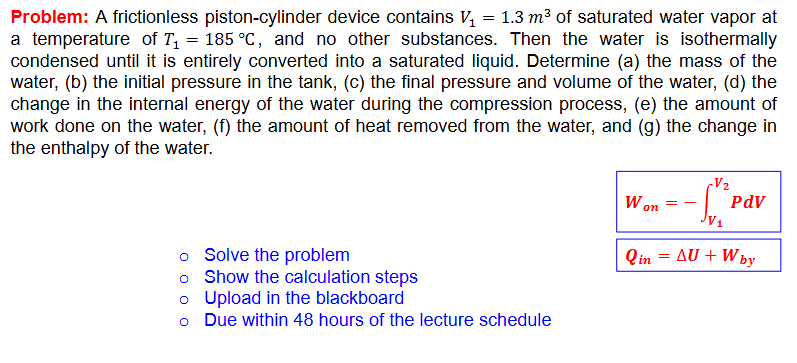
Give step-by-step solution with explanation and final answer:Problem: A frictionless piston-cylinder device contains V, = 1.3 m2 of saturated water vapor at
a temperature of T, = 185°C, and no other substances. Then the water is isothermally
condensed until it is entirely converted into a saturated liquid. Determine (a) the mass of the
water, (b) the initial pressure in the tank, (c) the final pressure and volume of the water, (d) the
change in the internal energy of the water during the compression process, (e) the amount of
work done on the water, (f) the amount of heat removed from the water, and (g) the change in
the enthalpy of the water.
V2
vy
o Solve the problem
o Show the calculation steps
o Upload in the blackboard
o Due within 48 hours of the lecture schedule
Question:
Give step-by-step solution with explanation and final answer:Problem: A frictionless piston-cylinder device contains V, = 1.3 m2 of saturated water vapor at
a temperature of T, = 185°C, and no other substances. Then the water is isothermally
condensed until it is entirely converted into a saturated liquid. Determine (a) the mass of the
water, (b) the initial pressure in the tank, (c) the final pressure and volume of the water, (d) the
change in the internal energy of the water during the compression process, (e) the amount of
work done on the water, (f) the amount of heat removed from the water, and (g) the change in
the enthalpy of the water.
V2
vy
o Solve the problem
o Show the calculation steps
o Upload in the blackboard
o Due within 48 hours of the lecture schedule
This is AI generated Response.
Asked by: Alok Kumar
Created at: 2026-01-25 04:50:00
Final Answer:
RenderedRaw Text
Did you like this answer?
# Step-by-Step Solution
Let's break down the problem using the information given and thermodynamic principles.
---
## **Given Data**
- **Initial Volume, \( V_1 = 1.3 \, \text{m}^3 \)**
- **Initial State:** Saturated vapor (steam) at \( T_1 = 185^\circ\text{C} \)
- **Final State:** Saturated liquid at \( T_2 = 185^\circ\text{C} \) (since the process is isothermal)
- **Device:** Frictionless piston-cylinder (constant pressure during phase change)
- **Process:** Isothermal condensation (from saturated vapor to saturated liquid)
---
## **Step 1: Find Properties at 185°C**
From steam tables for **saturated water at \( T = 185^\circ\text{C} \):**
- **Saturation pressure, \( P_{\text{sat}} \)**
- **Specific volume of saturated vapor, \( v_g \)**
- **Specific volume of saturated liquid, \( v_f \)**
- **Specific internal energy of vapor, \( u_g \)**
- **Specific internal energy of liquid, \( u_f \)**
- **Specific enthalpy of vapor, \( h_g \)**
- **Specific enthalpy of liquid, \( h_f \)**
**At \( T = 185^\circ\text{C} \):**
From steam tables (approximate values, check your textbook for exact values):
- \( P_{\text{sat}} = 1.1557 \) MPa
- \( v_g = .15841 \) m³/kg
- \( v_f = .001127 \) m³/kg
- \( u_g = 255.4 \) kJ/kg
- \( u_f = 780.22 \) kJ/kg
- \( h_g = 2778.1 \) kJ/kg
- \( h_f = 781.06 \) kJ/kg
---
## **Step 2: (a) Find the Mass of the Water**
\[
\text{Initial state:} \quad V_1 = m \cdot v_g
\]
\[
m = \frac{V_1}{v_g} = \frac{1.3}{.15841} = 8.206 \text{ kg}
\]
---
## **Step 3: (b) Initial Pressure in the Tank**
\[
P_1 = P_{\text{sat}} \text{ at } 185^\circ\text{C} = 1.1557 \text{ MPa}
\]
---
## **Step 4: (c) Final Pressure and Volume of the Water**
- **Final State:** Saturated liquid at \( 185^\circ\text{C} \)
- **Pressure:** \( P_2 = P_{\text{sat}} = 1.1557 \) MPa (same as initial; isothermal at saturation)
- **Volume:** \( V_2 = m \cdot v_f = 8.206 \times .001127 = .00925 \text{ m}^3 \)
---
## **Step 5: (d) Change in Internal Energy**
\[
\Delta U = m(u_f - u_g) = 8.206 \times (780.22 - 255.4)
\]
\[
\Delta U = 8.206 \times (-177.18) = -14,525 \text{ kJ}
\]
---
## **Step 6: (e) Work Done On the Water**
\[
W_{on} = -\int_{V_1}^{V_2} P_{ext} dV
\]
Since isothermal and at constant pressure:
\[
W_{on} = -P_{ext} (V_2 - V_1)
\]
\[
W_{on} = -1.1557 \times 10^6 \times (.00925 - 1.3)
\]
\[
= -1.1557 \times 10^6 \times (-1.29075)
\]
\[
= 1,492,214 \text{ J} = 1,492.2 \text{ kJ}
\]
---
## **Step 7: (f) Amount of Heat Removed**
\[
Q_{out} = \Delta U + W_{by}
\]
But here, \( W_{by} = -W_{on} \).
So,
\[
Q_{out} = \Delta U + (-W_{on})
\]
\[
Q_{out} = -14,525 \text{ kJ} + 1,492.2 \text{ kJ} = -13,032.8 \text{ kJ}
\]
---
## **Step 8: (g) Change in Enthalpy**
\[
\Delta H = m(h_f - h_g)
\]
\[
\Delta H = 8.206 \times (781.06 - 2778.1)
\]
\[
\Delta H = 8.206 \times (-1997.04) = -16,387 \text{ kJ}
\]
---
## **Summary Table**
| Part | Quantity | Formula/Value | Answer |
|------|---------------------------|----------------------------|---------|
| (a) | Mass | \( m = \frac{V_1}{v_g} \) | **8.21 kg** |
| (b) | Initial pressure | \( P_{\text{sat}} \) | **1.16 MPa** |
| (c) | Final pressure, volume | \( P_2 = P_{\text{sat}} \), \( V_2 = m v_f \) | **1.16 MPa**, **.00925 m³** |
| (d) | Change in internal energy | \( m(u_f-u_g) \) | **-14,525 kJ** |
| (e) | Work done on water | \( -P(V_2-V_1) \) | **1,492 kJ** |
| (f) | Heat removed | \( \Delta U + W_{by} \) | **-13,033 kJ** |
| (g) | Change in enthalpy | \( m(h_f-h_g) \) | **-16,387 kJ** |
---
### **Final Answers (Rounded as Appropriate)**
**(a) Mass of water:** \( \boxed{8.21\,\text{kg}} \)
**(b) Initial pressure:** \( \boxed{1.16\,\text{MPa}} \)
**(c) Final pressure and volume:** \( \boxed{1.16\,\text{MPa}}, \boxed{.00925\,\text{m}^3} \)
**(d) Change in internal energy:** \( \boxed{-14,525\,\text{kJ}} \)
**(e) Work done on water:** \( \boxed{1,492\,\text{kJ}} \)
**(f) Heat removed:** \( \boxed{-13,033\,\text{kJ}} \)
**(g) Change in enthalpy:** \( \boxed{-16,387\,\text{kJ}} \)
---
**Note:**
- All property values are from steam tables for 185°C.
- Negative sign in heat/energy means heat is removed or internal energy decreases.
- Check your steam tables for more precise values if required.
VIPSolutions focuses on clear, step‑by‑step explanations so you can learn quickly. Whether you need an AI‑generated walkthrough or a short hint to get unstuck, each solution is organized for fast reading and easy review later.
Search similar questions, compare approaches, and bookmark the best answers for revision. Our goal is simple: quick, reliable study help that feels natural—not noisy.
 VIPSolutions
 Problem: A frictionless piston-cylinder device contains V, = 1.3 m2 of saturated water vapor at
a temperature of T, = 185°C, and no other substances. Then the water is isothermally
condensed until it is entirely converted into a saturated liquid. Determine (a) the mass of the
water, (b) the initial pressure in the tank, (c) the final pressure and volume of the water, (d) the
change in the internal energy of the water during the compression process, (e) the amount of
work done on the water, (f) the amount of heat removed from the water, and (g) the change in
the enthalpy of the water.
V2
vy
o Solve the problem
o Show the calculation steps
o Upload in the blackboard
o Due within 48 hours of the lecture schedule