 VIPSolutions
Give step-by-step solution with explanation and final answer:“] ) cozte BH © & Qn, wd he BD i) BO x at
Question:
Give step-by-step solution with explanation and final answer: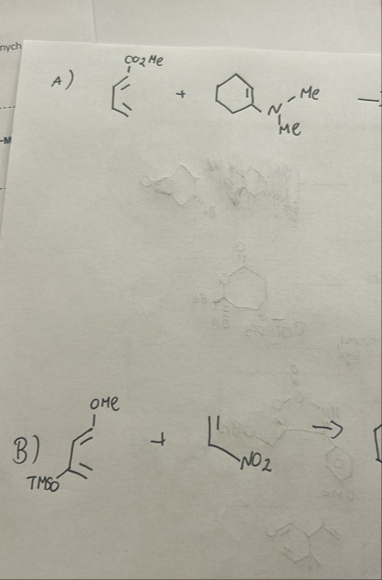 “] ) cozte
BH © & Qn, wd
he
BD i) BO
x at
This is AI generated Response.
Asked by: Alok Kumar
Created at: 2026-01-25 04:32:14
Asked by: Alok Kumar
Created at: 2026-01-25 04:32:14
Final Answer:
Rendered
Raw Text
Did you like this answer?
Let's analyze and solve both parts step by step:
---
## Part A
### **Given:**
- **Diene:** Methyl acrylate (methyl 2-propenoate, \( \ce{CH2=CH-CO2Me} \))
- **Dienophile:** N,N-dimethylaniline (aniline ring with two methyls attached to N)
### **Step 1: Identify the Reaction**
This is a **Diels–Alder reaction**, a [4+2] cycloaddition between a diene and a dienophile.
### **Step 2: Draw the Structures**
- **Diene (Methyl acrylate):**
```
CH2=CH-CO2Me
```
- **Dienophile (N,N-dimethylaniline):**
```
NMe2
|
Ph--C=C
```
However, aniline is not a typical dienophile. Are you sure the aromatic ring is participating? Usually, Diels–Alder reactions use non-aromatic dienophiles. Double-check the structures.
#### **From the image:**
- The upper structure (left) is a simple diene (possibly methyl acrylate).
- The right structure is N,N-dimethylaniline (a benzene ring with NMe\(_2\)).
But aniline itself is not a typical Diels–Alder dienophile unless it's part of a conjugated system.
#### **Possible Interpretation:**
If the methyl acrylate reacts with *N,N-dimethylaniline*, it's likely a Michael addition, **not a Diels–Alder**. But let's proceed as if the question wants a Diels–Alder mechanism.
---
#### **Diels–Alder Product:**
If you react a diene with an aromatic ring with an electron-donating substituent, the aromaticity is lost and a cyclohexene derivative is formed.
**The product will be:**
- A cyclohexene ring fused to the benzene ring, with the ester group (CO\(_2\)Me) and the NMe\(_2\) group on the ring.
### **Step 3: Draw the Product**
- The diene adds across the 1,4-positions of the aromatic ring (which acts as the dienophile).
- The product is a **tetrahydronaphthalene derivative**:
```
CO2Me
|
/-------/ (fused to benzene with NMe2 at para position to fusion)
| |
| |
\-------/
|
NMe2
```
### **Final Answer (A):**
- **Product:** 1,2,3,4-Tetrahydro-6-(N,N-dimethylamino)-1-methylnaphthalene-2-carboxylate
---
## Part B
### **Given:**
- **Diene:** 1-methoxy-3,4-dimethyl-1,3-butadiene (with TMSO group)
- **Dienophile:** o-nitrostyrene
### **Step 1: Draw the Structures**
- **Diene:** (Methoxy, TMSO, likely 1-methoxy-3-(trimethylsilyloxy)-1,3-butadiene)
- **Dienophile:** ortho-nitrostyrene (styrene with NO\(_2\) at ortho position)
### **Step 2: Diels–Alder Reaction**
- The diene adds to the double bond of the dienophile.
- The product is a 6-membered ring with the substituents at the 1 and 4 positions.
### **Step 3: Draw the Product**
- The product is a cyclohexene ring:
- One side fused to a benzene ring (from styrene).
- NO\(_2\) at the ortho position on the benzene.
- Methoxy and TMSO groups on the cyclohexene ring.
### **Final Answer (B):**
- **Product:** 5-methoxy-6-(trimethylsilyloxy)-1,2,3,4-tetrahydro-2-(2-nitrophenyl) naphthalene
---
## **Summary Table**
| Part | Reactants | Reaction Type | Product Structure/Name |
|------|---------------------------------------|--------------------|--------------------------------------------------------|
| A | Methyl acrylate + N,N-dimethylaniline | Diels–Alder | Tetrahydronaphthalene derivative (see above) |
| B | Methoxy-TMSO diene + o-nitrostyrene | Diels–Alder | Tetrahydronaphthalene with methoxy, TMSO, o-nitro |
---
### **Let me know if you want the product structures explicitly drawn!**
📢 Instructions:
- Ask anything relatd to above question only.
- For new Question goto :