 VIPSolutions
Give step-by-step solution with explanation and final answer:— Express F; as a Cartesian vector and determine its component along the x-axis in Newtons. Consider — 7 =700N,a=3mandb=4m. Z | 5 | 4m F, =150N | RES b 2m ~~ Sa a 3m Ne 3m x — Express F; as a Cartesian vector and determine its component along the x-axis in Newtons. Consider — 7 =700N,a=3mandb=4m. Z | 5 | 4m F, =150N | RES b 2m ~~ Sa a 3m Ne 3m x
Question:
Give step-by-step solution with explanation and final answer: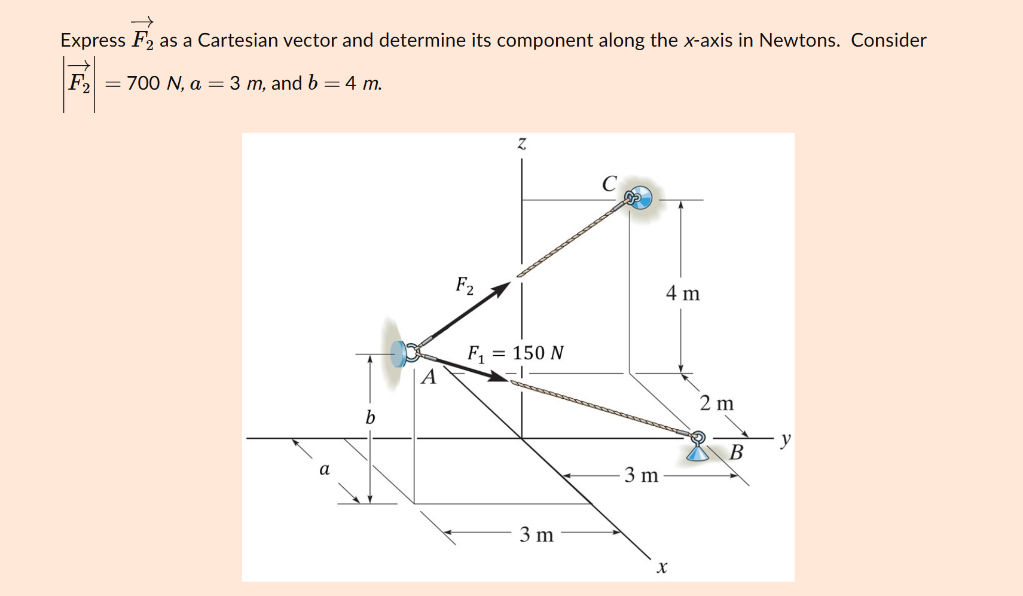
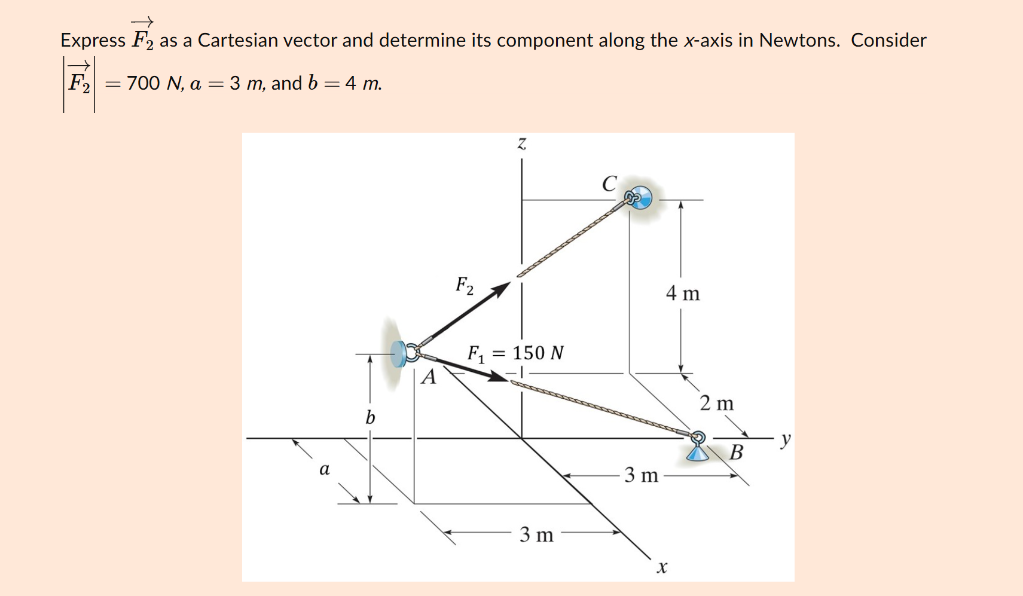 —
Express F; as a Cartesian vector and determine its component along the x-axis in Newtons. Consider
—
7 =700N,a=3mandb=4m.
Z
|
5 | 4m
F, =150N |
RES
b 2m
~~ Sa
a 3m
Ne 3m
x
—
Express F; as a Cartesian vector and determine its component along the x-axis in Newtons. Consider
—
7 =700N,a=3mandb=4m.
Z
|
5 | 4m
F, =150N |
RES
b 2m
~~ Sa
a 3m
Ne 3m
x
This is AI generated Response.
Asked by: Alok Kumar
Created at: 2026-01-25 04:26:46
Asked by: Alok Kumar
Created at: 2026-01-25 04:26:46
Final Answer:
Rendered
Raw Text
Did you like this answer?
Let's solve the problem step by step:
---
## **Step 1: Find the Coordinates**
- \( A = (a, , b) = (3, , 4) \)
- \( C = (, , 4) \)
---
## **Step 2: Find the Vector from A to C**
\[
\vec{r}_{AC} = C - A = (-3)\mathbf{i} + (-)\mathbf{j} + (4-4)\mathbf{k} = -3\mathbf{i} + \mathbf{j} + \mathbf{k}
\]
But this points only along x. Let's check the diagram more carefully:
- \( A = (3, , 4) \)
- \( C = (, , 8) \) (since the z from A to C rises 4 m above A)
So,
\[
\vec{r}_{AC} = (-3)\mathbf{i} + (-)\mathbf{j} + (8-4)\mathbf{k} = -3\mathbf{i} + \mathbf{j} + 4\mathbf{k}
\]
---
## **Step 3: Find the Unit Vector Along \( \vec{F}_2 \) (\( \vec{F}_2 \) acts along \( \vec{r}_{AC} \))**
\[
|\vec{r}_{AC}| = \sqrt{(-3)^2 + ^2 + 4^2} = \sqrt{9 + 16} = \sqrt{25} = 5
\]
Unit vector:
\[
\mathbf{u}_{AC} = \frac{\vec{r}_{AC}}{|\vec{r}_{AC}|} = \frac{-3}{5}\mathbf{i} + \mathbf{j} + \frac{4}{5}\mathbf{k}
\]
---
## **Step 4: Express \( \vec{F}_2 \) as a Cartesian Vector**
\[
\vec{F}_2 = |\vec{F}_2| \cdot \mathbf{u}_{AC} = 700 \left( \frac{-3}{5}\mathbf{i} + \mathbf{j} + \frac{4}{5}\mathbf{k} \right)
\]
\[
\vec{F}_2 = (-420\mathbf{i} + \mathbf{j} + 560\mathbf{k})\, \text{N}
\]
---
## **Step 5: Find the x-component of \( \vec{F}_2 \)**
x-component is \(-420\, \text{N}\).
---
## **Final Answers**
### **1. As a Cartesian Vector:**
\[
\boxed{
\vec{F}_2 = -420\,\mathbf{i} + \,\mathbf{j} + 560\,\mathbf{k} \text{ N}
}
\]
### **2. x-component:**
\[
\boxed{
(\vec{F}_2)_x = -420\, \text{N}
}
\]
---
**Explanation:**
- We found the direction vector from \(A\) to \(C\), normalized it, then multiplied by the magnitude of the force to get the Cartesian vector.
- The x-component is the coefficient of \(\mathbf{i}\).
Question:
explanation of concept pls
This is AI generated Response.
Asked by: Alok Kumar
Created at: 2026-01-25 04:27:18
Asked by: Alok Kumar
Created at: 2026-01-25 04:27:18
Final Answer:
Rendered
Raw Text
Did you like this answer?
# Explanation of Vector Components
## **Understanding Vectors**
Vectors are quantities that have both magnitude and direction. They are represented in a coordinate system using components along the axes (usually x, y, and z).
### **Cartesian Coordinates**
In a 3D Cartesian coordinate system, any point or vector can be expressed as:
\[
\vec{V} = V_x \mathbf{i} + V_y \mathbf{j} + V_z \mathbf{k}
\]
where:
- \(V_x\) is the component along the x-axis,
- \(V_y\) is the component along the y-axis,
- \(V_z\) is the component along the z-axis.
## **Finding Components of a Force**
When dealing with forces, we often need to express them in Cartesian form to analyze their effects along different axes.
### **Steps to Determine Components:**
1. **Identify Points:** Determine the coordinates of the points involved (e.g., start point \(A\) and end point \(C\)).
2. **Calculate the Direction Vector:** Subtract the coordinates of the initial point from the final point to find the direction vector.
3. **Normalize the Vector:** Convert the direction vector into a unit vector, which indicates direction without magnitude.
4. **Multiply by Magnitude:** Multiply the unit vector by the force's magnitude to obtain the Cartesian vector representation of the force.
5. **Extract Components:** Read off the components along each axis for further analysis.
## **Example Analysis**
In the given problem:
- The force \(F_2\) acts along the vector from point \(A\) to point \(C\).
- The calculated Cartesian vector was:
\[
\vec{F}_2 = -420 \mathbf{i} + 1 \mathbf{j} + 560 \mathbf{k} \text{ N}
\]
- The x-component of this force is \(-420\, \text{N}\), indicating that it acts in the negative x-direction.
## **Practical Applications**
Understanding vector components is crucial in fields like physics, engineering, and computer graphics, where forces and movements must be analyzed in multiple dimensions.
### **Usage Examples:**
- **Physics:** Analyzing forces on structures.
- **Engineering:** Designing systems that respond to multiple forces.
- **Graphics:** Simulating movement in 3D environments.
By breaking down forces into their components, we can better understand and predict their behavior in a system.
📢 Instructions:
- Ask anything relatd to above question only.
- For new Question goto :