 VIPSolutions
Give step-by-step solution with explanation and final answer:— Express F; as a Cartesian vector and determine its component along the x-axis in Newtons. Consider — 7 =700N,a=3mandb=4m. Z | 5 | 4m F, =150N | RES b 2m ~~ Sa a 3m Ne 3m x
Question:
Give step-by-step solution with explanation and final answer: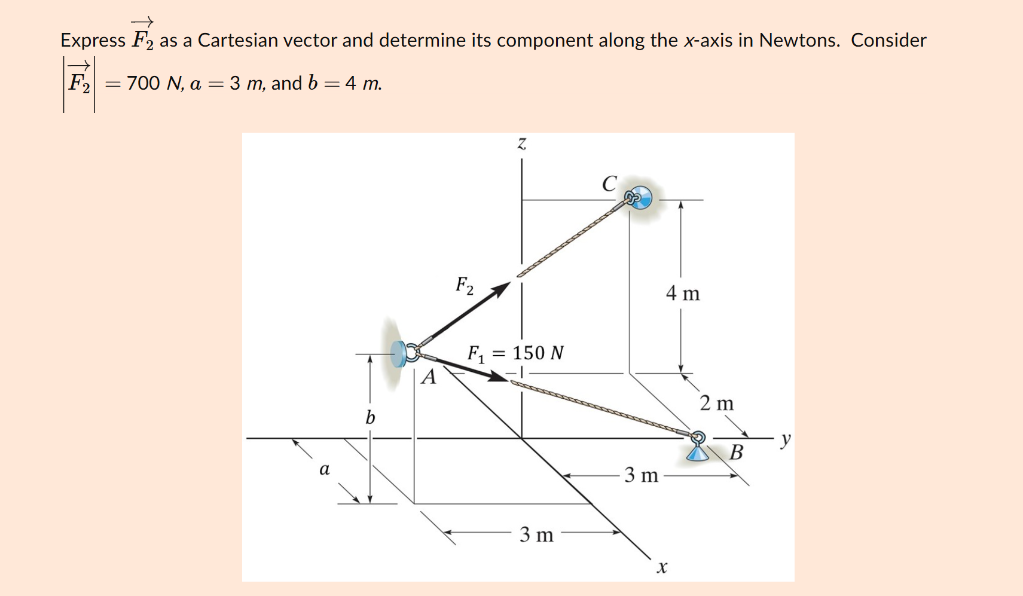 —
Express F; as a Cartesian vector and determine its component along the x-axis in Newtons. Consider
—
7 =700N,a=3mandb=4m.
Z
|
5 | 4m
F, =150N |
RES
b 2m
~~ Sa
a 3m
Ne 3m
x
This is AI generated Response.
Asked by: Alok Kumar
Created at: 2026-01-25 04:22:01
Asked by: Alok Kumar
Created at: 2026-01-25 04:22:01
Final Answer:
Rendered
Raw Text
Did you like this answer?
Let's break down the problem step-by-step:
---
## **Step 1: Write the Position Vectors**
Let's find the coordinates of points \( A \) and \( C \):
- \( A = (a, , b) = (3, , 4) \)
- \( C = (, , 8) \)
---
## **Step 2: Find the Vector from A to C**
\[
\vec{r}_{AC} = \vec{r}_C - \vec{r}_A = (, , 8) - (3, , 4) = (-3, , 4)
\]
---
## **Step 3: Find the Unit Vector Along \( \vec{F}_2 \)**
First, calculate the magnitude:
\[
|\vec{r}_{AC}| = \sqrt{(-3)^2 + ^2 + 4^2} = \sqrt{9 + + 16} = \sqrt{25} = 5
\]
Now, the unit vector:
\[
\hat{u}_{AC} = \frac{\vec{r}_{AC}}{|\vec{r}_{AC}|} = \left( \frac{-3}{5}, , \frac{4}{5} \right)
\]
---
## **Step 4: Write \( \vec{F}_2 \) as a Cartesian Vector**
\[
|\vec{F}_2| = 700\, \text{N}
\]
\[
\vec{F}_2 = 700 \cdot \hat{u}_{AC} = 700 \left( \frac{-3}{5} \vec{i} + \vec{j} + \frac{4}{5} \vec{k} \right)
\]
\[
\vec{F}_2 = (-420 \vec{i} + \vec{j} + 560 \vec{k})\, \text{N}
\]
---
## **Step 5: Find the Component Along the x-axis**
The x-component is:
\[
(\vec{F}_2)_x = -420\, \text{N}
\]
---
## **Final Answers**
### **Cartesian Vector Form**
\[
\boxed{\vec{F}_2 = -420\,\vec{i} + \,\vec{j} + 560\,\vec{k}\ \text{N}}
\]
### **Component Along x-axis**
\[
\boxed{-420\,\text{N}}
\]
Question:
explanation of concept pls
This is AI generated Response.
Asked by: Alok Kumar
Created at: 2026-01-25 04:23:33
Asked by: Alok Kumar
Created at: 2026-01-25 04:23:33
Final Answer:
Rendered
Raw Text
Did you like this answer?
# Explanation of the Concepts Involved
## **1. Vectors and Cartesian Coordinates**
Vectors are quantities that have both magnitude and direction. In a Cartesian coordinate system, vectors can be expressed in terms of their components along the x, y, and z axes. For example, a vector \( \vec{F} \) can be written as:
\[
\vec{F} = F_x \vec{i} + F_y \vec{j} + F_z \vec{k}
\]
where \( F_x, F_y, F_z \) are the components along the x, y, and z axes, respectively, and \( \vec{i}, \vec{j}, \vec{k} \) are the unit vectors in the direction of the axes.
## **2. Finding the Unit Vector**
To define a direction in space, we often use unit vectors. A unit vector \( \hat{u} \) is obtained by dividing a vector by its magnitude. For a vector \( \vec{r} = (x, y, z) \), the magnitude is calculated as:
\[
|\vec{r}| = \sqrt{x^2 + y^2 + z^2}
\]
The unit vector then becomes:
\[
\hat{u} = \frac{\vec{r}}{|\vec{r}|}
\]
## **3. Vector Representation of Forces**
Forces can also be expressed in vector form. If a force \( |\vec{F}| \) is applied in a certain direction, we can express it as:
\[
\vec{F} = |\vec{F}| \cdot \hat{u}
\]
where \( \hat{u} \) is the unit vector in the direction of the force. This allows us to break down the force into its component vectors along the axes.
## **4. Components of a Force**
To find the component of a force along a specific axis (e.g., x-axis), we simply take the coefficient of the unit vector corresponding to that axis. In our example, the x-component of the force \( \vec{F}_2 \) is:
\[
(\vec{F}_2)_x = -420\, \text{N}
\]
## **5. Applications**
Understanding vectors and their components is crucial in physics and engineering, as it allows for the analysis of forces acting on objects, providing insights into equilibrium, motion, and other physical phenomena.
### **Summary**
In summary, we analyzed a force vector by determining its components in a Cartesian coordinate system, calculated the unit vector, expressed the force in vector form, and found the component along the x-axis. This systematic approach is fundamental in solving problems involving forces and motion in physics.
📢 Instructions:
- Ask anything relatd to above question only.
- For new Question goto :