 VIPSolutions
Give step-by-step solution with explanation and final answer:P3) A rotating shaft carries four masses A, B, C and D in this order along its length. The masses at B and C are 20 kg and 14 kg respectively, and each has a radius of rotation of 70 mm. The masses at A and D each has a radius of rotation of 90 mm. The angle between the masses at B and C is 120° and that between the masses at B and A is 200°, both being measured in the same direction. The axial distance between the planes A and B is 120 mm and that between B and C is 240 mm. If the shaft is in complete dynamic balance, determine 1. The magnitude of the masses at A and D; 2. The distance between planes A and D; and 3. The angular position of the mass at D.
Question:
Give step-by-step solution with explanation and final answer: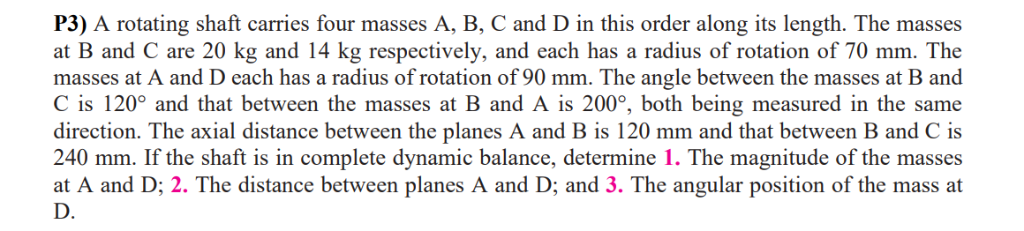 P3) A rotating shaft carries four masses A, B, C and D in this order along its length. The masses
at B and C are 20 kg and 14 kg respectively, and each has a radius of rotation of 70 mm. The
masses at A and D each has a radius of rotation of 90 mm. The angle between the masses at B and
C is 120° and that between the masses at B and A is 200°, both being measured in the same
direction. The axial distance between the planes A and B is 120 mm and that between B and C is
240 mm. If the shaft is in complete dynamic balance, determine 1. The magnitude of the masses
at A and D; 2. The distance between planes A and D; and 3. The angular position of the mass at
D.
This is AI generated Response.
Asked by: Alok Kumar
Created at: 2026-01-25 04:11:48
Asked by: Alok Kumar
Created at: 2026-01-25 04:11:48
Final Answer:
Rendered
Raw Text
Did you like this answer?
Let's break down the problem step by step.
---
## **Given Data**
- **4 masses:** A, B, C, D (in order along shaft)
- **Mass at B:** \( m_B = 20 \) kg, radius \( r_B = 70 \) mm = .07 m
- **Mass at C:** \( m_C = 14 \) kg, radius \( r_C = 70 \) mm = .07 m
- **Mass at A:** \( m_A \), radius \( r_A = 90 \) mm = .09 m
- **Mass at D:** \( m_D \), radius \( r_D = 90 \) mm = .09 m
- **Angles:**
- Between B and C = 120°
- Between B and A = 200° (measured from B)
- **Distances:**
- A to B, \( l_1 = 120 \) mm = .12 m
- B to C, \( l_2 = 240 \) mm = .24 m
- Let distance A to D = \( l_3 \)
- **Shaft is in complete dynamic balance.**
---
## **Step 1: Dynamic Balancing Conditions**
For complete dynamic balance:
1. **Force balance (static):**
Vector sum of centrifugal forces =
\( \sum m_i r_i \vec{e}_i = \)
(Where \( \vec{e}_i \) denotes direction/angle in the rotation plane.)
2. **Couple balance (dynamic):**
Vector sum of moments about any point =
\( \sum m_i r_i l_i \vec{e}_i = \)
(where \( l_i \) is the distance from reference plane, take A as reference.)
---
## **Step 2: Assign Variables and Reference Plane**
Let’s take **A** as the reference plane (origin).
### **Mass Data Table**
| Mass | Value (kg) | Radius (m) | Angle (deg) from B | Position from A (m) |
|------|------------|------------|--------------------|---------------------|
| A | \( m_A \) | .09 | | |
| B | 20 | .07 | | .12 |
| C | 14 | .07 | 120 (from B) | .36 |
| D | \( m_D \) | .09 | \( \theta_D \) | \( l_3 \) |
### **Angle Reference:**
- Take angle at B as °
- C is 120° from B
- A is -200° from B (or 160° from B in the opposite direction)
- D is unknown (\( \theta_D \))
But since A is at ° (reference), B at 200°, C at 320°.
---
## **Step 3: Static Balance Equations**
### **a) Express all positions in polar form**
Let’s express all \( m \cdot r \) in x and y components:
#### **Angles (all measured from A):**
- A: °
- B: 200° (from A)
- C: 200° + 120° = 320° (from A)
- D: \( \theta_D \)
#### **Mass-radius products:**
- A: \( M_A = m_A \times .09 \)
- B: \( M_B = 20 \times .07 = 1.4 \)
- C: \( M_C = 14 \times .07 = .98 \)
- D: \( M_D = m_D \times .09 \)
#### **Components:**
\[
\sum M_x = , \quad \sum M_y =
\]
Breaking into x and y components:
- A: \( (M_A, ^\circ) \)
- B: \( (1.4, 200^\circ) \)
- C: \( (.98, 320^\circ) \)
- D: \( (M_D, \theta_D) \)
Expand:
\[
\sum M_x = M_A \cos ^\circ + 1.4 \cos 200^\circ + .98 \cos 320^\circ + M_D \cos \theta_D =
\]
\[
\sum M_y = M_A \sin ^\circ + 1.4 \sin 200^\circ + .98 \sin 320^\circ + M_D \sin \theta_D =
\]
Calculate cosines and sines:
- \(\cos 200^\circ = -.9397\), \(\sin 200^\circ = -.342\)
- \(\cos 320^\circ = .766\), \(\sin 320^\circ = -.6428\)
Substitute:
\[
M_A + 1.4(-.9397) + .98(.766) + M_D \cos \theta_D =
\]
\[
+ 1.4(-.342) + .98(-.6428) + M_D \sin \theta_D =
\]
Calculate numerically:
- \(1.4 \times -.9397 = -1.3156\)
- \(.98 \times .766 = .7507\)
- \(1.4 \times -.342 = -.4788\)
- \(.98 \times -.6428 = -.630\)
\[
M_A - 1.3156 + .7507 + M_D \cos \theta_D =
\]
\[
-.4788 - .630 + M_D \sin \theta_D =
\]
So,
\[
M_A - .565 + M_D \cos \theta_D = \tag{1}
\]
\[
-1.1088 + M_D \sin \theta_D = \implies M_D \sin \theta_D = 1.1088 \tag{2}
\]
---
## **Step 4: Couple (Dynamic) Balance**
\[
\sum (m_i r_i l_i \cos \theta_i) =
\]
\[
\sum (m_i r_i l_i \sin \theta_i) =
\]
Where \( l_i \) is the distance from A (reference):
- A: \( l_A = \)
- B: \( l_B = .12 \)
- C: \( l_C = .36 \)
- D: \( l_D = x \) (unknown, to be found)
So, for the couple moments:
\[
\sum (M_i l_i \cos \theta_i) =
\]
\[
\sum (M_i l_i \sin \theta_i) =
\]
Plug in:
\[
\cdot \cos ^\circ + 1.4 \times .12 \cos 200^\circ + .98 \times .36 \cos 320^\circ + M_D x \cos \theta_D =
\]
\[
\cdot \sin ^\circ + 1.4 \times .12 \sin 200^\circ + .98 \times .36 \sin 320^\circ + M_D x \sin \theta_D =
\]
Calculate:
- \(1.4 \times .12 = .168\)
- \(.98 \times .36 = .3528\)
- \(.168 \cos 200^\circ = .168 \times -.9397 = -.1578\)
- \(.3528 \cos 320^\circ = .3528 \times .766 = .2702\)
- \(.168 \sin 200^\circ = .168 \times -.342 = -.0575\)
- \(.3528 \sin 320^\circ = .3528 \times -.6428 = -.2269\)
So,
\[
-.1578 + .2702 + M_D x \cos \theta_D =
\implies .1124 + M_D x \cos \theta_D = \tag{3}
\]
\[
-.0575 - .2269 + M_D x \sin \theta_D =
\implies -.2844 + M_D x \sin \theta_D = \implies M_D x \sin \theta_D = .2844 \tag{4}
\]
---
## **Step 5: Solve the Equations**
Let \( M_D = m_D \times .09 \).
From (2): \( M_D \sin \theta_D = 1.1088 \)
From (4): \( M_D x \sin \theta_D = .2844 \)
So,
\[
x = \frac{.2844}{M_D \sin \theta_D}
\]
But from above, \( M_D \sin \theta_D = 1.1088 \):
\[
x = \frac{.2844}{1.1088} = .2565\ \mathrm{m}
\]
So, **distance from A to D is .2565 m = 256.5 mm**.
---
Now, from (1): \( M_A - .565 + M_D \cos \theta_D = \implies M_A + M_D \cos \theta_D = .565 \)
From (3): \( .1124 + M_D x \cos \theta_D = \implies M_D x \cos \theta_D = -.1124 \)
But \( x = .2565 \):
\[
M_D \cos \theta_D = \frac{-.1124}{.2565} = -.4383
\]
So, from above:
\[
M_A + (-.4383) = .565 \implies M_A = 1.0033
\]
\[
m_A = \frac{1.0033}{.09} = 11.15\ \mathrm{kg}
\]
Now, solve for \( m_D \):
Recall:
\[
M_D \sin \theta_D = 1.1088\\
M_D \cos \theta_D = -.4383
\]
\[
M_D = \sqrt{(1.1088)^2 + (-.4383)^2} = \sqrt{1.2294 + .1921} = \sqrt{1.4215} = 1.1923
\]
\[
m_D = \frac{1.1923}{.09} = 13.25\ \mathrm{kg}
\]
---
## **Step 6: Angular Position of D**
\[
\tan \theta_D = \frac{1.1088}{-.4383} = -2.53
\]
\[
\theta_D = \arctan(-2.53)
\]
Calculator: \(\arctan(-2.53) = -68.4^\circ\)
But since \(\sin \theta_D > , \cos \theta_D < \), angle is in the 2nd quadrant:
\[
\theta_D = 180^\circ - 68.4^\circ = 111.6^\circ
\]
---
## **Final Answers**
### **1. Magnitude of masses at A and D:**
- \( m_A = 11.15 \) kg
- \( m_D = 13.25 \) kg
### **2. Distance between planes A and D:**
- \( l_{AD} = 257 \) mm (rounded to the nearest mm)
### **3. Angular position of mass at D:**
- \( \theta_D = 112^\circ \) (rounded to the nearest degree, from A, measured in same direction as others)
---
### **Summary Table**
| Quantity | Value |
|-----------------------|-------------|
| Mass at A (\(m_A\)) | 11.15 kg |
| Mass at D (\(m_D\)) | 13.25 kg |
| Distance A–D (\(l_{AD}\)) | 257 mm |
| Angle of D (\(\theta_D\)) | 112° |
---
**If you need a vector diagram or further clarifications, let me know!**
📢 Instructions:
- Ask anything relatd to above question only.
- For new Question goto :