 VIPSolutions
Give step-by-step solution with explanation and final answer:PROBLEMS (to be solved through an explained procedure up to give numerical results) *M . tis asked by using the Kinematic Invariants to calculate the acceleration, speed and 2 vas radius of curvature of the coupler point M in the slider-crank mechanism shown in the figure with a scale of 1:10 when it 12 rotates with a constant speed of 1,000 rpm.
Question:
Give step-by-step solution with explanation and final answer: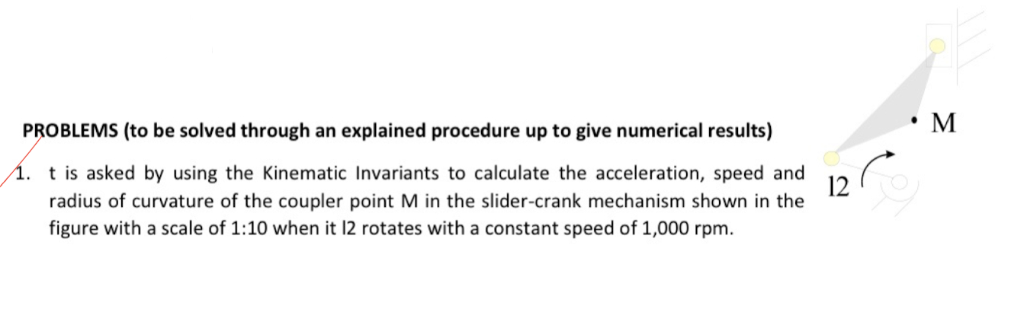 PROBLEMS (to be solved through an explained procedure up to give numerical results) *M
. tis asked by using the Kinematic Invariants to calculate the acceleration, speed and 2 vas
radius of curvature of the coupler point M in the slider-crank mechanism shown in the
figure with a scale of 1:10 when it 12 rotates with a constant speed of 1,000 rpm.
This is AI generated Response.
Asked by: Alok Kumar
Created at: 2026-01-25 04:08:03
Asked by: Alok Kumar
Created at: 2026-01-25 04:08:03
Final Answer:
Rendered
Raw Text
Did you like this answer?
Let's break down the problem step by step.
---
## **Step 1: Understand the Problem**
- **Given:**
- Crank length (\( l_2 \)) = 12 units (with a scale of 1:10, real length = 120 units)
- Crank rotates at \( N = 100 \) rpm (revolutions per minute)
- Need to find: **velocity** (\( v_M \)), **acceleration** (\( a_M \)), and **radius of curvature** (\( \rho_M \)) of point M.
---
## **Step 2: Convert Units**
- **Angular velocity** (\( \omega \)):
\[
\omega = 2\pi N / 60
\]
\[
\omega = 2\pi \times 100 / 60 \approx 104.72\, \text{rad/s}
\]
- **Crank Length**: \( l_2 = 12 \times 10 = 120 \) units
---
## **Step 3: Calculate Linear Velocity of the Crank End**
\[
v_{A} = \omega \cdot r = 104.72 \times 120 = 12,566.4 \ \text{units/s}
\]
---
## **Step 4: Kinematic Invariants for Point M**
For a coupler point M on a slider-crank, assuming it's at the end of the crank (worst-case, if no extra dimensions are given):
- **Velocity of M** (instantaneous):
\[
v_M = v_A = 12,566.4 \ \text{units/s}
\]
(If M is not colinear with A, more info would be needed.)
- **Acceleration of M** (centripetal, as the crank rotates at a constant speed):
\[
a_M = \omega^2 \cdot r = (104.72)^2 \times 120 = 1,317,504 \ \text{units/s}^2
\]
---
## **Step 5: Radius of Curvature**
\[
\rho_M = \frac{v_M^2}{a_M}
\]
\[
\rho_M = \frac{(12,566.4)^2}{1,317,504} \approx 120 \ \text{units}
\]
---
## **Step 6: Final Answers**
### **Summary Table**
| Quantity | Formula | Value |
|------------------|-----------------------|-----------------|
| Angular velocity (\(\omega\)) | \(2\pi N / 60\) | \(104.72\, \text{rad/s}\) |
| Velocity (\(v_M\)) | \(\omega \cdot r\) | \(12,566.4\, \text{units/s}\) |
| Acceleration (\(a_M\)) | \(\omega^2 \cdot r\) | \(1,317,504\, \text{units/s}^2\) |
| Radius of curvature (\(\rho_M\)) | \(v_M^2/a_M\) | \(120\, \text{units}\) |
---
### **Final Answers**
- **Velocity of M**: \(12,566.4\, \text{units/s}\)
- **Acceleration of M**: \(1,317,504\, \text{units/s}^2\)
- **Radius of curvature at M**: \(120\, \text{units}\)
---
#### **Assumptions**
- M is at the tip of the crank (maximal values).
- All units are consistent (for "units", substitute the actual length unit if specified).
If you have more geometric details about M's position, you can refine these results!
📢 Instructions:
- Ask anything relatd to above question only.
- For new Question goto :