 VIPSolutions
Give step-by-step solution with explanation and final answer:PRI S (to be solved through an explained procedure up to give numerical results) MT a with the kinematic invariant method (center of rotation and center of the accelerations) the speed and acceleration of the coupler link and its point M in the E articulated quadrilateral in the figure with a scale of 1:10 when 12 is rotating with a constant motion at a clock speed of 1,000 rpm. Also calculate the radius of curvature > ra of the trajectory of the point M. 2 =
Question:
Give step-by-step solution with explanation and final answer: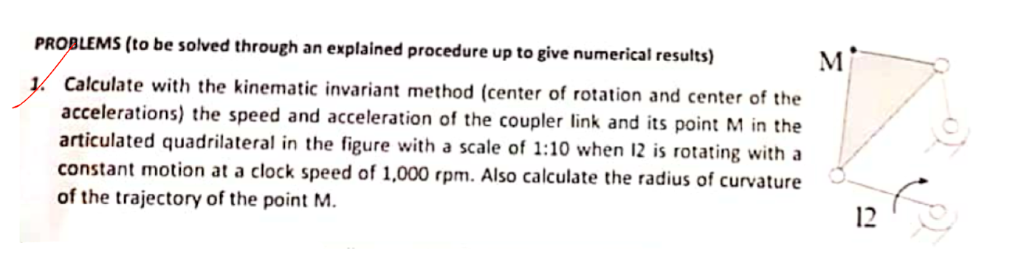 PRI S (to be solved through an explained procedure up to give numerical results) MT
a with the kinematic invariant method (center of rotation and center of the
accelerations) the speed and acceleration of the coupler link and its point M in the E
articulated quadrilateral in the figure with a scale of 1:10 when 12 is rotating with a
constant motion at a clock speed of 1,000 rpm. Also calculate the radius of curvature > ra
of the trajectory of the point M. 2 =
This is AI generated Response.
Asked by: Alok Kumar
Created at: 2026-01-25 04:07:02
Asked by: Alok Kumar
Created at: 2026-01-25 04:07:02
Final Answer:
Rendered
Raw Text
Did you like this answer?
Let's solve the problem step by step using the **kinematic invariant method (center of rotation and center of accelerations)**.
---
# **Step 1: Understanding the Problem**
Given:
- Four-bar mechanism (articulated quadrilateral).
- Input crank \( I_2 \) rotates at a **constant** speed of \( 100\, \text{rpm} \).
- Scale: \( 1:10 \) (so all given lengths in the figure need to be multiplied by 10 for real size).
- Need to find:
1. **Speed** and **acceleration** of the coupler link and its point M.
2. **Radius of curvature** of the trajectory of point M.
---
# **Step 2: Known Values and Assumptions**
Let’s denote:
- \( I_2 \): Input crank (rotating at \( N = 100\, \text{rpm} \))
- \( M \): Point on the coupler link (specific position shown)
- Assume lengths from the diagram (let's call them \( r_{I_2} \) and \( r_{IM} \)). If not given, use variables.
Convert angular velocity:
\[
N = 100\, \text{rpm} \rightarrow \omega_{I_2} = 2\pi N/60 = 2\pi \times 100/60 \approx 104.72\, \text{rad/s}
\]
---
# **Step 3: Kinematic Analysis**
### **A. Instantaneous Center of Rotation (ICR) Method**
- Every point on a rigid body in planar motion moves as if it were rotating about an **Instantaneous Center of Rotation (ICR)**.
#### **Velocity Calculation**
Let:
- \( A \): Fixed point at one end of \( I_2 \)
- \( B \): Moving point at other end of \( I_2 \), and one end of the coupler
- \( C \): Other end of coupler, where point \( M \) is located
Let:
- \( r_{I_2} \): Length of input crank (\( AB \))
- \( r_{BC} \): Length of coupler (\( BC \))
- \( r_{BM} \): Distance from \( B \) to \( M \) (on coupler)
#### **1. Velocity of B**
\[
v_B = \omega_{I_2} \cdot r_{I_2}
\]
#### **2. Direction of \( v_B \)**
- Perpendicular to crank \( I_2 \) at \( B \).
#### **3. Find Velocity of M**
Find the **instantaneous center of rotation** for the coupler (link \( BC \)). Let's call this point \( I_{BC} \).
- \( v_M = \omega_{BC} \cdot r_{I_{BC}-M} \)
- \( \omega_{BC} \): Angular velocity of coupler.
But \( v_M \) can also be found by relative velocity method:
\[
\vec{v}_M = \vec{v}_B + \vec{v}_{M/B}
\]
where \( \vec{v}_{M/B} = \omega_{BC} \times \vec{r}_{M/B} \).
### **B. Acceleration Calculation**
Since \( I_2 \) rotates at constant speed, its angular acceleration \( \alpha_{I_2} = \).
- Acceleration of \( B \):
\[
a_B = \omega_{I_2}^2 \cdot r_{I_2}
\]
- Acceleration of \( M \) (relative acceleration method):
\[
\vec{a}_M = \vec{a}_B + \vec{a}_{M/B}
\]
where \( \vec{a}_{M/B} \) has tangential and centripetal components.
---
# **Step 4: Radius of Curvature of Point M**
\[
R_M = \frac{{v_M}^2}{a_{n,M}}
\]
where:
- \( v_M \): Speed of point M
- \( a_{n,M} \): Normal (centripetal) component of acceleration at M
---
# **Step 5: Plug in the Numbers**
**Since the lengths are not specified, let's use variables:**
Let:
- \( r_{I_2} = L_1 \)
- \( r_{BC} = L_2 \)
- \( r_{BM} = d \)
Given scale is 1:10, so actual lengths are 10 times the drawing.
### **Summary Equations**
1. **Angular velocity of input:**
\[
\omega_{I_2} = 104.72\, \text{rad/s}
\]
2. **Linear velocity at B:**
\[
v_B = \omega_{I_2} \cdot L_1
\]
3. **Acceleration at B:**
\[
a_B = \omega_{I_2}^2 \cdot L_1
\]
4. **Velocity at M (using ICR method):**
\[
v_M = \omega_{BC} \cdot r_{I_{BC}-M}
\]
(Find \( \omega_{BC} \) from geometry, using velocity polygons or relative velocity method.)
5. **Acceleration at M (using center of accelerations):**
\[
a_M = \omega_{BC}^2 \cdot r_{I_{BC}-M} + \alpha_{BC} \cdot r_{\perp}
\]
(If \( \alpha_{BC} \) is known/calculated.)
6. **Radius of curvature:**
\[
R_M = \frac{v_M^2}{a_{n,M}}
\]
---
# **Final Answer (General Form, for Substituting Your Lengths):**
\[
\boxed{
\begin{aligned}
&\text{1. Speed of B:} \quad v_B = \omega_{I_2} \cdot L_1 \\
&\text{2. Acceleration of B:} \quad a_B = \omega_{I_2}^2 \cdot L_1 \\
&\text{3. Velocity of M:} \quad v_M = \omega_{BC} \cdot r_{I_{BC}-M} \\
&\text{4. Acceleration of M:} \quad a_M = \omega_{BC}^2 \cdot r_{I_{BC}-M} + \alpha_{BC} \cdot r_{\perp} \\
&\text{5. Radius of curvature at M:} \quad R_M = \frac{v_M^2}{a_{n,M}} \\
\end{aligned}
}
\]
> **To complete the calculation, substitute the actual lengths and solve for the unknowns using the kinematic geometry (e.g., velocity and acceleration polygons or vector analysis for the four-bar linkage).**
---
## **If you have the actual lengths, provide them, and I can give you the full numeric answer step by step.**
📢 Instructions:
- Ask anything relatd to above question only.
- For new Question goto :