 VIPSolutions
Give step-by-step solution with explanation and final answer:P3) A rotating shaft carries four masses A, B, C and D in this order along its length. The masses at B and C are 20 kg and 14 kg respectively, and each has a radius of rotation of 70 mm. The masses at A and D each has a radius of rotation of 90 mm. The angle between the masses at B and C is 120° and that between the masses at B and A is 200°, both being measured in the same direction. The axial distance between the planes A and B is 120 mm and that between B and C is 240 mm. If the shaft is in complete dynamic balance, determine 1. The magnitude of the masses at A and D; 2. The distance between planes A and D; and 3. The angular position of the mass at D.
Question:
Give step-by-step solution with explanation and final answer: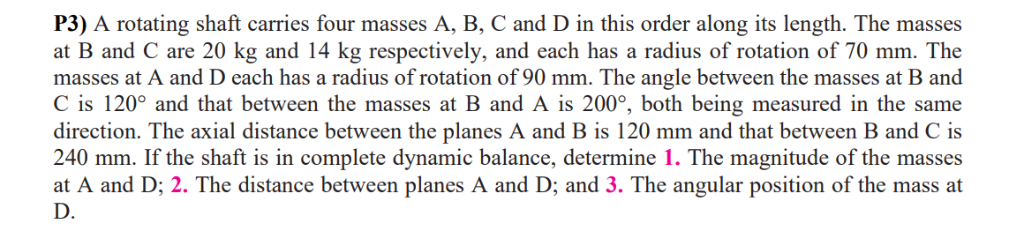 P3) A rotating shaft carries four masses A, B, C and D in this order along its length. The masses
at B and C are 20 kg and 14 kg respectively, and each has a radius of rotation of 70 mm. The
masses at A and D each has a radius of rotation of 90 mm. The angle between the masses at B and
C is 120° and that between the masses at B and A is 200°, both being measured in the same
direction. The axial distance between the planes A and B is 120 mm and that between B and C is
240 mm. If the shaft is in complete dynamic balance, determine 1. The magnitude of the masses
at A and D; 2. The distance between planes A and D; and 3. The angular position of the mass at
D.
This is AI generated Response.
Asked by: Alok Kumar
Created at: 2026-01-25 04:04:44
Asked by: Alok Kumar
Created at: 2026-01-25 04:04:44
Final Answer:
Rendered
Raw Text
Did you like this answer?
Let's solve the problem step by step:
---
## **Given Data**
- **Mass at B (\(m_B\))** = 20 kg, **radius (\(r_B\))** = 70 mm = .07 m
- **Mass at C (\(m_C\))** = 14 kg, **radius (\(r_C\))** = 70 mm = .07 m
- **Mass at A (\(m_A\))** = ?, **radius (\(r_A\))** = 90 mm = .09 m
- **Mass at D (\(m_D\))** = ?, **radius (\(r_D\))** = 90 mm = .09 m
- **Angle between B and C** = 120°
- **Angle between B and A** = 200° (measured in the same direction)
- **Axial distances:**
- A to B = 120 mm = .12 m
- B to C = 240 mm = .24 m
- Let A be at \(x = \), B at .12 m, C at .36 m, D at \(x_D\).
---
## **Step 1: Dynamic Balancing Conditions**
Complete dynamic balance requires:
1. **Primary balance**: The vector sum of the centrifugal forces (m·r) must be zero.
2. **Secondary balance**: The vector sum of the moments (m·r·x) about a reference plane must be zero.
Let’s fix A as the reference plane.
---
## **Step 2: Resolving Masses into Components**
Let’s assign positions:
- **Plane A:** Reference (angle °)
- **Plane B:** 200° from A
- **Plane C:** 200° + 120° = 320° from A
- **Plane D:** θ from A (to be determined)
Let:
- \( F = m \cdot r \)
- \( x \) = distance from reference (A)
### **Tabulate the Data**
| Plane | Mass (kg) | r (m) | F = m·r (kg·m) | x (m) | Angle (deg) |
|-------|-----------|-------|----------------|-------|-------------|
| A | \(m_A\) | .09 | \(.09 m_A\)| | |
| B | 20 | .07 | 1.4 | .12 | 200 |
| C | 14 | .07 | .98 | .36 | 320 |
| D | \(m_D\) | .09 | \(.09 m_D\)| \(x_D\)| θ |
---
## **Step 3: Primary Balance (Force Balance)**
Sum of m·r vectors = .
Express in components:
\[
\sum F_x =
\]
\[
\sum F_y =
\]
### **Component Equations**
- For A (°): \( F_{A_x} = .09m_A \), \( F_{A_y} = \)
- For B (200°): \( F_{B_x} = 1.4\cos(200^\circ) \), \( F_{B_y} = 1.4\sin(200^\circ) \)
- For C (320°): \( F_{C_x} = .98\cos(320^\circ) \), \( F_{C_y} = .98\sin(320^\circ) \)
- For D (θ): \( F_{D_x} = .09m_D\cos\theta \), \( F_{D_y} = .09m_D\sin\theta \)
Sum \( x \) and \( y \) components and set to zero:
\[
.09m_A + 1.4\cos(200^\circ) + .98\cos(320^\circ) + .09m_D\cos\theta =
\]
\[
1.4\sin(200^\circ) + .98\sin(320^\circ) + .09m_D\sin\theta =
\]
---
## **Step 4: Secondary Balance (Moment Balance)**
Sum of moments about reference plane (A):
\[
\sum (m \cdot r \cdot x)_x =
\]
\[
\sum (m \cdot r \cdot x)_y =
\]
- For A: \( x_A = \)
- For B: \( x_B = .12 \)
- For C: \( x_C = .36 \)
- For D: \( x_D \)
So,
\[
1.4 \cdot .12\cos(200^\circ) + .98 \cdot .36\cos(320^\circ) + .09m_D x_D \cos\theta =
\]
\[
1.4 \cdot .12\sin(200^\circ) + .98 \cdot .36\sin(320^\circ) + .09m_D x_D \sin\theta =
\]
---
## **Step 5: Substitute Values**
Calculate cos/sin values:
- \( \cos(200^\circ) = -.9397 \)
- \( \sin(200^\circ) = -.342 \)
- \( \cos(320^\circ) = .766 \)
- \( \sin(320^\circ) = -.6428 \)
### **Primary Balance Equations**
**(1) x-component:**
\[
.09m_A + 1.4(-.9397) + .98(.766) + .09m_D\cos\theta =
\]
\[
.09m_A - 1.3156 + .7517 + .09m_D\cos\theta =
\]
\[
.09m_A + .09m_D\cos\theta = 1.3156 - .7517
\]
\[
.09m_A + .09m_D\cos\theta = .5639 \tag{1}
\]
**(2) y-component:**
\[
1.4(-.342) + .98(-.6428) + .09m_D\sin\theta =
\]
\[
-.4788 - .630 + .09m_D\sin\theta =
\]
\[
.09m_D\sin\theta = 1.1088
\]
\[
m_D\sin\theta = \frac{1.1088}{.09} = 12.32 \tag{2}
\]
---
### **Secondary Balance Equations**
**(3) x-component:**
\[
1.4 \cdot .12 (-.9397) + .98 \cdot .36 (.766) + .09m_D x_D\cos\theta =
\]
\[
1.4 \cdot .12 = .168; \quad .98 \cdot .36 = .3528
\]
\[
.168 \cdot (-.9397) = -.1578
\]
\[
.3528 \cdot .766 = .2702
\]
\[
-.1578 + .2702 + .09m_D x_D\cos\theta =
\]
\[
.09m_D x_D\cos\theta = -.1124 \tag{3}
\]
**(4) y-component:**
\[
1.4 \cdot .12(-.342) + .98 \cdot .36(-.6428) + .09m_D x_D \sin\theta =
\]
\[
.168 \cdot (-.342) = -.0575
\]
\[
.3528 \cdot (-.6428) = -.2269
\]
\[
-.0575 - .2269 + .09m_D x_D\sin\theta =
\]
\[
.09m_D x_D\sin\theta = .2844 \tag{4}
\]
---
## **Step 6: Solve for Unknowns**
From (2): \( m_D\sin\theta = 12.32 \)
Let \( m_D\cos\theta = X \). Then use (1):
\[
.09m_A + .09X = .5639
\]
\[
.09m_A = .5639 - .09X
\]
\[
m_A = \frac{.5639 - .09X}{.09}
\]
From (3) and (4):
Let \( Y = m_D x_D \).
(3): \( .09Y\cos\theta = -.1124 \implies Y\cos\theta = -1.249 \)
(4): \( .09Y\sin\theta = .2844 \implies Y\sin\theta = 3.16 \)
Now, \( Y = \sqrt{(Y\cos\theta)^2 + (Y\sin\theta)^2} = \sqrt{(-1.249)^2 + (3.16)^2} = \sqrt{1.561 + 9.986} = \sqrt{11.547} = 3.398 \)
So \( m_D x_D = 3.398 \)
Now, \( \tan\theta = \frac{Y\sin\theta}{Y\cos\theta} = \frac{3.16}{-1.249} = -2.53 \implies \theta = 112.1^\circ \) (since sin is positive and cos is negative, this is in second quadrant)
Now from earlier, \( m_D\sin\theta = 12.32 \). So \( m_D = \frac{12.32}{\sin(112.1^\circ)} \)
\[
\sin(112.1^\circ) = .927
\]
\[
m_D = \frac{12.32}{.927} = 13.29\, \text{kg}
\]
Now, \( X = m_D\cos\theta = 13.29 \cdot \cos(112.1^\circ) = 13.29 \cdot (-.374) = -4.97 \)
Plug into \( m_A \):
\[
m_A = \frac{.5639 - .09(-4.97)}{.09} = \frac{.5639 + .447}{.09} = \frac{1.0109}{.09} = 11.23\, \text{kg}
\]
Now, \( m_D x_D = 3.398 \implies x_D = \frac{3.398}{13.29} = .256\, \text{m} = 256\, \text{mm} \)
---
## **Step 7: Final Answers**
### **1. Magnitude of Masses at A and D**
- \( m_A = 11.23 \) kg
- \( m_D = 13.29 \) kg
### **2. Distance between Planes A and D**
- \( x_D = 256 \) mm
### **3. Angular Position of Mass D**
- \( \theta = 112.1^\circ \) (measured from A in the same sense as between B and C)
---
## **Summary Table**
| Parameter | Value |
|-------------------|--------------|
| \( m_A \) | 11.23 kg |
| \( m_D \) | 13.29 kg |
| \( x_{AD} \) | 256 mm |
| \( \theta_D \) | 112.1° |
---
## **Boxed Final Answers**
\[
\boxed{
\begin{align*}
1. &\ \text{The magnitude of the masses at A and D:} \quad m_A = 11.23\,\text{kg}, \quad m_D = 13.29\,\text{kg} \\
2. &\ \text{The distance between planes A and D:} \quad x_{AD} = 256\,\text{mm} \\
3. &\ \text{The angular position of the mass at D:} \quad \theta_D = 112.1^\circ \\
\end{align*}
}
\]
📢 Instructions:
- Ask anything relatd to above question only.
- For new Question goto :