 VIPSolutions
Give step-by-step solution with explanation and final answer:» Ein 88 ist f 2 iE: n= ii: TEz = B jo si 550) i E EH I: ee, | ii £> kL i] 8
Question:
Give step-by-step solution with explanation and final answer: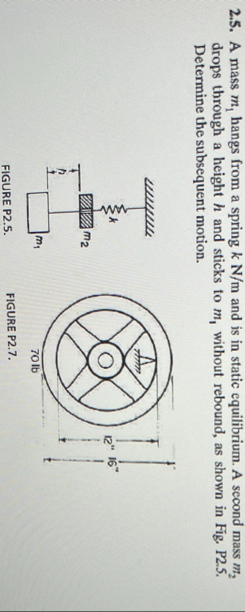 »
Ein
88
ist
f
2 iE:
n= ii:
TEz
= B
jo si
550) i
E EH
I:
ee, | ii
£>
kL
i]
8
This is AI generated Response.
Asked by: Alok Kumar
Created at: 2026-01-25 03:45:40
Asked by: Alok Kumar
Created at: 2026-01-25 03:45:40
Final Answer:
Rendered
Raw Text
Did you like this answer?
Let's break down the problem step-by-step:
---
## **Problem Restatement**
- A mass \( m_1 \) hangs from a spring (spring constant \( k \)), at static equilibrium.
- A second mass \( m_2 \) is dropped from height \( h \) and sticks to \( m_1 \) **(perfectly inelastic collision, no rebound)**.
- Find the **subsequent motion** (i.e., the motion of the combined mass after the collision).
---
## **Step 1: Initial Static Equilibrium**
At static equilibrium, the spring force balances the weight of \( m_1 \):
\[
k x_ = m_1 g \implies x_ = \frac{m_1 g}{k}
\]
where:
- \( x_ \) = initial stretch of spring (from natural length)
- \( g \) = acceleration due to gravity
---
## **Step 2: Mass \( m_2 \) Drops and Sticks**
- Mass \( m_2 \) is dropped from height \( h \).
- Just before collision, its velocity: \( v_2 = \sqrt{2gh} \).
- It sticks to \( m_1 \): **perfectly inelastic collision**.
**Let’s find the velocity of the combined mass immediately after collision:**
### **Conservation of Momentum**
Let \( v_1 = \) (since \( m_1 \) was at rest at equilibrium):
\[
(m_1 + m_2) v' = m_1 \cdot + m_2 \cdot v_2
\]
\[
v' = \frac{m_2}{m_1 + m_2} \sqrt{2gh}
\]
where \( v' \) is the velocity of the combined mass immediately after sticking.
---
## **Step 3: Motion After Collision (Oscillation Analysis)**
Now, the combined mass (\( m_1 + m_2 \)) moves as a mass-spring system.
### **New Equilibrium Position**
\[
k x_{\text{eq}} = (m_1 + m_2)g \implies x_{\text{eq}} = \frac{(m_1 + m_2)g}{k}
\]
### **Displacement from New Equilibrium**
Immediately after the collision:
- The position is still at \( x_ \) (old equilibrium).
- The new equilibrium is at \( x_{\text{eq}} \).
- So, initial displacement from new equilibrium:
\[
y_ = x_ - x_{\text{eq}} = \frac{m_1 g}{k} - \frac{(m_1 + m_2)g}{k} = -\frac{m_2 g}{k}
\]
(Negative: above new equilibrium.)
- Initial velocity: \( v' \) (downward, so positive).
---
## **Step 4: Equation of Motion (Simple Harmonic Motion)**
The system now undergoes **SHM** about the new equilibrium.
For mass \( M = m_1 + m_2 \):
\[
y(t) = A \cos(\omega t) + B \sin(\omega t)
\]
where:
- \( \omega = \sqrt{\frac{k}{m_1 + m_2}} \)
- \( y \) is measured from new equilibrium position.
**Initial Conditions:**
- At \( t = \): \( y() = y_ = -\frac{m_2 g}{k} \)
- \( \dot{y}() = v' \)
\[
y() = A = -\frac{m_2 g}{k}
\]
\[
\dot{y}() = -A \omega \sin() + B \omega \cos() = B \omega = v'
\implies B = \frac{v'}{\omega}
\]
Plug in \( v' \):
\[
B = \frac{1}{\omega} \cdot \frac{m_2}{m_1 + m_2} \sqrt{2gh}
\]
Therefore, the **subsequent motion** is:
---
## **Final Answer: Subsequent Motion**
\[
\boxed{
y(t) = -\frac{m_2 g}{k} \cos\left(\sqrt{\frac{k}{m_1 + m_2}}\, t\right)
+ \frac{m_2}{m_1 + m_2} \sqrt{\frac{2gh}{k/(m_1 + m_2)}} \sin\left(\sqrt{\frac{k}{m_1 + m_2}}\, t\right)
}
\]
where \( y(t) \) is measured **downward from the new equilibrium position**.
---
### **Summary of Steps**
1. **Static equilibrium**: Find initial and new spring stretches.
2. **Collision**: Use momentum to get velocity after sticking.
3. **Oscillation**: Write SHM equation about the new equilibrium, use initial displacement and velocity to solve for constants.
Let me know if you'd like a worked numerical example or further clarification!
📢 Instructions:
- Ask anything relatd to above question only.
- For new Question goto :