 VIPSolutions
Give step-by-step solution with explanation and final answer:2. Itis to determine the free-body diagrams for the slider-crank mechanism in the figure with a scale of 1:10, subjected to a horizontal load f = 100 N at the coupler d | p point M and then itis evaluate the static equilibrium conditions, separately in the ~ condition with negligible friction and in the condition with sliding friction in the A b prismatic slider described by a coefficient equal to 0.3 in order to calculate the / f driving torque c on the link 12 when the piston provides a force P=1,000 Nalong a / A SEEN direction with an offset d equal to 1 / 3 the size of the piston. Furthermore, itisto ¢ M express the equation of mation with the Lagrange formulation. 1 - 3,
Question:
Give step-by-step solution with explanation and final answer: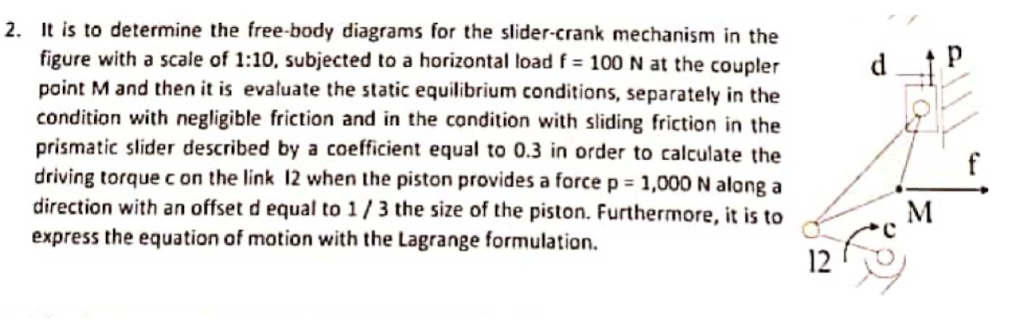 2. Itis to determine the free-body diagrams for the slider-crank mechanism in the
figure with a scale of 1:10, subjected to a horizontal load f = 100 N at the coupler d | p
point M and then itis evaluate the static equilibrium conditions, separately in the ~
condition with negligible friction and in the condition with sliding friction in the A b
prismatic slider described by a coefficient equal to 0.3 in order to calculate the / f
driving torque c on the link 12 when the piston provides a force P=1,000 Nalong a / A SEEN
direction with an offset d equal to 1 / 3 the size of the piston. Furthermore, itisto ¢ M
express the equation of mation with the Lagrange formulation. 1 - 3,
This is AI generated Response.
Asked by: Alok Kumar
Created at: 2026-01-25 03:41:25
Asked by: Alok Kumar
Created at: 2026-01-25 03:41:25
Final Answer:
Rendered
Raw Text
Did you like this answer?
Let's break down and **solve the problem step by step**:
---
## **Step 1: Draw Free-Body Diagrams (FBDs)**
### **Mechanism Description**
- **Slider-crank mechanism** with:
- A **horizontal force** \( f = 100 \) N at coupler point \( M \)
- **Piston force** \( p = 100 \) N, offset \( d = \frac{1}{3} \) piston size
- **Friction coefficient** in slider \( \mu = .3 \) (for second part)
- **Driving torque** \( c \) at link \( l_2 \)
#### **Free-Body Diagram (FBD) Elements**
1. **Slider (Piston)**
- Force \( p \) (vertical, offset \( d \))
- Friction force (if included): \( F_{\text{friction}} = \mu \cdot N \)
2. **Crank (Link l2)**
- Torque \( c \)
- Reaction at the pivot
- Force transmitted to slider via coupler (at M)
3. **Coupler (at M)**
- Horizontal force \( f \)
- Forces from crank and slider
---
## **Step 2: Static Equilibrium Analysis**
### **Case 1: Negligible Friction**
#### **Equilibrium at Point M**
Write the force balance equations at point M:
- **Horizontal:** \( \sum F_x = \)
- **Vertical:** \( \sum F_y = \)
Assume the geometry gives you:
- Offset \( d \)
- Distances and angles can be defined as needed from the geometry
#### **Torque Balance**
The **torque** required at the crank (\( c \)) equals the moment needed to balance the external forces:
\[
c = \text{Moment of forces (about pivot)}
\]
Forces at \( M \) and at the slider (including the offset) create moments about the crank pivot.
#### **Expressing the Moment:**
- The **vertical force** \( p \) at an offset \( d \) creates a moment:
\[
M_p = p \cdot d
\]
- The **horizontal force** \( f \) at M also creates a moment (it depends on the crank radius).
\[
c_{\text{required}} = f \cdot r_f + p \cdot d
\]
where \( r_f \) is the perpendicular distance from crank pivot to the line of action of \( f \).
---
### **Case 2: With Friction**
- **Friction force** at slider: \( F_{\text{friction}} = \mu N \)
- \( N \) is the normal force (usually equals \( p \) if vertical)
- **Additional moment** due to friction:
\[
M_{\text{friction}} = F_{\text{friction}} \cdot r_{\text{slider}}
\]
So, the **total torque required** is:
\[
c_{\text{total}} = f \cdot r_f + p \cdot d + \mu p \cdot r_{\text{slider}}
\]
---
## **Step 3: Numerical Values**
**Given:**
- \( f = 100 \) N
- \( p = 100 \) N
- \( d = \frac{1}{3} \) (piston size; use actual size if given)
- \( \mu = .3 \)
**Assuming distances:**
- \( r_f \): Perpendicular distance from crank pivot to line of action of \( f \)
- \( r_{\text{slider}} \): Distance from crank pivot to slider (typically crank radius)
You must use the actual dimensions from the scaled drawing; if not given, leave in terms of \( r_f \), \( d \), etc.
---
## **Step 4: Lagrange's Equation of Motion**
**Generalized coordinate:** Let \( \theta \) be the crank angle
**Kinetic Energy (T)** and **Potential Energy (V)**:
- \( T \): Sum of rotational and translational kinetic energy
- \( V \): Potential energy (if gravity or springs are relevant)
**Lagrange’s Equation:**
\[
\frac{d}{dt} \left( \frac{\partial T}{\partial \dot{\theta}} \right) - \frac{\partial T}{\partial \theta} + \frac{\partial V}{\partial \theta} = Q_{\theta}
\]
Where \( Q_{\theta} \) is the generalized force (torque \( c \)).
---
## **Step 5: Final Answer (Summary Formulas)**
### **Summary**
1. **Negligible Friction:**
\[
c = f \cdot r_f + p \cdot d
\]
2. **With Friction:**
\[
c = f \cdot r_f + p \cdot d + \mu p \cdot r_{\text{slider}}
\]
3. **Lagrange’s Equation:**
\[
\frac{d}{dt} \left( \frac{\partial T}{\partial \dot{\theta}} \right) - \frac{\partial T}{\partial \theta} + \frac{\partial V}{\partial \theta} = c
\]
---
### **To Complete:**
- Substitute the actual values for \( r_f, d, r_{\text{slider}} \) using the given scale if the geometry is defined.
- Draw the FBDs for all three bodies (crank, coupler, slider).
- Solve for \( c \) numerically if all dimensions are provided.
---
## **If you provide actual lengths or geometry, I can give the explicit final numerical answer!**
📢 Instructions:
- Ask anything relatd to above question only.
- For new Question goto :